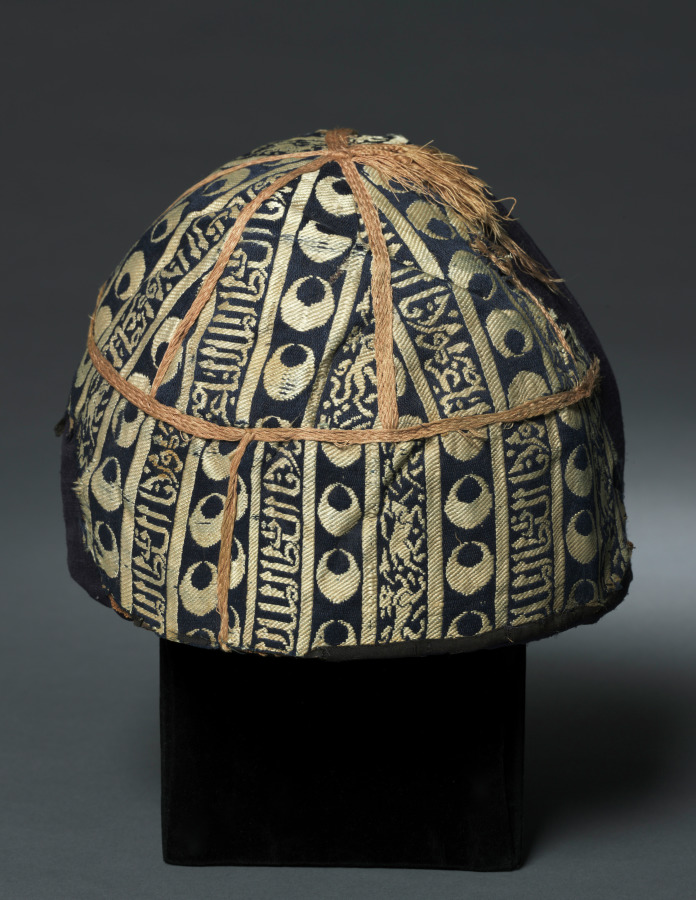
The Cap with Striped Inscribed Silk: A Study in Imperial Craft and Modern Legacy
Introduction: The Artifact as Archive
Within the hallowed corridors of Lauren Fashion Heritage Lab, we encounter an object of deceptive simplicity: a cap, fashioned from striped inscribed silk. At first glance, it is a headpiece; upon closer scrutiny, it is a document. This cap is not merely an accessory but a tangible fragment of a vast, interwoven narrative—one that binds the meticulous hand of the imperial silk weaver to the discerning eye of the Savile Row tailor. Its materiality, rooted in the legacy of imperial silk weaving, speaks to a tradition where cloth was not just woven but inscribed with meaning, status, and power. This artifact serves as a critical bridge between the ceremonial grandeur of ancient courts and the understated luxury of contemporary British craftsmanship.
The cap’s construction is a study in restraint. The silk, a medium of unparalleled luster and drape, is here disciplined into a structured form. The stripes, precise and unyielding, are not printed but woven, a testament to the weaver’s command over the loom. The inscription—likely a repeating motif, a name, or a blessing—is integrated into the fabric’s very warp and weft, making the message inseparable from the material. This is not decoration applied to a surface; it is meaning embedded within the structure. For the imperial workshops of China, Persia, or the Ottoman Empire, such inscribed silks were reserved for the highest echelons of society. The cap, therefore, is a relic of a world where clothing was a language, and silk was its most eloquent dialect.
Materiality: The Silk of Empires
To understand this cap, one must first understand its medium. Silk is not a neutral substrate; it is a material charged with history. The cultivation of silk, a secret guarded for millennia, emerged from the looms of imperial China, where the mulberry silkworm was treated as a national treasure. The Silk Road, that ancient artery of commerce, carried these fabrics westward, where they became synonymous with wealth, divinity, and authority. In the Byzantine Empire, silk weaving was a state monopoly; in Renaissance Italy, it fueled the rise of city-states like Florence and Venice. The legacy of imperial silk weaving is one of controlled knowledge, immense labor, and profound artistry.
The cap’s striped pattern is particularly telling. Stripes in silk, especially those of contrasting colors, were historically difficult to achieve. They required precise dyeing of the threads before weaving, a process that demanded both chemical acumen and aesthetic judgment. In imperial contexts, stripes often denoted rank or affiliation—the vertical lines of a Persian courtier’s robe, the horizontal bands of a Chinese official’s surcoat. The inscription, woven into these stripes, elevates the cap beyond mere utility. It becomes a personal or institutional marker, a piece of wearable calligraphy. The silk itself, with its natural sheen and fluidity, would have caught the light, making the inscription shimmer and recede, a secret message for those who knew how to read it.
Context: The Imperial Workshop and the Savile Row Ethos
The legacy of imperial silk weaving is not a static artifact of the past; it is a living tradition that informs the philosophy of London’s Savile Row. The Row, as it is known, is the epicenter of bespoke tailoring, where a single suit can require over 50 hours of hand-stitching. Its ethos—precision, patience, and an almost obsessive attention to detail—mirrors the values of the imperial silk weaver. Both traditions reject mass production in favor of the singular, the made-to-order, the irreplaceable. The cap with striped inscribed silk, therefore, is not an exotic curio but a kindred spirit to the hand-finished garments that line the Row’s storied ateliers.
Consider the process. The imperial weaver, working on a drawloom, would have manipulated thousands of threads to create the inscription, a task requiring years of training and a memory for patterns. Similarly, a Savile Row cutter, armed with chalk and shears, translates a client’s measurements into a paper pattern, a skill honed over a decade. Both artisans are custodians of a disappearing world—one where the maker’s hand is visible, where the object carries the trace of its creation. The cap, in its small way, embodies this ethos. It is a testament to the belief that clothing should be built, not assembled; that fabric should be honored, not exploited.
Furthermore, the cap’s stripes and inscription evoke the heraldic traditions that Savile Row tailors have long adapted for their clients. A regimental stripe, a club tie, a family crest woven into a scarf—these are the modern descendants of the imperial inscription. They are codes of belonging, markers of identity. The cap, with its woven message, is an ancestor to these symbols. It reminds us that the desire to communicate through cloth is universal and enduring.
Interpretation: The Cap as a Bridge Between Worlds
To wear this cap is to wear history. But it is also to participate in a dialogue between East and West, between the imperial court and the gentleman’s club. The cap’s form—a soft, rounded shape—is practical, even humble. Yet its material and decoration are anything but. This tension between modesty and opulence is a hallmark of true luxury. It is the same tension that defines a Savile Row suit: understated from a distance, revelatory upon close inspection. The cap does not shout its worth; it whispers it, in a language of silk and thread.
For the Lauren Fashion Heritage Lab, this artifact is a key that unlocks multiple doors. It speaks to the global circulation of luxury goods, the transmission of technical knowledge, and the enduring power of the handmade. It challenges us to see the cap not as a relic but as a living object, one that can inform contemporary design. How might a modern tailor reinterpret the inscribed stripe? Could a laser-cut pattern echo the weaver’s precision? These are the questions that the cap provokes.
Conclusion: A Legacy Woven in Stripes
The cap with striped inscribed silk is more than a heritage artifact; it is a manifesto. It declares that materiality matters, that craft is not nostalgia but a discipline, and that the legacy of imperial silk weaving is not confined to museum vitrines. It lives on in every hand-stitched buttonhole, every perfectly matched stripe, every garment that respects the integrity of its fabric. At Lauren Fashion Heritage Lab, we honor this legacy by studying it, preserving it, and, most importantly, by allowing it to inspire the future. The cap, in its silent, shimmering way, reminds us that the best traditions are not static—they are woven anew, with every generation.