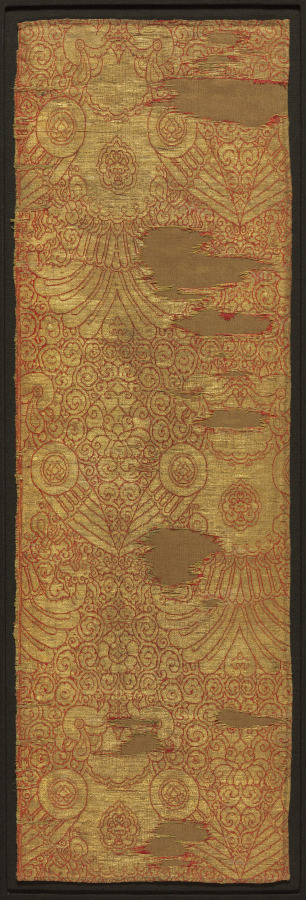
The Cloth of Gold: Displayed Falcons and the Legacy of Imperial Silk Weaving
Introduction: The Artifact in Context
The heritage artifact under examination—a fragment of Cloth of Gold featuring displayed falcons—represents a pinnacle of imperial silk weaving, a tradition that marries material opulence with symbolic power. This textile, woven from silk threads interlaced with gold, is not merely a decorative fabric but a testament to the technical mastery and cultural significance of silk production in historical empires, particularly those of the Byzantine, Ottoman, and Persian courts. The displayed falcon motif, a heraldic emblem of sovereignty and vision, underscores the cloth’s role as a marker of status and authority. For Lauren Fashion Heritage Lab, this artifact serves as a critical lens through which to explore the enduring legacy of silk weaving, its materiality, and its influence on modern luxury fashion. This paper will dissect the artifact’s material composition, its historical context, and its resonance within the Savile Row tradition of bespoke craftsmanship, where heritage and precision converge.
Materiality: Silk and Gold as Conduits of Power
The materiality of the Cloth of Gold is foundational to its heritage value. Silk, derived from the cocoons of Bombyx mori silkworms, is a protein fiber renowned for its luster, strength, and drape. In this artifact, the silk is woven with gold thread—typically a core of silk or linen wrapped in thin strips of gilded metal—creating a fabric that shimmers with an almost liquid brilliance. The gold content is not merely decorative; it signifies the cloth’s exclusivity. Historically, such textiles were reserved for imperial robes, ecclesiastical vestments, and diplomatic gifts, as the cost of gold and the labor-intensive weaving process rendered them inaccessible to all but the highest echelons of society. The weight of the fabric, its tactile richness, and its ability to catch light in a room of candles or torches made it a literal and metaphorical beacon of power. For the displayed falcons, the gold thread accentuates the birds’ predatory gaze and outstretched wings, embedding the motif into the very structure of the cloth. This is not a printed or embroidered pattern but a woven one, requiring the weaver to manipulate the warp and weft with precision—a skill passed down through generations in imperial workshops such as the Byzantine gynaeceum or the Ottoman nakkaşhane.
Context: The Legacy of Imperial Silk Weaving
The legacy of imperial silk weaving is a narrative of trade, conquest, and artistry. The Silk Road, a network of routes connecting East Asia to the Mediterranean, facilitated the transmission of sericulture from China to the Byzantine Empire around the 6th century AD. Under Emperor Justinian, silk weaving became a state monopoly, with workshops in Constantinople producing fabrics that rivaled Chinese silks in quality. The Cloth of Gold emerged as a distinct category in the medieval period, particularly in the Islamic world, where the tiraz tradition—inscribing rulers’ names and motifs into textiles—merged with Persian and Central Asian weaving techniques. The displayed falcon motif, often associated with falconry—a sport of kings—appears in Persian paisley and Ottoman çintemani patterns, symbolizing divine vision and earthly dominion. By the 16th century, the Ottoman Empire’s Bursa workshops and the Safavid Empire’s Isfahan looms produced some of the finest Cloth of Gold, which were exported to Europe and used in royal courts from the Vatican to the Tudor dynasty. Henry VIII’s Field of the Cloth of Gold (1520) famously featured such textiles, cementing their association with diplomatic grandeur. The legacy of these weaving traditions persists in the meticulous handcraft of modern silk mills, such as those in Como, Italy, and in the bespoke tailoring houses of London’s Savile Row.
Savile Row Resonance: Craftsmanship and Continuity
In the context of Savile Row, the Cloth of Gold artifact resonates with the principles of bespoke tailoring: precision, exclusivity, and a reverence for material heritage. Savile Row houses, such as Huntsman, Anderson & Sheppard, and Gieves & Hawkes, have long sourced the finest silks from mills like Stephen Walters & Sons and Vanners Silk Weavers, which continue traditions dating back centuries. The displayed falcon motif, with its clean lines and heraldic symmetry, aligns with the aesthetic of British tailoring, where patterns are often subtle but deliberate—a stripe, a check, or a crest that speaks to the wearer’s lineage. For a modern client, a Cloth of Gold jacket or waistcoat would be a statement of sartorial authority, akin to the imperial robes of old. The weaving technique itself—the “shaft” or “dobby” loom—requires a skilled weaver to control each thread, a process that mirrors the hand-stitching of a Savile Row suit. This continuity of craft is the thread that binds the artifact to contemporary luxury: both are products of time, patience, and an unwavering commitment to quality. The Lauren Fashion Heritage Lab’s study of this artifact thus informs not only historical understanding but also the curation of future collections that honor these techniques.
Conclusion: The Artifact as a Living Legacy
The Cloth of Gold with displayed falcons is more than a relic; it is a living document of imperial ambition, artistic innovation, and material mastery. Its silk and gold composition speaks to the global trade networks that shaped civilizations, while its motif reflects the universal human desire to assert power through visual symbolism. For the Lauren Fashion Heritage Lab, this artifact serves as a cornerstone for research into how heritage textiles can inform sustainable luxury, ethical sourcing, and the preservation of endangered crafts. As Savile Row continues to evolve, the lessons of the Cloth of Gold—its materiality, its context, and its craftsmanship—remain vital. We are not merely preserving the past; we are weaving it into the future, one thread at a time.