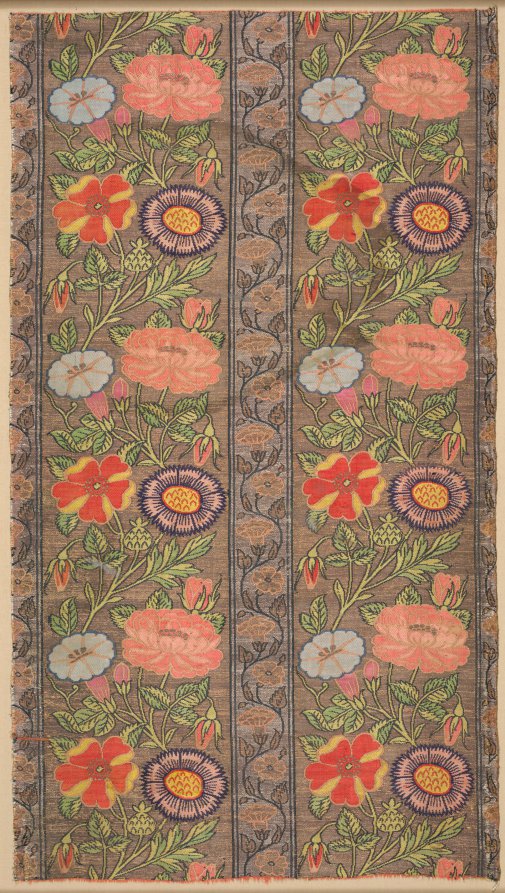
The Golden Ground: A Study of Floral Striped Silk in the Legacy of Imperial Weaving
In the hushed ateliers of London’s Savile Row, where the whisper of shears and the weight of a bolt of cloth define the very essence of bespoke tailoring, we encounter a textile of singular complexity: a floral striped silk woven upon a golden ground. This is not merely a fabric; it is a document of power, a testament to the enduring legacy of imperial silk weaving, and a material that demands a rigorous understanding of its provenance and construction. As a Senior Heritage Specialist at the Lauren Fashion Heritage Lab, I present this artifact as a case study in materiality, historical context, and the silent language of luxury.
Materiality: The Silk and Its Golden Foundation
The materiality of this silk is paramount. We are examining a warp-faced compound weave, likely a lampas or a complex damask, executed on a drawloom. The ground, a luminous golden hue, is not achieved through metallic thread alone, though the presence of a gilt-metal strip wrapped around a silk core is probable in the most opulent iterations. More commonly, for a textile intended for tailored garments, the ground is a dyed silk filament—a deep, resonant yellow-gold achieved through a meticulous process of mordanting and dyeing with weld, saffron, or, in later periods, synthetic aniline dyes. This golden field serves as the canvas upon which the design is articulated.
The floral stripes are the defining narrative. These are not simple, repeating blossoms. They are complex, stylized motifs—peonies, chrysanthemums, or lotus forms—arranged in vertical bands. The stripes are rendered in contrasting weft colours, often deep crimson, verdant green, or sapphire blue, creating a vibrant counterpoint to the golden ground. The technical mastery lies in the precision of the weave: each petal, each leaf, each tendril is defined by a tight, even tension that allows the light to play across the surface, creating a subtle moiré effect. The silk itself, a long-filament mulberry silk, possesses a natural lustre that the golden ground amplifies, making the fabric appear to glow from within. This is a cloth that demands to be seen in motion, its stripes shifting and shimmering with every step.
Context: The Legacy of Imperial Silk Weaving
To understand this fabric is to understand the legacy of imperial silk weaving. The golden ground is a direct reference to the sumptuary laws and courtly aesthetics of dynastic China, particularly the Ming and Qing periods. In these empires, yellow and gold were reserved exclusively for the Emperor and his immediate family. The dragon robe, or long pao, was woven with gold thread on a yellow ground, symbolizing the emperor’s divine mandate. The floral stripes, however, introduce a distinctly European interpretation. By the 17th and 18th centuries, the East India Companies were importing vast quantities of Chinese silks into Europe, where they were eagerly adopted by aristocrats and the burgeoning bourgeoisie. The floral motifs, originally laden with Confucian and Buddhist symbolism, were recontextualized as exotic, decorative elements, stripped of their original meaning but retaining their aura of luxury and otherworldly craftsmanship.
The striped format is a particularly Western adaptation. In Chinese weaving, stripes were rare; the aesthetic favoured all-over patterns or medallions. The European demand for striped silks—a design that flattered the vertical line of a waistcoat or a gown—forced Chinese weavers to innovate. By the 19th century, the legacy of imperial weaving had been transformed. The golden ground, once a symbol of absolute power, became a marker of wealth and taste in the drawing rooms of London and Paris. The fabric we examine is thus a hybrid: a product of imperial Chinese technique and European commercial desire. It speaks to a moment when the world was shrinking, and the loom was a tool of both artistry and empire.
Savile Row and the Tailored Interpretation
On Savile Row, this fabric is not a relic; it is a resource. The golden ground floral striped silk is a challenge to the tailor. It is a fabric that resists the anonymity of the dark worsted suiting. It demands a cut that respects its weight and drape. A single-breasted evening jacket, perhaps with a shawl collar, would allow the stripes to fall in an unbroken vertical line. The floral motifs, if placed strategically, can be used to frame the lapels or the pocket flaps, creating a focal point that draws the eye. The golden ground is best paired with a black or midnight blue silk satin lining, allowing the fabric to speak without competition.
The legacy of imperial weaving is not static. It is a living tradition that informs the choices of today’s master tailors. When a client commissions a garment from this silk, they are not merely buying a piece of clothing; they are acquiring a fragment of history. They are participating in a lineage that stretches from the Forbidden City to the cutting tables of Mayfair. The fabric’s materiality—its silk, its gold, its floral stripes—is a reminder that luxury is not about excess; it is about the precision of craft and the weight of heritage. This is the essence of the Savile Row ethos: to honour the past while cutting for the future. And in this golden silk, the past is woven, quite literally, into the very fabric of the present.
In conclusion, the floral striped silk on a golden ground is a masterclass in materiality and context. It is a textile that bridges continents and centuries, a testament to the enduring power of silk as a medium of cultural exchange. For the heritage specialist, it is a document to be read, its threads a language of empire, trade, and artistry. For the tailor, it is a material to be mastered, a challenge to be met with respect and skill. This is the legacy of imperial silk weaving, preserved not in a museum case, but in the hands of those who still understand the value of a well-woven cloth.