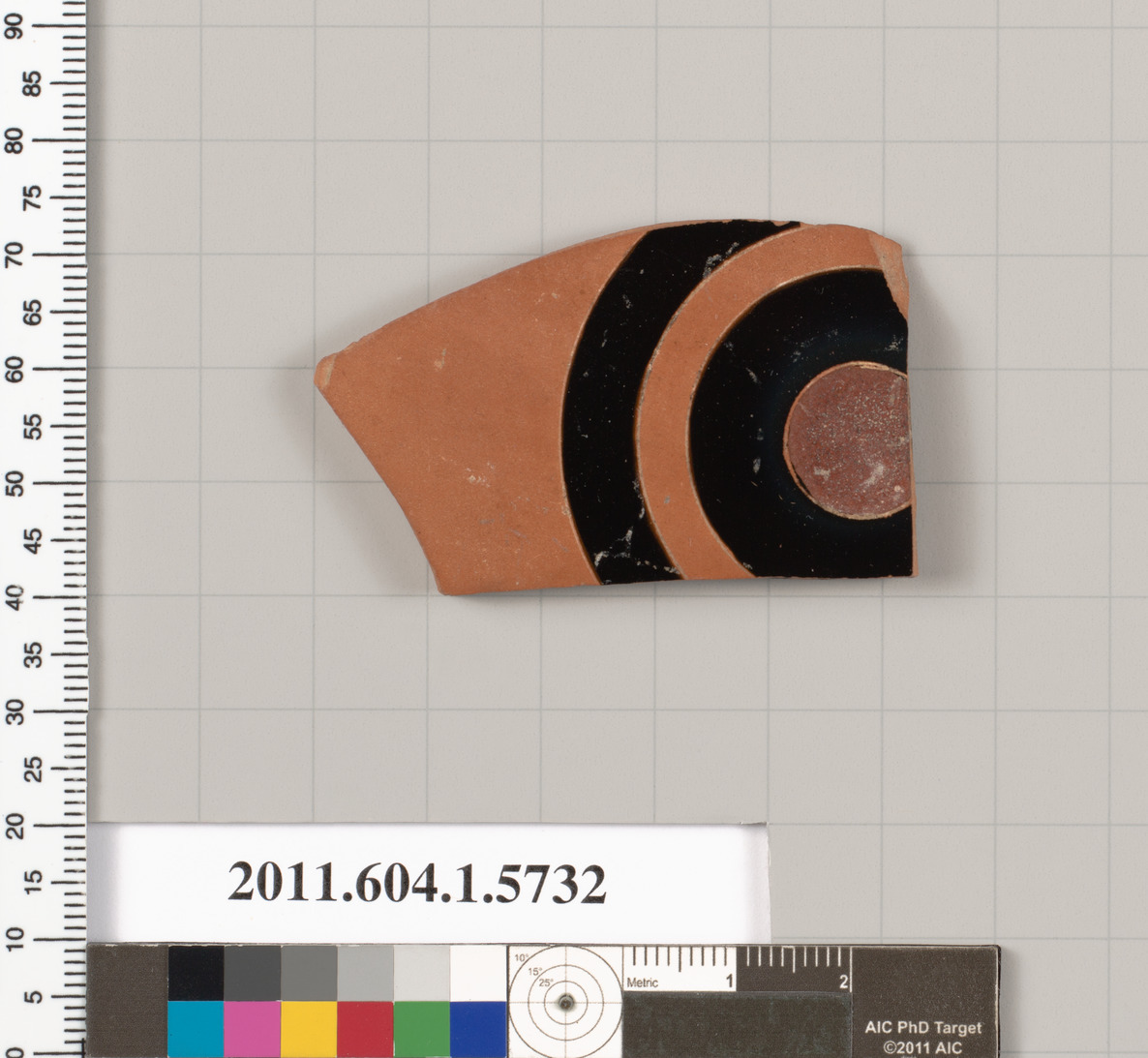
The Gaze of Eternity: From Attic Eye-Cup to the 2026 Silhouette of Contained Power
The pursuit of a heritage aesthetic is not merely an excavation of forms, but a dialogue with ancestral gazes and the philosophies they embody. In developing the 2026 "Old Money" silhouette for Lauren Fashion, we engage in a profound transhistorical triangulation. Our internal genetic code—the dialectic between the Tang dynasty’s Portrait of Night-Shining White by Han Gan and the Qing dynasty’s Hundred Flowers Scroll: Peony and Plum Blossom by Yun Shouping—establishes a foundational spectrum of Chinese aesthetics: one pole representing potent, constrained vitality and cosmic consciousness, the other celebrating harmonious, lyrical naturalism. The introduction of the Attic Greek terracotta eye-cup fragment, a vessel designed for the symposium, compels a radical synthesis. This artifact does not simply add a Western reference; it provides the crucial third term—the architectural gaze—that bridges our Eastern polarities and crystallizes a contemporary silhouette of authoritative, silent presence.
The Artifact: Architectonics of the Gaze
The terracotta eye-cup (kylix) is a masterclass in functional symbolism. Its defining feature, the large, painted eyes on either exterior, transforms a drinking vessel into a sentient object. When raised to the lips, the drinker’s face is framed by these apotropaic eyes, becoming both the seen and the seer, the mask and the wearer. The vessel’s form is a study in geometric purity: a wide, shallow bowl with horizontal handles, creating a stable, symmetrical architecture. This is not a form that shrinks from attention; it commands the symposium space. The terracotta material, fired earth, grounds its symbolism in tangible, enduring substance. The eye motif is neither a portrait nor a narrative; it is an emblem of conscious presence, a declaration of being within a social and ritualized space. It speaks to a power that is observed, observing, and fundamentally contained within a perfect, circular form.
Synthesis: The Triangulation of Power, Gaze, and Form
To synthesize this with our internal code is to find the connective tissue between seemingly disparate worlds. Han Gan’s Night-Shining White presents a vortex of contained energy—the horse’s monumental vitality strained against the tether and post. Its power is dynamic, internal, and tragic. Yun Shouping’s peony and plum blossom express a harmonious, blooming vitality, a power of serene flourishing. The Greek eye-cup introduces a third mode: power as a calibrated, externalized performance of awareness. It is neither the struggling beast nor the blooming flower, but the composed symposium participant, shielded and projected by an iconic gaze.
This triangulation informs the 2026 Old Money silhouette through three core principles:
1. The Architecture of Containment: The 2026 silhouette moves away from overt opulence or soft drapery. It embraces the geometric clarity and stable horizontality of the kylix. Expect broad, structured shoulders that echo the cup’s handles, creating a powerful horizontal line—a "shelf of presence." Torsos will be defined not by constriction, but by the clean, architectural lines of a column or a vessel’s curve, mirroring the taut, cylindrical post in Han Gan’s painting and the circular form of the cup. The power is in the frame, not the flourish.
2. The Heritage-Black Palette as Fired Earth and Ink: The primary material expression becomes Heritage-Black—a shade absorbing the depth of Han Gan’s ink, the solemnity of fired terracotta, and the shadow within a gazing eye. This is not a flat black, but a complex, textural one: matte finishes that recall ancient pottery, subtle sheens that mimic the patina of old bronze or worn ink stones, and profound depths that hold light like the pupil of an eye. It is the color of essence, of foundation, of a gaze that absorbs light and returns it as authority.
3. The Emblematic Detail as Apotropaic Symbol: Overt ornamentation is banished in favor of singular, emblematic details that function like the eyes on the cup. A precise, geometric cut-out at the collar bone may frame the throat. A singular, massive closure—crafted from jade, obsidian, or darkened metal—acts as a central, tethering point, recalling both the post of Night-Shining White and the focal point of a ceremonial vessel. These are not decorative; they are talismans of intent, designed to ward off the trivial and focus the gaze of both wearer and observer.
The 2026 Silhouette: A Vessel for the Modern Symposium
The resulting 2026 Old Money silhouette is a vessel for a contemporary ethos. It is the uniform for the modern symposium—the boardroom, the gallery, the private club. It understands that true, enduring authority is no longer shouted through logos or extreme tailoring, but whispered through impeccable containment, geometric integrity, and a calibrated gaze.
The wearer of this silhouette embodies the synthesis: they carry the internal, untamable vitality of the Night-Shining White, now channeled not into a struggle, but into a poised, immovable will. They possess the appreciative, cultivated eye of Yun Shouping, able to discern quality and harmony in a world of noise. Most critically, they project the architectural, performative awareness of the eye-cup, entering a space as a complete, self-possessed entity, both observing and defining the room’s dynamics. The silhouette is their terracotta vessel—fired in the kiln of heritage, durable, symbolic, and designed to hold the intoxicating draft of quiet power.
Thus, from the polarities of Tang dynamism and Qing lyricism, through the mediating gaze of an Attic cup, we arrive at a silhouette that is neither Eastern nor Western, but archetypal. It is Heritage-Black because it is the color of primordial form, the void from which the gaze emerges, and the earth to which all power ultimately returns. It is a testament to the fact that the oldest money is not currency, but the deeply capital of cultural consciousness, forged in the fire of history and worn as a second skin.