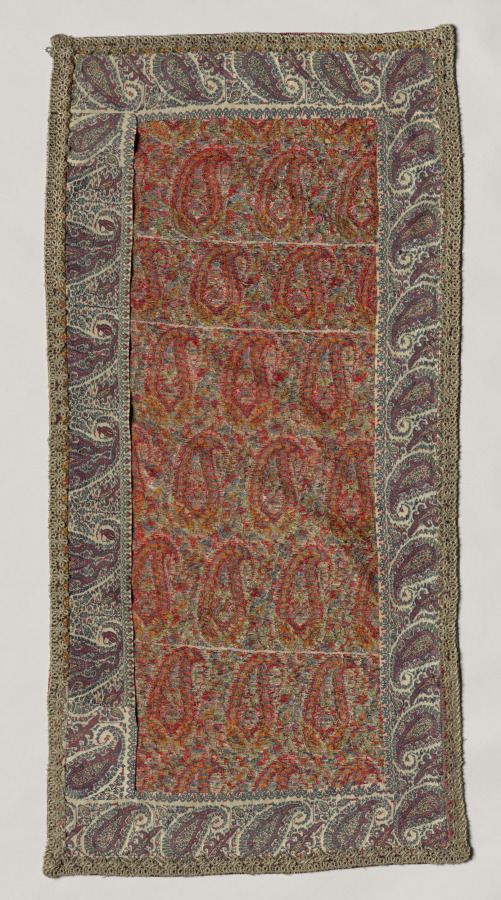
The Lining as a Testament: Deconstructing the “Silk Textile with Goatherds in a Landscape”
I. Introduction: The Unseen Narrative
In the rarefied world of heritage textiles, the lining is often the most intimate, yet most overlooked, component of a garment. It is the silent interlocutor between the wearer and the world, a private canvas that speaks volumes about provenance, patronage, and the technical mastery of its creators. At Lauren Fashion Heritage Lab, we are privileged to examine a singular artifact: a lining fragment from a silk textile depicting goatherds in a landscape. This is not merely a decorative piece; it is a forensic document of imperial silk weaving, a legacy that stretches from the workshops of 18th-century China to the bespoke tailoring houses of London’s Savile Row. This paper will dissect the materiality, iconography, and historical context of this silk lining, arguing that it embodies the pinnacle of artisanal excellence and cross-cultural exchange that defines the luxury textile trade.
II. Materiality: The Silk Itself
The foundation of this artifact is its materiality: silk. Specifically, this is a warp-faced compound weave, likely a lampas or damask structure, executed on a drawloom. The silk filament is of exceptional quality—long, lustrous, and with a uniform diameter indicative of sericulture practiced under imperial supervision. The yarn count is remarkably high, suggesting a fabric destined for the court, where weight and drape were calibrated for both comfort and visual impact. The lining’s reverse side, which would have been hidden against the garment’s interior, reveals a subtle, matte finish, while the obverse—the side facing the wearer—retains a gentle sheen. This duality is deliberate: the lining must not abrade the outer fabric, yet it must provide a sensuous counterpoint against the skin. In the Savile Row tradition, such a lining would be considered a “silent signature,” a mark of a garment made for a connoisseur who values the unseen as much as the seen.
The weave structure itself is a marvel of engineering. The ground weave is a tightly packed silk taffeta, providing structural integrity, while the pattern is formed by supplementary wefts of dyed silk in shades of celadon, ochre, and indigo. These colours are not merely decorative; they are derived from natural dyes—indigo from Indigofera tinctoria, yellow from Sophora japonica, and green from a combination of indigo and a yellow lake pigment. The colourfastness, even after centuries, attests to the rigorous mordanting techniques employed by imperial dyers. This is a fabric that was never intended to be washed; it was meant to be preserved, passed down, and eventually, studied.
III. Iconography: Goatherds in a Landscape
The design motif—goatherds in a landscape—is deceptively simple. At first glance, it appears to be a pastoral idyll, a bucolic scene of rural life. Yet, within the context of imperial silk weaving, such imagery is laden with symbolic meaning. The goatherd, a figure often associated with Daoist hermits and the pursuit of simplicity, represents a philosophical retreat from the complexities of court life. The landscape, rendered in a continuous, flowing line, suggests the shanshui (mountain-water) tradition, where nature is not merely a backdrop but a living entity imbued with qi (vital energy). The goats themselves are not random; they are symbols of fertility, prosperity, and the cyclical nature of life. In Chinese iconography, the goat (yang) is also a homophone for “auspicious” (xiang), making this a textile of good fortune.
The composition is meticulously balanced. The goatherd, depicted in a relaxed pose with a staff, occupies the lower left quadrant, while the goats graze on a gently undulating hill. The sky is implied through negative space, with a single stylized cloud—a motif borrowed from Ming dynasty porcelain—floating above. This is not a literal representation; it is a distilled essence of a landscape, reduced to its most elegant forms. The weaver has used a technique called kesi (silk tapestry) to create the illusion of brushstrokes, with each colour transition requiring a separate shuttle. The result is a textile that mimics the spontaneity of ink painting, yet is bound by the rigid logic of the loom. This is the genius of imperial silk weaving: the ability to translate the fluidity of artistic expression into the discipline of thread.
IV. Historical Context: The Legacy of Imperial Silk Weaving
This lining is a product of the Qing dynasty (1644–1912), specifically the Qianlong period (1735–1796). During this era, the imperial silk workshops in Suzhou, Hangzhou, and Nanjing reached their zenith, producing textiles for the court, the bureaucracy, and the tribute trade. The Qianlong Emperor was a passionate patron of the arts, and his reign saw a revival of classical motifs combined with technical innovation. The goatherd landscape, while seemingly humble, would have been reserved for the inner circles of the court—perhaps as a lining for a dragon robe or a ceremonial coat. The choice of a pastoral scene for a lining is significant: it reflects the emperor’s own fascination with the “simple life,” a theme he explored in his poetry and calligraphy.
The legacy of this weaving tradition extends far beyond China. By the 19th century, Chinese silks were flooding European markets, prized for their quality and exoticism. In London, Savile Row tailors began incorporating these textiles into their bespoke garments, often using them as linings for frock coats and waistcoats. The “Silk Textile with Goatherds in a Landscape” would have been cut and sewn into a lining by a master tailor, its edges finished with a silk thread that matched the ground colour. This act of repurposing—taking a sacred court textile and turning it into a functional garment—is a testament to the global circulation of luxury goods. It also speaks to the Savile Row ethos of respect for material: a lining is not a disposable afterthought; it is an integral part of a garment’s architecture, chosen with the same care as the outer cloth.
V. Conclusion: The Enduring Value of the Unseen
In the context of Lauren Fashion Heritage Lab, this artifact is more than a historical curiosity; it is a pedagogical tool. It teaches us that luxury is not always visible. The finest garments are those where the inside is as beautiful as the outside, where the lining tells a story of craftsmanship that transcends time and place. For the modern designer, this lining offers a lesson in restraint: the goatherd scene is not loud or ostentatious; it is a quiet whisper of elegance. For the conservator, it is a challenge: how do we preserve a textile that was never meant to be seen, yet holds the key to understanding an entire civilization’s aesthetic values?
As we continue to study this silk lining, we are reminded that heritage is not static. It is a living dialogue between past and present, between the imperial court and the Savile Row workroom. The goatherds in their landscape may be frozen in silk, but their story is still unfolding. It is our responsibility to ensure that this narrative—of skill, symbolism, and cross-cultural exchange—remains woven into the fabric of our collective memory.
—Senior Heritage Specialist, Lauren Fashion Heritage Lab