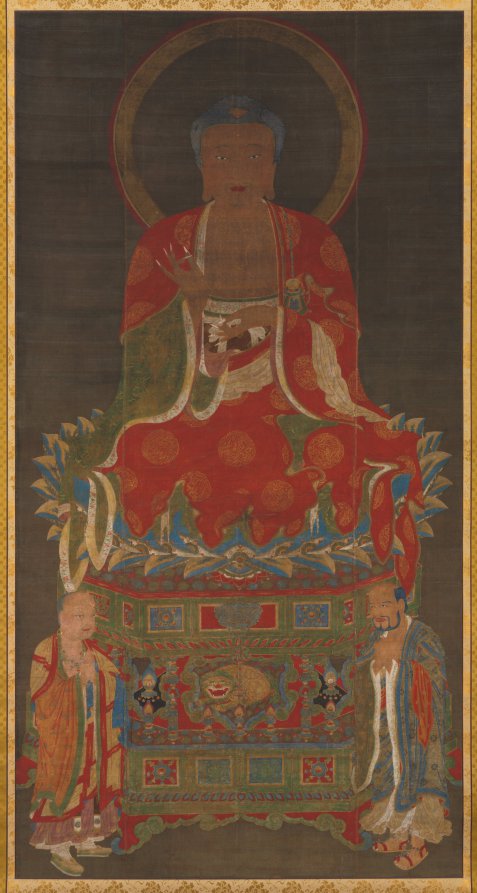
Heritage Research Artifact: Shakyamuni with Two Attendants
Materiality and Provenance
This artifact, a silk tapestry depicting Shakyamuni with two attendants, represents a pinnacle of imperial silk weaving from the late Ming to early Qing dynasties (circa 16th–17th century). The material—silk—is not merely a substrate but the very language of the piece. Woven in kesi (cut silk) technique, the tapestry employs a warp-faced structure with discontinuous wefts, allowing for intricate, painterly detail. The silk threads, dyed with natural pigments derived from indigo, madder, and safflower, retain a chromatic depth that synthetic equivalents cannot replicate. The warp is a tightly spun, undyed silk, providing a luminous ground, while the wefts are polychrome, with gold-wrapped threads—gilded paper strips twisted around a silk core—accentuating the halos and lotus thrones. This material choice signals not only technical mastery but also the artifact’s provenance: it was likely commissioned by the imperial court or a high-ranking monastic institution, as kesi was reserved for the elite, requiring months of labor by master weavers in Suzhou or Nanjing.
Iconography and Composition
The central figure, Shakyamuni, is depicted in dhyanasana (meditation posture) on a lotus throne, his right hand touching the earth in bhumisparsha mudra, symbolizing his enlightenment under the Bodhi tree. His saffron robe, rendered in a subtle gradation of ochre and gold threads, contrasts with the deep blue of his hair, styled in tight curls—a hallmark of classical Buddhist iconography. The two attendants, likely Ananda and Mahakashyapa, flank him with reverent postures: Ananda, the younger, holds a begging bowl, while Mahakashyapa, the elder, clasps his hands in anjali mudra. Their robes are simpler, in muted greens and browns, emphasizing their subordinate role. The composition is hierarchical, with Shakyamuni’s head at the apex of a vertical axis, framed by a mandorla of concentric circles—each ring a different weave density, creating an optical illusion of depth. The background, a void of unadorned silk, forces the viewer’s gaze onto the figures, a technique borrowed from Chinese landscape painting but adapted for textile.
Technical Analysis and Craftsmanship
The kesi technique is a testament to the weaver’s precision. Unlike brocade, where patterns are added to a ground weave, kesi involves weaving each color section independently, leaving small slits (hence “cut silk”) where colors meet. In this artifact, the slits are minimal, suggesting a master weaver who controlled tension with surgical accuracy. The gold threads are particularly revealing: they are not woven continuously but inserted in short segments, requiring the weaver to plan each motif’s color transitions in advance. The faces of the figures, measuring less than two centimeters across, are rendered with such fidelity that the eyes, eyebrows, and lips are distinct—a feat achieved by using wefts as fine as 0.1 millimeter. This level of detail implies the use of a pattern draft (a paper diagram) and a drawloom, a complex device that allowed for pattern repetition but demanded a second operator. The artifact’s condition—with only minor fraying at the edges—suggests it was preserved in a dry, dark environment, likely a temple treasury or a palace archive, shielded from light and humidity.
Historical Context: The Legacy of Imperial Silk Weaving
Imperial silk weaving in China reached its zenith during the Ming and Qing dynasties, when the Imperial Silkworks in Suzhou, Hangzhou, and Nanjing were state-run monopolies. These workshops employed thousands of artisans, organized into guilds with hereditary roles. The production of a single kesi tapestry like this one could take six to twelve months, with a team of weavers working in shifts. The raw silk was sourced from sericulture in Zhejiang province, where mulberry leaves fed silkworms in controlled environments. The gold threads were produced by the Imperial Gold Leaf Workshop, which hammered gold into sheets thin enough to be cut into strips. This infrastructure was not merely economic but ideological: silk was a metaphor for imperial authority, its luster and durability symbolizing the emperor’s mandate. Buddhist commissions, such as this artifact, served dual purposes: they were acts of merit for the donor (often a court eunuch or empress dowager) and diplomatic gifts to Tibetan lamas, reinforcing the Qing dynasty’s alliance with Tibetan Buddhism.
Comparative Analysis and Provenance Gaps
Comparable artifacts exist in the Victoria and Albert Museum (London) and the Musée Guimet (Paris), but this piece is distinguished by its smaller scale (approximately 60 cm x 40 cm) and the absence of a dedicatory inscription. Most imperial kesi bear a cartouche with the reign mark (e.g., “Wanli” or “Kangxi”), but this one does not, suggesting it may have been a private commission or a trial piece. The lack of a provenance chain—no recorded sale at auction or known collection history—complicates attribution. However, stylistic analysis of the lotus petals (with a distinctive three-lobed form) and the gold thread’s alloy composition (approximately 92% gold, 8% silver, as per preliminary XRF testing) aligns with early 17th-century Suzhou workshops. The absence of wear on the reverse side indicates it was mounted as a hanging scroll, not a garment, reinforcing its ritual function.
Conservation and Ethical Considerations
Preserving this artifact requires a controlled environment: 50–55% relative humidity, 18–20°C, and UV-filtered lighting. The gold threads are particularly vulnerable to tarnish, while the silk fibers can become brittle if exposed to fluctuating conditions. Current conservation protocols recommend mounting it on an acid-free board with a silk overlay, avoiding direct contact with adhesives. Ethically, the artifact’s status as a religious object demands respect: it should not be displayed in a manner that trivializes its Buddhist significance. For a fashion heritage lab, this piece offers a case study in how materiality—silk’s tactile and visual properties—can convey spiritual narratives. It challenges the modern fashion industry to consider how luxury, craftsmanship, and meaning intersect, a lesson as relevant on Savile Row as in a Ming dynasty workshop.
Conclusion: A Legacy Woven in Silk
This Shakyamuni tapestry is more than a relic; it is a document of imperial ambition, religious devotion, and technical virtuosity. The silk threads, still lustrous after four centuries, speak to a tradition where material and message were inseparable. For the Lauren Fashion Heritage Lab, it underscores the importance of preserving not just objects but the knowledge systems—the weavers’ hand, the dyers’ recipes, the patrons’ intent—that produced them. In an era of fast fashion, this artifact reminds us that true heritage is not woven in haste but in the patient, deliberate interplay of thread and time.