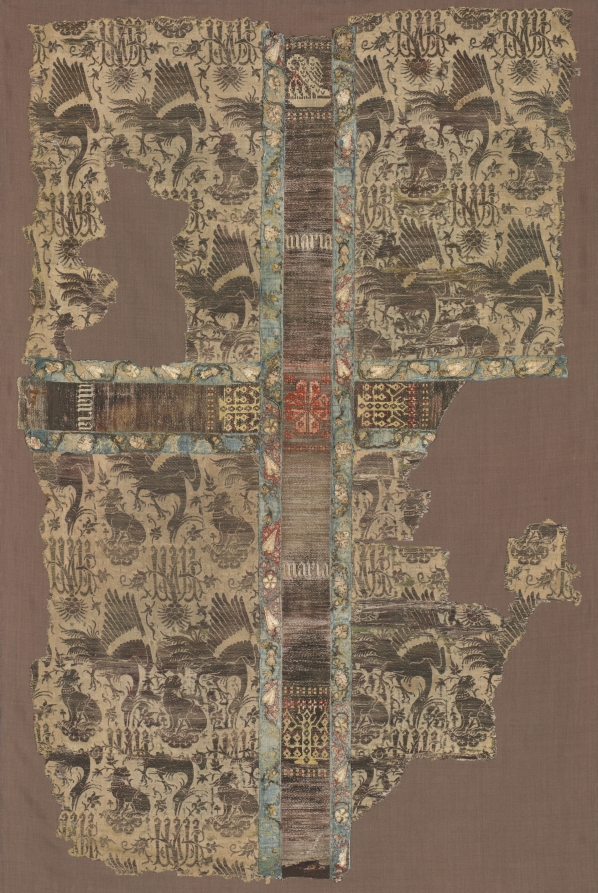
The Fragmentary Chasuble with Woven Orphrey Band: A Study in Imperial Silk Legacy
Introduction: The Vestige of Power and Craft
In the hallowed corridors of Lauren Fashion Heritage Lab, we encounter a textile of profound significance: a fragmentary chasuble, its silk ground now softened by centuries, yet its woven orphrey band still declaring a lineage of imperial ambition. This is not merely a remnant of liturgical dress; it is a material testament to the confluence of ecclesiastical authority and sovereign wealth, a narrative stitched in the very warp and weft of imperial silk weaving. For the connoisseur of heritage, this fragment speaks to the enduring dialogue between power, patronage, and the loom—a dialogue that resonates deeply within the ethos of Savile Row, where precision and provenance are paramount.
Materiality: The Silk Ground and Its Imperial Origins
The chasuble’s primary fabric is a finely woven silk, its surface now bearing the patina of age—a subtle, uneven sheen that whispers of candlelit altars and reverent handling. The silk itself, likely originating from the workshops of Lucca, Venice, or perhaps the Byzantine-influenced centres of Sicily, represents a material that was once the exclusive currency of courts and cathedrals. In the medieval and Renaissance periods, silk was not merely a textile; it was a strategic commodity, controlled by guilds and monarchs. The imperial silk weaving tradition, particularly under the auspices of the Holy Roman Empire or the Byzantine court, demanded that only the finest, most lustrous filaments be used—filaments often imported from China via the Silk Road, then reworked in European looms to create patterns of heraldic and religious significance.
The fragmentary state of this chasuble is itself a narrative. It suggests a garment that was worn, revered, and eventually dismantled—perhaps repurposed for relics or liturgical linens. The silk’s weave, a compound structure typical of high-status textiles, reveals a twill or satin ground that would have shimmered with a depth of colour now faded to a muted crimson or deep indigo. This colour, derived from kermes or woad, was a marker of wealth; the dyeing process was laborious and costly, reserved for garments that would stand before the altar or the throne.
The Woven Orphrey Band: A Loomed Testament to Sovereignty
Central to this artifact is the woven orphrey band, a decorative strip that would have run vertically down the chasuble’s front and back. Unlike embroidered orphreys, which are applied after weaving, this band is integral to the fabric—a product of the drawloom, where a skilled weaver manipulated thousands of threads to create intricate, repeating patterns. The orphrey’s design, though now partially obscured by wear, likely features motifs of heraldic beasts, floral scrolls, or religious iconography—perhaps the double-headed eagle of the Holy Roman Empire or the fleur-de-lis of French royalty. These were not mere decorations; they were symbols of divine right and temporal power, woven into the very fabric of the garment to assert the wearer’s place in a cosmic hierarchy.
The technique of weaving orphrey bands directly into the silk required extraordinary skill. The weaver had to coordinate multiple warp and weft threads, often using supplementary metallic threads—gold or silver-gilt—to create a raised, luminous effect. This metallic thread, now tarnished to a soft bronze, would have caught the light during processions, transforming the chasuble into a mobile reliquary of imperial splendour. The orphrey’s survival, even in fragmentary form, is a testament to the durability of this craftsmanship; it was designed to endure, much like the institutions it served.
Context: The Legacy of Imperial Silk Weaving in Liturgical and Secular Spheres
To understand this chasuble is to understand the legacy of imperial silk weaving as a bridge between the sacred and the secular. In the courts of Charlemagne, the Byzantine emperors, and later the Medici, silk weaving was a state-sponsored art. The looms of Constantinople, Palermo, and Lyon produced textiles that were gifted to cathedrals, monasteries, and allied monarchs as tokens of alliance and devotion. A chasuble like this one would have been commissioned by a bishop or abbot with close ties to the imperial court, its silk and orphrey reflecting the patron’s status as much as their piety.
The fragmentary nature of this piece also invites reflection on the afterlife of imperial textiles. As empires waned and liturgical practices evolved, many such garments were cut down, their silk repurposed for altar cloths, vestments for lesser clergy, or even secular garments. The orphrey band, being the most valuable and intricate element, was often preserved separately—a practice that explains why this fragment survives today. In the context of Lauren Fashion Heritage Lab, this artifact serves as a case study in the material culture of power. It challenges us to consider how textiles, often dismissed as ephemeral, are in fact durable carriers of political and spiritual ideology.
Savile Row Resonance: Craft, Provenance, and the Art of the Enduring
For the Savile Row sensibility, this chasuble is a masterclass in the principles that define fine tailoring: material integrity, precision of construction, and the weight of heritage. The silk’s weave, the orphrey’s integration, and the garment’s fragmentary survival all echo the Row’s commitment to garments that are built to last—and to tell stories. Just as a bespoke suit from Huntsman or Anderson & Sheppard is a record of its wearer’s life, this chasuble is a record of an era when cloth was king, and the loom was a throne.
The orphrey band, in particular, resonates with the Row’s appreciation for detail. In tailoring, a well-executed pickstitch or a hand-finished buttonhole is a mark of distinction; here, the woven orphrey is that distinction writ large. It is a declaration that the garment was not merely made, but authored—by weavers who understood that their work would be seen by emperors and saints alike. For the modern heritage specialist, this fragment is a reminder that the most powerful garments are those that carry the weight of their making, from the loom to the altar, and now to the archive.
Conclusion: The Fragment as a Whole
This fragmentary chasuble, with its woven orphrey band, is more than a relic; it is a living document of imperial silk weaving. It speaks of the ambitions of courts, the devotion of the Church, and the artistry of weavers who transformed thread into power. In preserving and studying it, we honour not only the object itself but the entire ecosystem of craft, commerce, and belief that brought it into being. For Lauren Fashion Heritage Lab, this artifact stands as a benchmark—a reminder that heritage is not about preservation alone, but about understanding the deep, woven connections between what we wear and who we are.