← BACK TO ARCHIVES
Heritage-Black
Heritage Synthesis: Terracotta fragments of kylikes (drinking cups)
Curated on Jul 18, 2026 // Node: LDN-01
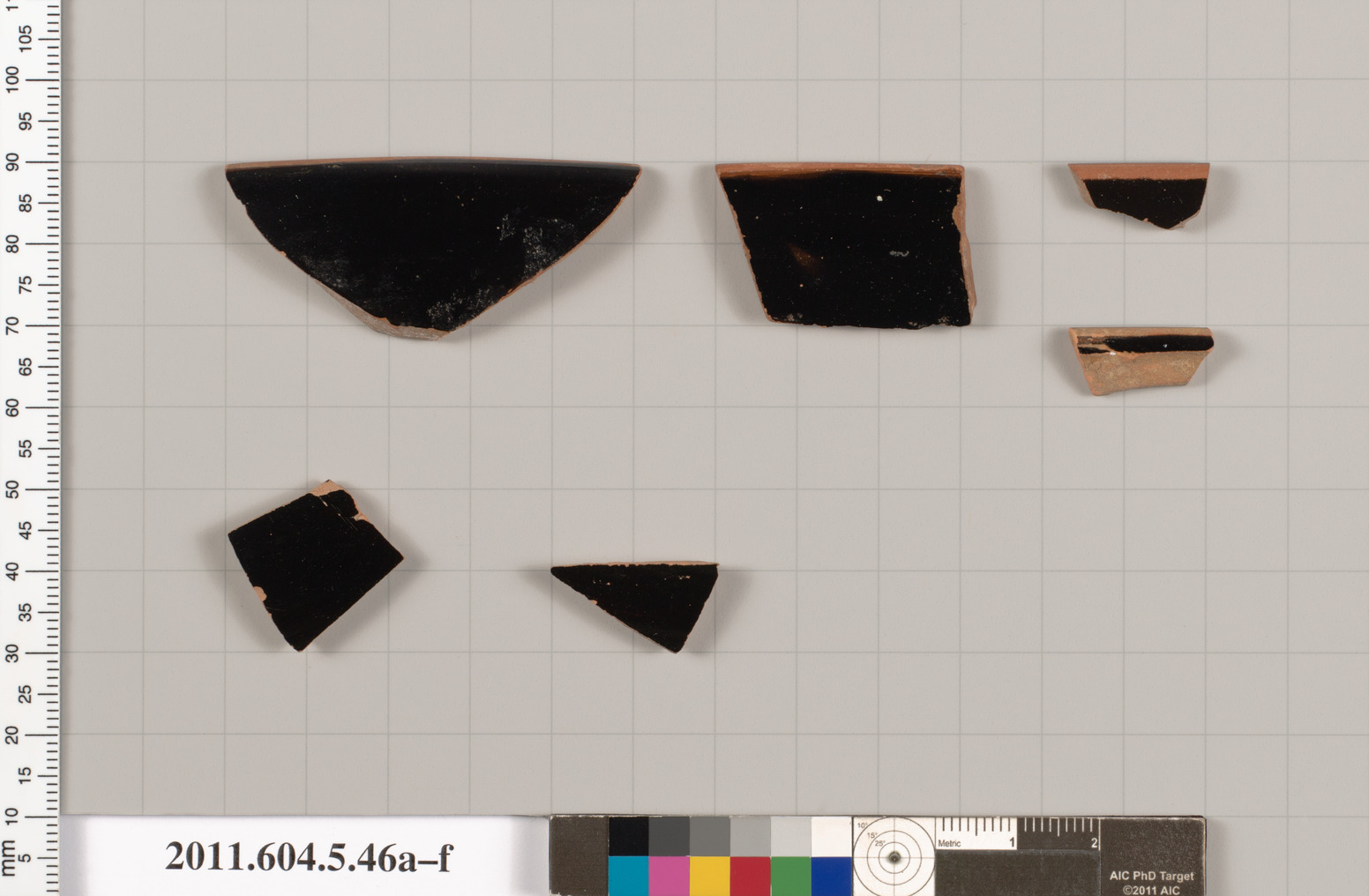
The Terracotta Fragment and the Architecture of Restraint: Recasting Attic Kylikes for the 2026 Old Money Silhouette
The visual dialogue between the serene Buddhist *Bodhisattva* and the compact Egyptian *Bull-Headed Amulet* reveals a fundamental truth about sacred objects: they are vessels of concentrated meaning, their forms shaped by the spiritual and social forces they serve. When we turn from these devotional artifacts to the seemingly mundane *Terracotta fragments of kylikes* (Attic drinking cups), we must ask: what sacred or secular power do these broken vessels hold? For the Lauren Fashion Heritage Lab, these fragments are not mere archaeological debris. They are a genetic code for the 2026 Old Money silhouette—a silhouette that, like the kylix itself, is defined not by what it displays, but by what it contains, what it restrains, and the quiet authority of its proportions.
The Kylix as a Study in Contained Power
The Attic kylix, particularly in its fragmented state, offers a masterclass in the aesthetics of restraint. Unlike the *Bodhisattva*’s outward-facing, compassionate gaze or the amulet’s concentrated, protective density, the kylix is an object of *use* and *circulation*. Its shallow bowl, delicate stem, and twin horizontal handles were engineered for the symposium—a ritualized space of elite male bonding, philosophical discourse, and measured consumption. The terracotta fragments we examine, likely from the 6th–5th century BCE, retain the sharp, clean lines of the potter’s wheel. The black-figure or red-figure decoration, now chipped and faded, once depicted scenes of myth, athletics, or daily life, but the *form* itself speaks louder than any surviving image.
The key design principles of the kylix are: **balance, horizontality, and a deliberate absence of excess.** The bowl’s curve is generous but never bulbous; the stem is slender but structurally confident; the handles are functional, not ornamental. This is an architecture of *contained volume*—a shape that holds liquid without spilling, that fits the hand without demanding attention. In the 2026 Old Money context, this translates directly into the silhouette’s core: a jacket that drapes without pulling, a trouser that falls without pooling, a shoulder that is broad but not padded. The kylix teaches us that true luxury is not in the material’s abundance but in the precision of its containment.
From Symposium to Silhouette: The Horizontal Line of Authority
The most striking formal element of the kylix is its **emphatic horizontality**. The handles extend outward, creating a visual axis that broadens the object’s presence without increasing its height. This horizontal emphasis is a direct counterpoint to the verticality of the *Bodhisattva* (which lifts the eye toward transcendence) and the compactness of the amulet (which draws the gaze inward). For the Old Money silhouette, this horizontal line becomes a signifier of *grounded authority*. The 2026 collection will feature double-breasted jackets with wider lapels that visually extend the shoulder line, not through aggressive padding (a hallmark of nouveau-riche power dressing) but through careful tailoring that creates a clean, uninterrupted horizontal from shoulder to shoulder. The kylix’s handles, when translated, become the subtle structure of a coat’s sleeve head—a quiet architectural statement that says: *I occupy space with purpose, not with noise.*
Furthermore, the kylix’s low center of gravity—its bowl sits close to the table, its stem short relative to its width—informs the silhouette’s lower half. The 2026 Old Money trouser will feature a slightly wider leg from hip to hem, with a gentle break over the shoe. This is not the exaggerated flare of the 1970s or the aggressive taper of the 2010s; it is a *controlled volume* that mirrors the kylix’s bowl. The fabric—likely a dense wool or a cashmere-wool blend—will hold its shape without stiffness, creating a column of material that moves with the body but never loses its architectural integrity. The hem will be finished with a deep cuff, echoing the kylix’s rim, which provides both weight and visual termination.
The Fragment as a Design Philosophy: Imperfection as Heritage
Perhaps the most profound insight from the terracotta fragments is their **state of incompleteness**. These are not pristine museum pieces; they are shards, their edges worn, their surfaces scarred by centuries of burial. Yet, in their fragmentation, they reveal something the intact object cannot: the *process* of their making, the *history* of their use, and the *honesty* of their material. The terracotta’s warm, earthy orange-brown hue, its slightly porous surface, and the visible marks of the potter’s wheel are all evidence of human hands and natural materials.
For the 2026 Old Money silhouette, this translates into a rejection of synthetic perfection. The fabrics will be chosen for their *natural irregularities*: the subtle slubs in a silk-wool blend, the uneven dyeing of a heritage-black cashmere, the visible weave of a worsted wool. The construction will favor *visible craftsmanship*—hand-finished buttonholes, pick-stitching along lapels, and interior pockets that are functional, not decorative. The silhouette itself will be slightly *unfitted*, not in a sloppy sense, but in a way that acknowledges the body’s movement and the garment’s life. A jacket might have a slight roll at the collar; a trouser might show a gentle crease at the knee. These are not flaws; they are *fragments* of the wearer’s story, just as the kylix’s chips tell of symposia long past.
The Sacred and the Secular: A Shared Language of Restraint
Returning to the *Bodhisattva* and the *Bull-Headed Amulet*, we see that both are objects of *faith*—one in transcendence, one in protection. The kylix, in its secular context, is an object of *ritual*—the symposium as a social sacrament. All three share a fundamental principle: **form follows function, and function is always in service of a higher purpose.** For the *Bodhisattva*, the purpose is spiritual elevation; for the amulet, it is magical protection; for the kylix, it is the facilitation of civilized discourse. The 2026 Old Money silhouette, then, must serve a purpose beyond mere clothing. It must facilitate *presence*—the ability to occupy a room without dominating it, to engage in conversation without distraction, to project authority without aggression.
This is achieved through the same design vocabulary: **balance, horizontality, and material honesty.** The silhouette will be a *vessel* for the wearer’s character, not a *display* of their wealth. The proportions will be generous but never excessive, the colors deep and muted (heritage-black, charcoal, midnight navy, and the warm terracotta of the fragments themselves), and the details subtle enough to reward close inspection but invisible from across a room.
Conclusion: The Kylix as a Genetic Code for 2026
The terracotta fragments of the Attic kylix are not merely archaeological curiosities; they are a design manifesto for the 2026 Old Money silhouette. Their horizontal authority, their contained volume, and their honest materiality offer a counter-narrative to the excesses of contemporary fashion. In an era of digital spectacle and viral trends, the Old Money aesthetic—as reimagined through the kylix—returns to the principles of the symposium: measured consumption, intellectual depth, and the quiet confidence of a well-made object. The *Bodhisattva* and the amulet remind us of the sacred; the kylix reminds us of the *social*. Together, they form the heritage DNA of a silhouette that is both timeless and urgently relevant. The 2026 collection will not shout. It will hold its place, like a kylix on a marble table, and wait for the conversation to begin.
Heritage Lab Insight
Genetic Bridge: Archive node focusing on Heritage-Black craftsmanship.