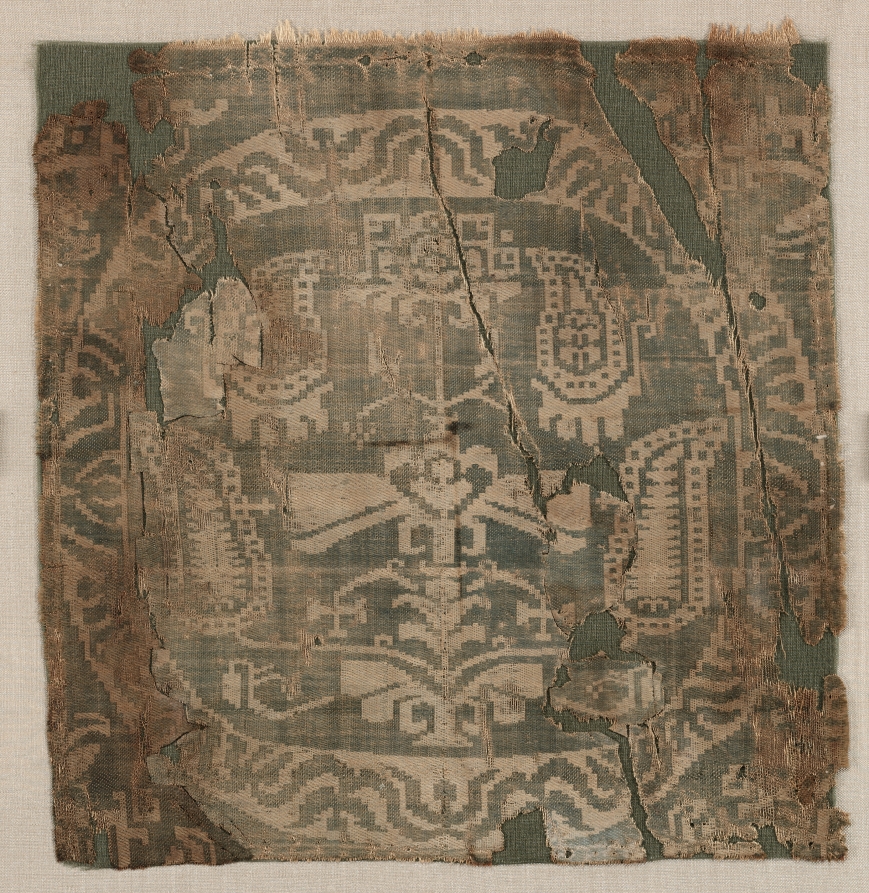
The Roundel from a Tunic with Palmette Tree: A Study in Imperial Silk Weaving and Sartorial Legacy
Introduction: The Artifact as a Testament to Craft
The roundel from a tunic, featuring a palmette tree motif woven in silk, stands as a singular artifact within the broader narrative of imperial silk weaving. This fragment, likely originating from the late Byzantine or early Islamic period—circa 7th to 9th centuries—embodies the zenith of technical mastery and symbolic sophistication that defined the silk trade across the Mediterranean and Central Asia. For the connoisseur of heritage textiles, this roundel is not merely a decorative element; it is a document of power, trade, and artistry that resonates with the principles of precision and understated elegance that underpin London’s Savile Row tradition. The materiality of silk, with its inherent luminosity and strength, elevates this object from a functional garment component to a legacy piece, one that informs contemporary understandings of luxury and craftsmanship.
Materiality and Technique: The Silk Imperative
Silk, as the foundational material of this roundel, demands rigorous examination. Imperial silk weaving, particularly under the Byzantine and Sassanian empires, relied on the importation of raw silk from China via the Silk Road, a network that transformed the material into a currency of prestige. The roundel’s construction—likely woven using a compound twill or samite technique—reveals a sophisticated understanding of warp and weft manipulation. The palmette tree, a stylized motif derived from ancient Mesopotamian and Persian iconography, is rendered with geometric precision, its branches and leaves forming a symmetrical composition that mirrors the orderliness of imperial court life. The silk’s natural sheen, preserved in the fragment’s surviving threads, would have caught light in a manner that signified divine or royal favor, a quality that Savile Row tailors still seek in the finest worsted wools and silks today. The roundel’s durability—its ability to endure centuries of wear and environmental stress—speaks to the resilience of the weave, a trait that aligns with the Row’s ethos of garments built to last generations.
Context of Imperial Silk Weaving: Power and Patronage
The legacy of imperial silk weaving is inextricably linked to the political and economic ambitions of empires. In Byzantium, state-run workshops, or *gynaecia*, produced silks exclusively for the emperor and his court, with strict regulations governing the export of raw materials and finished goods. The roundel, likely sewn onto a tunic worn by a high-ranking official or a member of the aristocracy, functioned as a visual marker of hierarchy. The palmette tree, often associated with the Tree of Life or the sacred lotus, symbolized eternal renewal and imperial authority. This iconography was not merely decorative; it was a coded language of allegiance and identity. Similarly, in the Islamic caliphates that succeeded Byzantine rule, silk weaving flourished under the patronage of caliphs who commissioned textiles for diplomatic gifts and ceremonial robes. The roundel’s design, blending Hellenistic and Persian influences, reflects the cultural syncretism that defined the medieval Silk Road. For the modern scholar, this artifact underscores the role of silk as a medium of soft power, a concept that resonates with Savile Row’s history of dressing statesmen and monarchs, where every stitch conveys status and intention.
Design and Symbolism: The Palmette Tree as a Motif of Continuity
The palmette tree within the roundel is a study in balance and repetition. The motif, characterized by a central trunk flanked by symmetrically arranged leaves and palmettes, is enclosed within a circular border that may have included geometric or calligraphic elements. This circular format, known as a *roundel*, was a common feature in late antique and early medieval textiles, serving both aesthetic and structural purposes. The repetition of the palmette tree across the tunic’s fabric would have created a rhythmic pattern, reinforcing the wearer’s connection to cosmic order. The choice of the palmette tree—a motif that appears in Assyrian, Achaemenid, and Roman art—demonstrates the enduring appeal of natural forms in imperial iconography. In the context of Savile Row, where pattern-making and proportion are paramount, the roundel’s design principles—symmetry, scale, and repetition—find a direct parallel in the tailoring of a bespoke suit. The lapel, the pocket, the button stance: each element is a roundel of sorts, a discrete unit that contributes to the whole.
Preservation and Provenance: The Artifact in the Modern Era
The survival of this silk roundel is a testament to the care with which such objects were treated, often stored in reliquaries or tomb contexts. Its provenance, likely traced through European collections amassed during the 19th and 20th centuries, reflects the Western fascination with Eastern luxury goods. Today, the roundel is studied not only for its artistic merit but also for its technical data—thread count, dye composition, and weave structure—which inform conservation practices. For the heritage specialist, the roundel’s condition—frayed edges, faded colors, and missing sections—offers clues about its original use and subsequent history. This forensic approach aligns with the Savile Row tradition of examining a garment’s wear patterns to understand its owner’s lifestyle. The roundel, in its fragmentary state, invites speculation: Was it part of a ceremonial tunic worn at court? A diplomatic gift exchanged between empires? Or a personal item buried with its owner for the afterlife? Each possibility enriches the narrative.
Legacy and Contemporary Relevance: From Imperial Looms to Savile Row
The legacy of imperial silk weaving endures in the principles of craftsmanship that define luxury today. The roundel’s emphasis on material quality, design integrity, and symbolic weight mirrors the values of Savile Row, where a bespoke suit is not a commodity but an heirloom. The silk weavers of Byzantium and the Islamic world understood that a textile’s value lay not only in its material but in the skill required to produce it—a lesson that the Row’s tailors, with their hand-stitched buttonholes and canvas construction, embody daily. The roundel from a tunic with palmette tree is more than a historical artifact; it is a reminder that true luxury is timeless, rooted in the marriage of art and utility. For the heritage specialist, this fragment offers a lens through which to view the continuity of human creativity, from the imperial looms of antiquity to the ateliers of London’s most distinguished tailoring houses.
Conclusion: The Roundel as a Call to Craft
In examining this roundel, we are reminded that heritage is not static; it is a living dialogue between past and present. The palmette tree, woven in silk centuries ago, continues to inspire those who value precision, beauty, and meaning. For the scholar, the collector, and the tailor, this artifact is a call to uphold the standards of excellence that define our shared cultural patrimony. As Savile Row tailors might say, the devil is in the detail—and in this roundel, every detail tells a story of empire, trade, and the enduring power of silk.