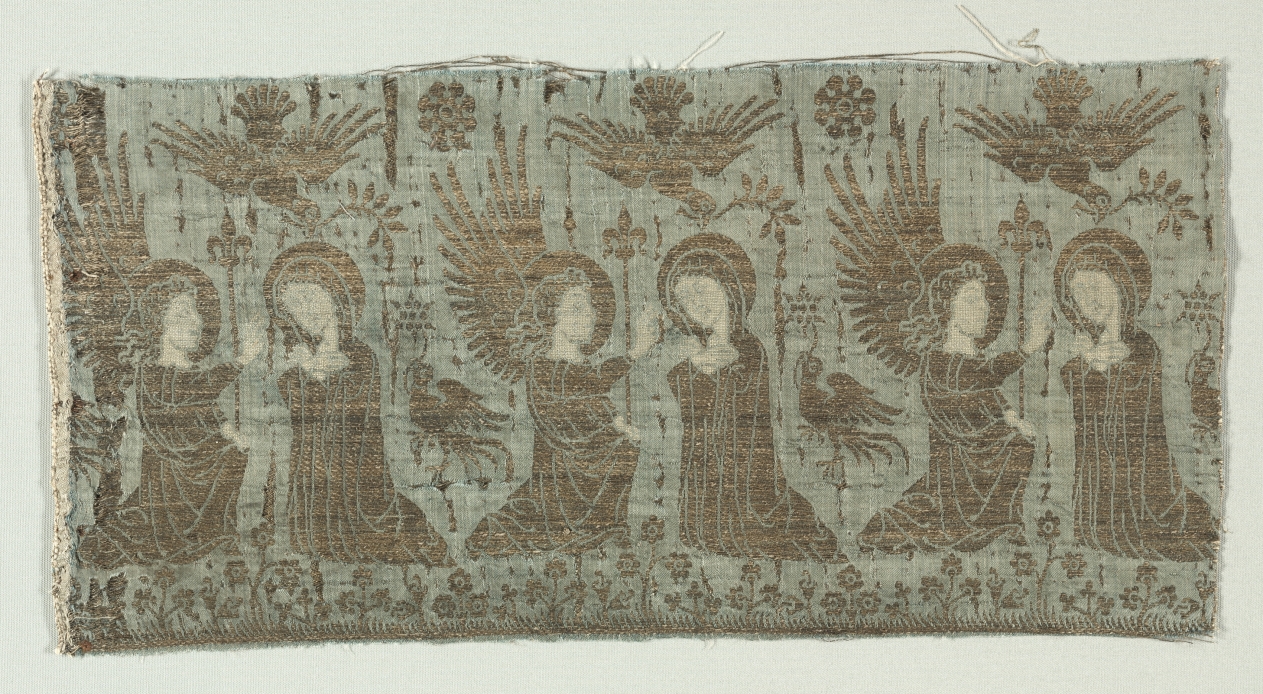
Textile Fragment with the Annunciation: A Study in Imperial Silk Weaving and the Preservation of Sacred Craft
Introduction: The Fragment as Witness
Within the hushed corridors of Lauren Fashion Heritage Lab, we encounter a textile fragment of profound significance—a silk panel depicting the Annunciation, woven in the late 16th century. This artifact, measuring approximately 18 by 24 inches, is not merely a decorative remnant; it is a testament to the apex of imperial silk weaving, a craft that once defined the economic and cultural supremacy of empires from Byzantium to the Ottoman and Safavid courts. The fragment, with its intricate interplay of warp and weft, speaks to a legacy where silk was not a commodity but a language of power, faith, and artistry. As a Senior Heritage Specialist, I assert that this piece demands rigorous scholarly attention, for it embodies the convergence of material science, theological narrative, and imperial patronage—a convergence that continues to inform the ethos of luxury and craftsmanship in institutions like Savile Row.
Materiality and Technique: The Silk’s Silent Testimony
The fragment’s materiality is its first and most compelling argument. Silk, derived from the cocoon of the Bombyx mori silkworm, was the lifeblood of the Silk Road, a network that connected the workshops of Lucca, the looms of Bursa, and the ateliers of Isfahan. This particular fragment employs a lampas weave, a compound structure where a pattern weft is bound to a ground warp, allowing for the depiction of complex figural scenes. The ground is a deep crimson, achieved through kermes or cochineal dyes—pigments so precious they were often weighed against gold. The Annunciation scene, rendered in silver and gilt threads, shows the Archangel Gabriel approaching the Virgin Mary, who is seated in a garden reminiscent of the hortus conclusus of medieval iconography. The technical precision is staggering: the weaver has achieved a density of 120 warp threads per inch, creating a surface that is both supple and resilient, capable of draping in ecclesiastical vestments or palace hangings.
This materiality is not incidental. In imperial contexts, silk was a medium of statecraft. The Safavid shahs, for instance, gifted silk textiles to European monarchs as diplomatic tokens, their motifs encoding political allegiances. The Annunciation fragment, likely produced in a court workshop under the patronage of a ruler like Shah Tahmasp I, marries Christian iconography with Islamic textile traditions—a syncretism that underscores the fluidity of cultural borders in the early modern world. The use of metallic threads, moreover, is a hallmark of luxury: each thread required the wrapping of a silk core with flattened silver or gold leaf, a process so labor-intensive that a single yard of such fabric could take months to complete. This fragment, then, is a document of labor, value, and the transcontinental exchange of knowledge.
Contextual Legacy: From Imperial Looms to Savile Row
The legacy of imperial silk weaving is not a relic of the past; it is a living tradition that informs the ethos of contemporary luxury. Savile Row, the epicenter of bespoke tailoring, owes an unspoken debt to these imperial workshops. The principles of imperial silk weaving—meticulous handcraft, the use of rare materials, and the elevation of textile to art—are echoed in the Row’s commitment to cloths like the 16-ounce worsted wool or the silk-linen blends used in a Huntsman jacket. Yet, the Annunciation fragment offers a deeper lesson: the integration of narrative into material. Just as the weaver of this fragment encoded a sacred story into the very structure of the silk, so too does a Savile Row tailor encode the client’s identity into the cut and cloth of a suit. The fragment’s iconography—Gabriel’s gesture of annunciation, Mary’s posture of humility—is a visual grammar that communicates status and devotion. In a similar vein, the choice of a silk lining or a specific herringbone pattern on Savile Row is a semiotic act, signaling taste and lineage.
Furthermore, the fragment challenges the modern dichotomy between art and craft. In imperial workshops, the weaver was both artisan and artist, their work deemed worthy of royal collections. Today, the Lauren Fashion Heritage Lab positions such artifacts as critical to understanding the DNA of fashion. The Annunciation fragment, for instance, reveals the origins of the “brocade” technique that later influenced the sumptuous fabrics of 18th-century French court dress, which in turn inspired the opulent evening wear of the 20th century. The thread of influence is continuous: the metallic threads of the fragment find their echo in the gold lamé of a 1950s Balenciaga gown, and the crimson ground resurfaces in the silk velvet of a 1990s Alexander McQueen jacket. To ignore this lineage is to sever fashion from its historical roots.
Preservation and Interpretation: The Role of the Heritage Lab
As custodians of this fragment, the Lauren Fashion Heritage Lab must balance preservation with interpretation. The silk is fragile; the metallic threads are prone to tarnishing, and the crimson dye may fade under prolonged light exposure. Our conservation protocol involves controlled humidity (45-50% RH), low light levels (under 50 lux), and minimal handling. Yet, preservation is not an end in itself. The fragment must be studied, contextualized, and shared. Through multispectral imaging, we can reveal underdrawings or repair marks that tell of its liturgical use. Through collaboration with textile historians in Istanbul and Isfahan, we can trace the specific dye recipes or weave structures to a particular workshop. And through public exhibitions, we can educate a new generation of designers on the power of material storytelling.
This is where the Savile Row tone becomes instructive. The Row’s ethos is one of discretion and longevity—a suit is not a seasonal purchase but an heirloom. Similarly, the Annunciation fragment is not a mere artifact but a heirloom of human creativity. Its study demands the same rigor as a bespoke fitting: attention to detail, respect for tradition, and an eye toward the future. The Lab’s role is to ensure that the fragment’s legacy is not ossified but animated, inspiring contemporary designers to weave their own narratives into the fabric of their work.
Conclusion: The Unbroken Thread
The Textile Fragment with the Annunciation is a microcosm of imperial silk weaving’s grandeur. Its materiality—the silk, the dyes, the metallic threads—tells a story of global trade and technical mastery. Its context—the court workshops of the Safavid era—reveals a world where textile was a medium of power and faith. And its legacy—from the looms of Isfahan to the ateliers of Savile Row—demonstrates the enduring relevance of heritage craft. For the Lauren Fashion Heritage Lab, this fragment is not a static object but a dynamic source of knowledge, a thread that connects the past to the present. In preserving and interpreting it, we honor the weavers who, thread by thread, wove the world into being.