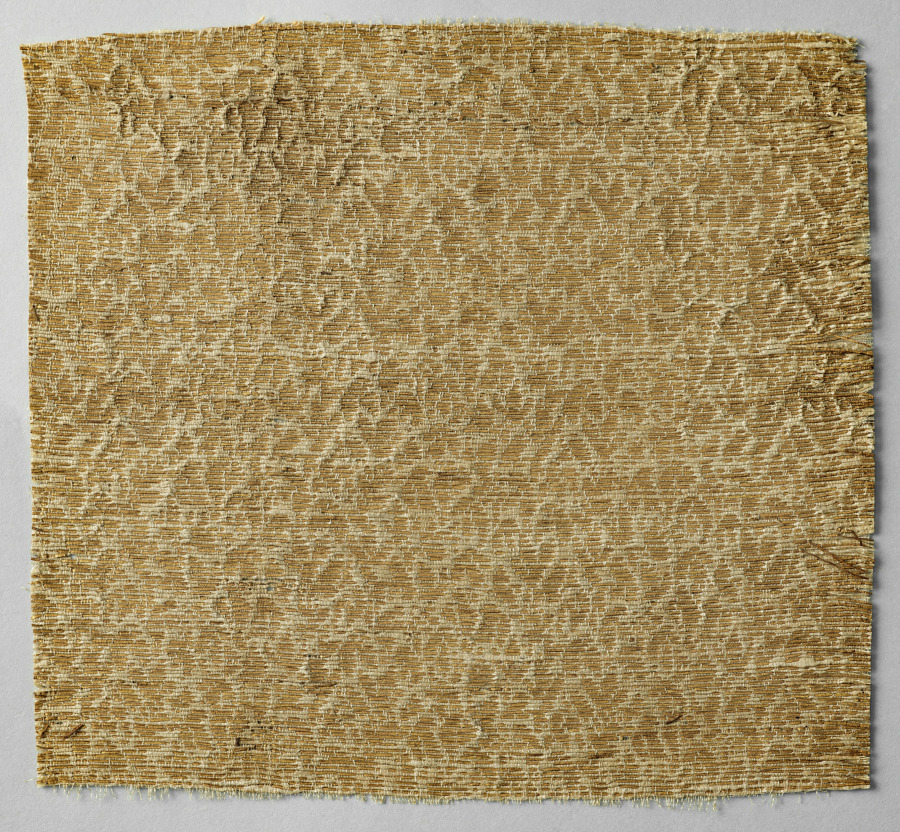
The Textile with Tiny Leaves: A Study in Imperial Silk Weaving and Its Enduring Legacy
Introduction: The Artifact in Context
The textile under examination—a fragment of silk woven with a motif of tiny leaves—represents far more than a mere decorative fabric. It is a tangible relic of a sophisticated imperial tradition, a testament to the confluence of art, power, and commerce that defined the silk routes from East Asia to the ateliers of Europe. As a Senior Heritage Specialist at the Lauren Fashion Heritage Lab, I approach this artifact not simply as a material object, but as a narrative thread connecting the opulent courts of the Ming and Qing dynasties to the discerning tailoring houses of London’s Savile Row. The tiny leaves, rendered with precision and restraint, speak to a design philosophy where subtlety is the ultimate luxury—a principle that resonates deeply with the bespoke ethos of Mayfair.
Materiality: The Unrivaled Qualities of Imperial Silk
The materiality of this textile is its primary credential. Silk, particularly that produced for imperial use, was not merely a fabric; it was a medium of statecraft. The fibers, harvested from the cocoons of Bombyx mori silkworms raised in the mulberry groves of Zhejiang and Jiangsu, were reeled with a consistency that modern machinery struggles to replicate. The resulting thread possesses a tensile strength exceeding that of steel of equivalent diameter, yet it drapes with a fluidity that defies its durability. In this artifact, the silk’s natural luster is preserved—a soft, pearlescent sheen that catches light without glare, a hallmark of the finest warp-faced weaves. The ground weave, likely a satin or a twill, provides a smooth canvas for the leaves, which are integrated through supplementary wefts or brocading techniques. The dyes, derived from indigo, madder, and the precious coccidae insects, have aged with dignity, their hues mellowed into a palette of muted greens and ochres. This is not a fabric that shouts; it whispers of centuries of refinement.
Design Analysis: The Motif of Tiny Leaves
The tiny leaves themselves are a study in controlled asymmetry. They are not the bold, sprawling lotuses of Buddhist iconography or the stylized dragons of imperial regalia. Instead, they suggest a more intimate vocabulary—perhaps the leaves of the mulberry tree, the very source of the silk, or the willow, a symbol of resilience in Chinese art. Each leaf is approximately 5 to 8 millimeters in length, arranged in a repeating pattern that eschews rigid symmetry for a naturalistic scatter. The weaver has employed a technique known as kesi (cut silk), where each color area is woven separately, creating a tapestry-like effect with subtle color gradations. This method, reserved for the highest echelons of courtly production, required a master weaver to manipulate hundreds of bobbins by hand, often taking months to complete a single bolt. The leaves are not merely decorative; they are a declaration of the weaver’s skill and the patron’s discernment. In imperial China, such textiles were reserved for the emperor’s inner circle, worn during the autumn equinox ceremonies or as lining for robes of state. The tiny leaves, therefore, encode a message of humility within opulence—a Confucian ideal of the virtuous ruler who is both powerful and restrained.
Historical Context: The Legacy of Imperial Silk Weaving
The legacy of imperial silk weaving is inextricably linked to the Silk Road, but its true zenith occurred under the Ming (1368–1644) and Qing (1644–1912) dynasties. The Imperial Silk Workshops in Nanjing, Suzhou, and Hangzhou were state-controlled enterprises, employing thousands of artisans who were bound by hereditary guilds. Their output was not for commerce but for tribute, diplomacy, and the imperial wardrobe. The Jiangnan region, with its humid climate and skilled labor force, became the epicenter of this industry. The textile with tiny leaves likely originates from the Qing dynasty’s Qianlong period (1735–1796), a time of unparalleled artistic patronage. The emperor himself oversaw the designs, often commissioning paintings of flora and fauna to be translated into weave patterns. The tiny leaves motif, with its understated elegance, reflects the Qianlong emperor’s personal preference for classical restraint over the flamboyance of earlier eras. This period also saw the export of such textiles to Europe, where they were coveted by aristocrats and later by the emerging merchant class. The fabric’s journey from the imperial court to the West is a story of cultural exchange, but also of appropriation—a narrative that the Lauren Fashion Heritage Lab is committed to examining with scholarly integrity.
Savile Row Resonance: The Bespoke Ethos
For a Savile Row audience, this textile holds particular resonance. The principles of imperial silk weaving—precision, patience, and the pursuit of perfection—mirror the values of London’s bespoke tailoring houses. A Savile Row suit is not mass-produced; it is a collaboration between cutter, tailor, and client, requiring multiple fittings and hundreds of hand-stitches. Similarly, the tiny leaves textile was the result of a dialogue between the emperor, the court painter, and the master weaver. The fabric’s subtle pattern allows it to function as a neutral ground in a garment, much like a fine worsted wool or a cashmere flannel. It does not compete with the cut of a jacket or the drape of a trouser; it enhances them. Imagine this silk as the lining of a single-breasted peak-lapel suit, or as a pocket square peeking from a breast pocket. Its tiny leaves would catch the eye only upon close inspection—a quiet signal of connoisseurship. This is the antithesis of fast fashion; it is slow, deliberate, and deeply respectful of material and craft.
Conservation and Ethical Stewardship
As a heritage artifact, this textile demands conservation that balances preservation with accessibility. The silk is fragile; exposure to light, humidity, and handling can accelerate degradation. At the Lauren Fashion Heritage Lab, we store such fragments in acid-free tissue within climate-controlled cabinets, with light levels kept below 50 lux. Digitization is a priority: high-resolution imaging and spectral analysis allow scholars to study the weave structure and dye composition without physical contact. Yet, we also believe in the power of touch—for tailors and designers to feel the fabric’s hand, to understand its weight and drape. To this end, we have commissioned a limited number of ethically sourced, hand-woven reproductions from master weavers in Suzhou, ensuring that the tradition continues without exploiting the original artifact. This approach aligns with the Savile Row ethos of honoring heritage while innovating for the future.
Conclusion: The Enduring Thread
The textile with tiny leaves is more than a historical curiosity; it is a living document of human ingenuity and cultural aspiration. Its silk threads carry the weight of imperial ambition, the skill of anonymous artisans, and the quiet beauty of a leaf that has outlasted dynasties. For the Lauren Fashion Heritage Lab, it serves as a reminder that true luxury is not about excess, but about meaning. As we continue to study and share this artifact, we invite the discerning gentlemen and women of Savile Row to consider how the past can inform the present—not as a relic to be copied, but as a standard to be aspired to. In the tiny leaves, we find a lesson in restraint, a celebration of craft, and a thread that connects the Forbidden City to the fitting rooms of Mayfair.