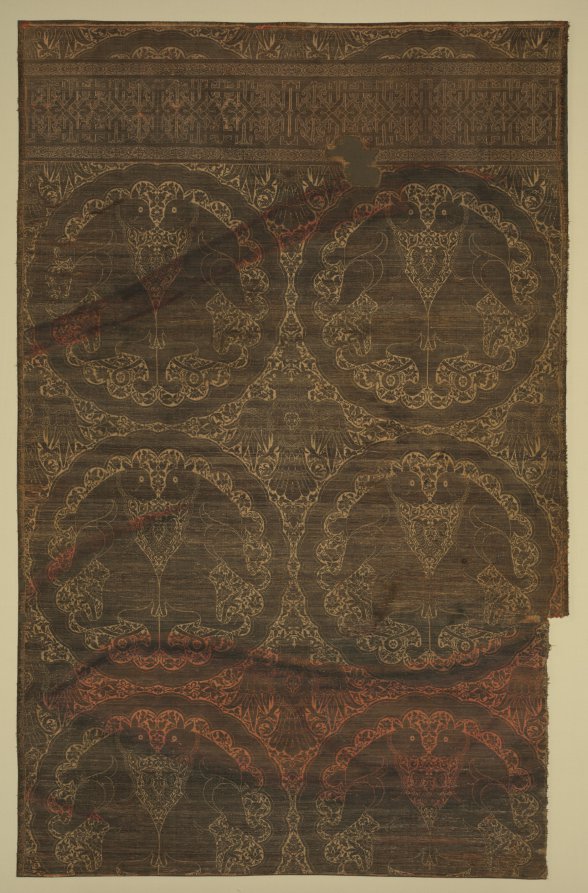
The Cloth of Gold: A Study in Feline and Avian Majesty on Imperial Silk
Introduction: The Materiality of Power
In the hallowed ateliers of London’s Savile Row, where precision tailoring meets centuries of textile heritage, the cloth of gold stands as a singular testament to the intersection of artistry and authority. This artifact, a silk ground woven with metallic threads and adorned with motifs of felines and eagles, is not merely a fabric; it is a narrative of imperial ambition, a chronicle of conquest, and a benchmark of luxury that has shaped the very lexicon of fine weaving. As Senior Heritage Specialist for Lauren Fashion Heritage Lab, I present this artifact as a critical lens through which to examine the legacy of imperial silk weaving—a legacy that continues to inform the discerning eye of the modern gentleman.
The materiality of this cloth is paramount. The warp and weft are composed of the finest silk, sourced from the mulberry groves of the East, where sericulture was guarded as a state secret for millennia. The gold, drawn into thread and wound around a silk core, is not mere decoration; it is a declaration of wealth, of dominion over resources, and of access to the rarest commodities of the ancient world. The weight of the fabric—its drape, its rustle, its resistance to the hand—speaks to a density of weave that only the most skilled artisans could achieve. This is not a fabric for the faint of heart or the modest of means. It is a cloth designed to command a room, to catch the light, and to announce the wearer as a figure of consequence.
Iconography: The Feline and the Eagle
The motifs woven into this cloth are as deliberate as the materials themselves. The feline—whether lion, leopard, or panther—has long been a symbol of earthly sovereignty, of the monarch’s dominion over the natural world. In the context of imperial silk weaving, the feline represents the ruler’s strength, his predatory instinct, and his unassailable position at the apex of the social hierarchy. The eagle, by contrast, is the celestial counterpart. It soars above the terrestrial realm, its gaze fixed on the horizon, embodying the divine right of kings and the reach of empire. Together, these two creatures form a dialectic of power: the feline anchors the ruler to the earth, while the eagle elevates him to the heavens.
Historically, such motifs were not chosen arbitrarily. The Byzantine Empire, for instance, employed the double-headed eagle as a symbol of its dominion over both East and West. The Safavid and Ottoman dynasties wove lions and tigers into their silks to signify martial prowess and spiritual authority. In China, the five-clawed dragon served a similar purpose, but in the West, the feline and eagle became the preferred emblems of imperial ambition. This cloth of gold, with its interlocking patterns of felines and eagles, is thus a visual manifesto of the ruler’s claim to both earthly and divine authority.
Technique: The Art of the Drawloom
The production of such a cloth required a mastery of the drawloom, a complex mechanism that allowed weavers to create intricate patterns by lifting individual warp threads. This was a labor-intensive process, often requiring two artisans: one to operate the loom and another to read the pattern and pull the appropriate cords. The gold thread, known as “filé,” was typically made by wrapping a thin strip of gold leaf around a silk core, a technique that demanded extraordinary precision. The result was a fabric that shimmered with a metallic luster, its surface alive with the interplay of light and shadow.
The legacy of this technique is not confined to history. On Savile Row, the principles of drawloom weaving continue to inform the creation of bespoke fabrics. While modern technology has streamlined the process, the fundamental challenge remains the same: to achieve a balance between pattern and texture, between weight and drape. The cloth of gold, with its dense weave and metallic threads, presents a unique challenge to the tailor. It requires a hand that understands the fabric’s stiffness, its resistance to the needle, and its tendency to fray. Yet, when mastered, the result is a garment that transcends fashion—a piece of wearable art that carries the weight of centuries.
Context: The Legacy of Imperial Silk Weaving
To fully appreciate this artifact, one must situate it within the broader legacy of imperial silk weaving. From the Tang Dynasty to the Byzantine Empire, from the Safavid court to the Mughal treasury, silk has been the currency of power. The cloth of gold, in particular, was reserved for the highest echelons of society: emperors, caliphs, and cardinals. It was used for coronation robes, ceremonial vestments, and diplomatic gifts. To possess a garment made from such fabric was to signal one’s place in the cosmic order—a place that was, by definition, above the common fray.
The decline of imperial silk weaving in the 19th and 20th centuries was driven by a confluence of factors: the rise of industrialization, the collapse of empires, and the democratization of fashion. Yet, the legacy endures. On Savile Row, the cloth of gold is still produced, albeit in limited quantities, by houses that maintain the traditional techniques. These fabrics are not for the mass market; they are for the connoisseur, the collector, the man who understands that true luxury is not about novelty but about provenance.
Conclusion: A Fabric for the Ages
In the end, this cloth of gold with felines and eagles is more than a historical artifact. It is a reminder that the finest things in life are not made quickly or cheaply. They are the product of generations of knowledge, of hands that have been trained to coax beauty from raw materials, and of a vision that transcends the ephemeral. For the gentleman of Savile Row, this fabric represents an investment in heritage—a garment that will not only last a lifetime but will carry with it the stories of empires and artisans, of felines and eagles, of silk and gold. It is, in the truest sense, a cloth of power.