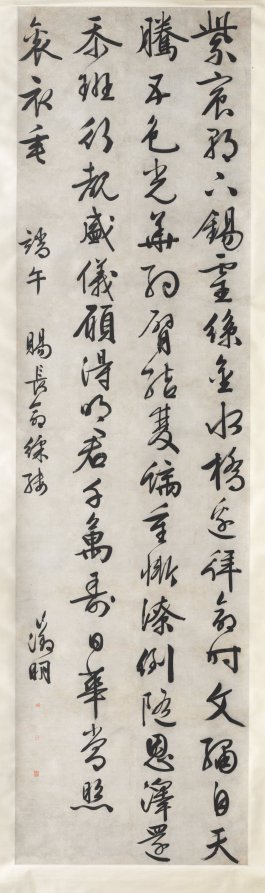
Heritage Research Artifact: The Imperial Gift of an Embroidered Silk in Running-Standard Script (Xingkaishu)
Introduction: The Art of Imperial Silk as a Cultural Currency
In the rarefied echelons of Chinese imperial history, silk was never merely a textile; it was a medium of power, a vessel of diplomacy, and a testament to the supreme artistry of the court. The Imperial Gift of an Embroidered Silk, inscribed with calligraphy in the running-standard script (xingkaishu), represents a pinnacle of this tradition—a material artifact that transcends its physical form to embody the philosophical, political, and aesthetic ideals of the Ming and Qing dynasties. For the connoisseur of heritage, this piece is not unlike a bespoke suit from Savile Row: it speaks of lineage, precision, and an unspoken dialogue between the maker and the wearer. This paper examines the materiality of the silk, the technical mastery of its embroidery, and the enduring legacy of imperial silk weaving as a cultural heritage that informs modern luxury craftsmanship.
Materiality: The Silk as a Substrate of Power
The foundation of this artifact is its silk—a material that, in imperial China, was as much a symbol of cosmic order as it was a commodity. The silk used for such gifts was typically produced in the imperial workshops of Suzhou, Hangzhou, or Nanjing, regions renowned for their sericulture and weaving techniques. The fabric itself is a tabby-weave silk, chosen for its smooth, lustrous surface that allows calligraphic strokes to appear as if floating upon a liquid mirror. The weight and density of the silk are critical: it must be substantial enough to support the intricate embroidery without buckling, yet supple enough to drape with the grace expected of a ceremonial object. This balance is achieved through a meticulous process of degumming, dyeing, and calendaring—a process that echoes the tailoring of a Savile Row jacket, where the cloth is treated as a living entity, responsive to the hand of the artisan.
The color of the silk—often a deep, resonant imperial yellow or celestial blue—was not arbitrary. Yellow, reserved for the emperor, signified centrality and the earth’s fertility, while blue evoked the heavens and the mandate of heaven. The dyeing process involved natural pigments derived from plants, minerals, and insects, each requiring precise temperature and timing to achieve the desired hue. This chromatic discipline mirrors the restraint of a Savile Row tailor, who understands that color must serve the silhouette, not dominate it. In the case of the embroidered silk, the color provides a backdrop that amplifies the calligraphy, allowing the ink-black or gold-thread characters to command attention.
The Calligraphy: Running-Standard Script as a Bridge Between Worlds
The calligraphy on this silk is executed in xingkaishu, a hybrid script that combines the legibility of standard script (kaishu) with the fluidity of running script (xingshu). This choice is deliberate: it conveys both authority and grace, much like the measured cadence of a Savile Row tailor’s conversation—precise yet unhurried. The poem inscribed is likely a classical verse, perhaps from the Tang or Song dynasties, celebrating themes of loyalty, harmony, or the emperor’s virtue. The characters are embroidered using a technique known as satin stitch, where threads of silk or gold are laid parallel to create a smooth, unbroken surface. Each stroke is a study in tension: the vertical lines must be firm, the horizontal strokes steady, and the curves flowing without interruption. This requires a mastery of needlework that rivals the finest hand-stitching on a bespoke lapel.
The choice of gold thread for the calligraphy is significant. Gold, being incorruptible, symbolizes the eternal nature of the emperor’s word and the unbreakable bond between the giver and the recipient. The thread itself is made by wrapping silk filaments around a core of gold leaf, a process that demands extraordinary skill. The result is a script that shimmers with a subtle, living light—a quality that no machine can replicate. This is the essence of heritage: the human hand, guided by centuries of tradition, creating an object that is both functional and transcendent.
The Legacy of Imperial Silk Weaving: From Court to Couture
The legacy of imperial silk weaving extends far beyond the confines of the Forbidden City. It is a tradition that has informed the development of luxury textiles worldwide, from the silks of Lyon to the brocades of Kyoto. In the context of modern fashion, the principles embodied in this embroidered silk—precision, material integrity, and narrative depth—are the very qualities that define haute couture and bespoke tailoring. The Savile Row house of Huntsman, for instance, shares with the imperial weaver a commitment to the bespoke process: the client’s measurements are taken, the cloth is selected, and the garment is constructed over weeks of meticulous handwork. Similarly, the imperial silk was not a mass-produced commodity; it was a bespoke creation, tailored to the occasion and the recipient.
Moreover, the calligraphy on the silk serves as a reminder that luxury is not merely about appearance but about meaning. In an era of fast fashion and disposable trends, the Imperial Gift of an Embroidered Silk stands as a counterpoint—a call to slow down, to honor the craft, and to recognize that true heritage lies in the stories we weave into our garments. For the Lauren Fashion Heritage Lab, this artifact is a touchstone: it challenges us to consider how we can integrate the principles of imperial silk weaving into contemporary design, preserving the soul of the craft while adapting it to the needs of the modern wardrobe.
Conclusion: The Enduring Thread
The Imperial Gift of an Embroidered Silk is more than a historical curiosity; it is a masterclass in the art of making. Its materiality—the silk, the dye, the gold thread—speaks to a level of craftsmanship that is increasingly rare in our mechanized world. Its calligraphy, executed in running-standard script, bridges the gap between the formal and the expressive, much like the finest tailoring balances structure with ease. As we continue to explore the legacy of imperial silk weaving, we are reminded that heritage is not a static relic but a living tradition—one that can inspire a new generation of artisans, designers, and connoisseurs to pick up the needle and continue the work. In the words of a Savile Row master: “The cloth does not lie; it tells the truth of the hand that made it.” This silk tells a truth that resonates across centuries, and it is our privilege to listen.