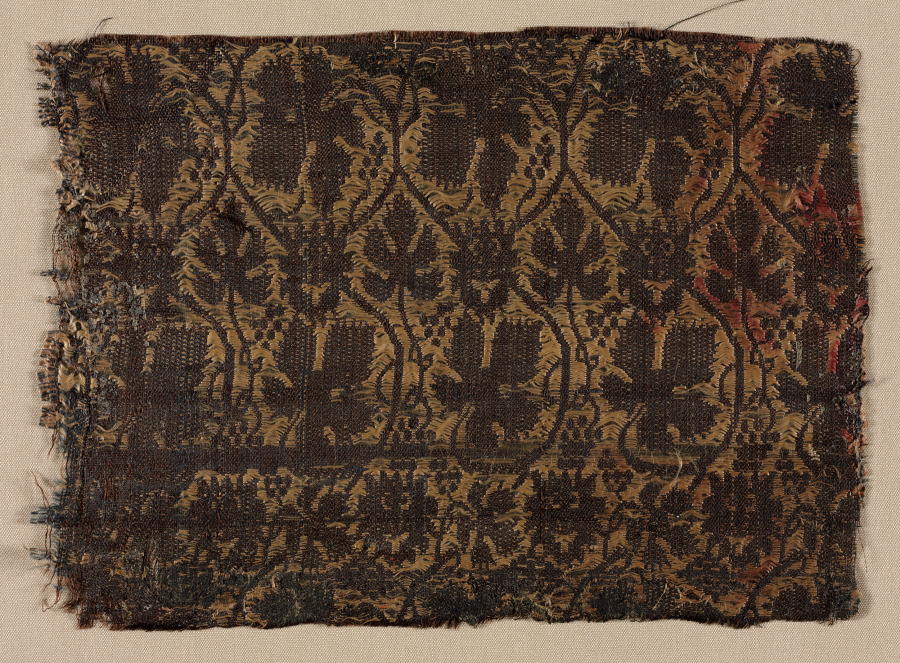
An Examination of Imperial Legacy in a Singular Fragment
One does not merely observe such an artifact; one is received by it. Presented for consideration is a fragment, a modest tessera in the grand mosaic of textile history. Its dimensions are deliberately unremarkable, yet its presence is commanding. The material, of course, is silk—the undisputed sovereign of fibres. This is not the silk of commonplace luxury, but the product of a system so refined, so exacting in its pursuit of perfection, that it functioned as an instrument of state. To comprehend this fragment is to engage with the very machinery of imperial aspiration, where aesthetics were inseparable from authority and the loom served as a crucible for power.
The Loom as an Instrument of State
The legacy herein is not one of happenstance, but of formidable, centralised intention. Imperial silk weaving, particularly as perfected in the Chinese and Byzantine spheres, was less an artisanal endeavour and more a sophisticated arm of governance. State-controlled ateliers, or jinxiu yuan in the Ming and Qing contexts, operated with a precision that would satisfy the most exacting of modern boards. Patterns were codified, their use dictated by sumptuary laws of breathtaking complexity. The dragon’s claw, the phoenix’s feather, the specific arrangement of clouds—these were not decorative whims but a visual lexicon of rank, a semaphore of privilege visible across a throne room. The fragment before us, with its intricate, possibly avian motif hinted at in the warp, is a silent testament to this bureaucratic mastery of beauty. It speaks of a supply chain that began with mulberry groves under imperial stewardship and ended only in the innermost sanctums of the palace. The value generated was twofold: tangible economic wealth and the intangible, yet far more potent, capital of perceived celestial mandate.
A Discourse on Material Virtuosity
Let us turn to the physical specimen. The hand, trained by exposure to the finest contemporary textiles, immediately registers a density, a substantive hand-feel that belies the fibre’s inherent delicacy. This is the result of a high-thread count and a mastery of spinning that produced yarns of exceptional tensile strength and luminous consistency. Under magnification, one would expect to find a weave structure of formidable complexity—perhaps a kesi tapestry weave, where the weft threads do not travel the full width of the cloth, allowing for curvilinear, painterly designs. The colours, now softened by centuries, would have been violently brilliant in their prime: vermillions from powdered cinnabar, regal blues from fermented indigo, yellows from gardenia fruit, all fixed with mineral mordants in a chemistry that was itself a guarded secret. The durability of this fragment, its resistance to the utter ravages of time, is the ultimate endorsement of its provenance. It was crafted not for a season, but for eternity; not for the individual, but for the institution they embodied.
The Fragment as a Philosophical Proposition
Therein lies the most compelling narrative. This fragment is, by its very existence, a ruin. It is a physical echo of a vanished whole—a robe, a hanging, a canopy of state. Yet, its fragmentation elevates its discourse. It compels us to consider the tension between permanence and decay, between the imperial desire for immutable legacy and the inexorable entropy of history. The empire that mandated its creation has receded into the annals; its laws are obsolete, its hierarchies dust. But the fragment endures, now speaking a different, more universal language. It no longer denotes the rank of a specific courtier, but rather the universal human pursuit of excellence, of rendering the ephemeral (a silkworm’s cocoon) into a testament meant to defy time. It becomes a metaphor for heritage itself: rarely passed down in complete, unaltered form, but rather in potent, revered fragments from which we extrapolate the grandeur of the whole.
Conclusion: A Legacy Recalibrated
To conclude, this silk fragment transcends its material classification. It is a nexus of historical forces—an object of economic policy, a tool of social stratification, a masterpiece of technical innovation, and now, a philosophical artefact. Its value to the contemporary connoisseur of heritage lies not in any potential for restoration to its original form, a frankly vulgar notion, but in its dignified state of eloquent decay. It teaches us that true legacy is not about pristine preservation, but about the transmission of essence—the standards, the ambition, the unwavering commitment to quality that the fragment so palpably embodies. In an age of disposable fashion and planned obsolescence, it stands as a silent, formidable rebuke and a benchmark. The imperial looms are silent, but their product continues to speak, in a whisper that carries the weight of dynasties. Our task is not to replicate their output, but to understand the profound discipline of their intent, and to ensure that such rigour finds its expression in the idioms of our own time. The fragment is not an end, but a beginning.