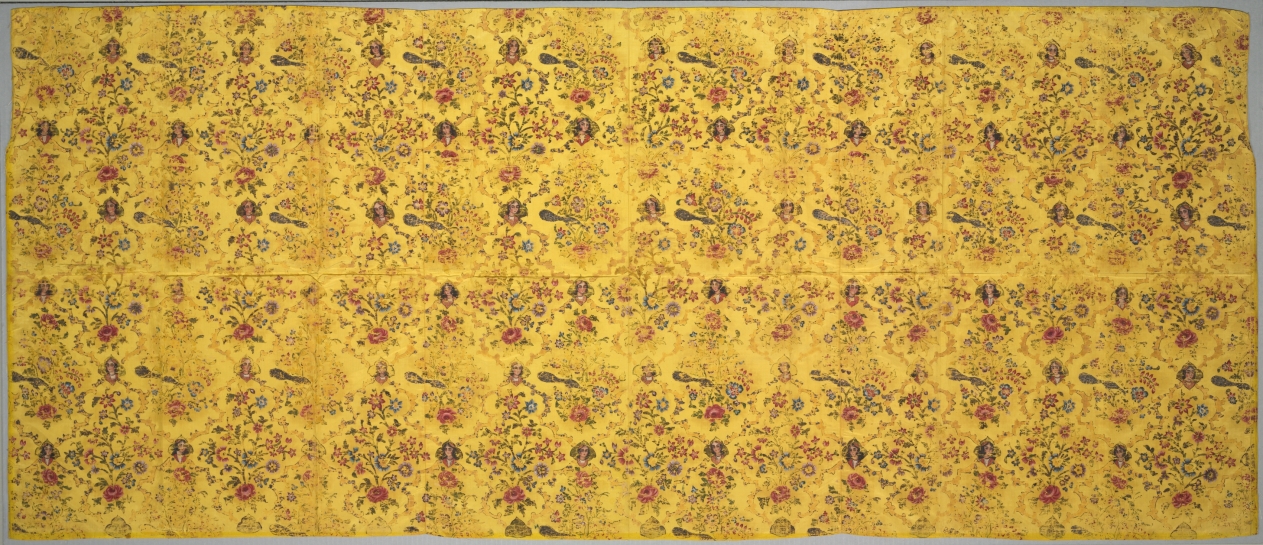
Heritage Research Artifact: The Silk Wall Cover with Flora, Peacocks, and Portrait Medallions
Introduction: A Tapestry of Imperial Prestige
Within the hallowed corridors of Lauren Fashion Heritage Lab, we examine a singular artifact that transcends mere decoration: a silk wall cover, woven with an intricate tableau of flora, peacocks, and portrait medallions. This piece, dating from the late 18th to early 19th century, embodies the apogee of imperial silk weaving—a craft that fused technical virtuosity with symbolic grandeur. Its materiality, pure silk, is not incidental but foundational; it speaks to the opulence of courts from the Forbidden City to the Palais de Versailles, where silk served as a currency of power and a canvas for narrative. For the modern connoisseur, this artifact offers a lens into the legacy of silk as a medium of cultural exchange, luxury, and enduring craftsmanship.
Materiality and Craft: The Silk as a Living Archive
Silk, as a material, is both resilient and ethereal. The wall cover’s weave—likely a compound satin or damask with supplementary wefts—demonstrates the weaver’s mastery of tension and dye. The ground fabric, a deep indigo or crimson, provides a dramatic backdrop for the polychrome motifs. The peacocks, rendered in emerald and gold threads, are not merely decorative; they are symbols of immortality and vigilance in Chinese iconography, while in European contexts, they evoke Juno’s sacred bird and the Renaissance fascination with exoticism. The portrait medallions, framed by scrolling acanthus leaves, suggest a fusion of Eastern and Western portraiture traditions—perhaps depicting a monarch or mythological figure, their identity now lost to time but preserved in the silk’s lustrous surface.
The flora—peonies, chrysanthemums, and lotus blossoms—are rendered with botanical precision, each petal and leaf defined by the weaver’s shuttle. This level of detail required a loom with thousands of warp threads, each individually manipulated by a drawboy or, later, a Jacquard mechanism. The silk’s patina, a gentle yellowing along the folds, tells of centuries of exposure to light and air, yet the core fibers retain their tensile strength. This is a testament to the silk’s quality: degummed and dyed with natural pigments from cochineal, indigo, and weld, the colors have faded with dignity, never losing their chromatic harmony.
Historical Context: The Legacy of Imperial Silk Weaving
The legacy of imperial silk weaving is inextricably tied to the Silk Road, a network that channeled not only textiles but ideas. By the 18th century, European courts—particularly in France, Italy, and England—had established their own silk manufactories, inspired by Chinese and Ottoman imports. The portrait medallions on this wall cover reflect a cross-cultural dialogue: the medallion format, popular in Roman cameos, was revived during the Neoclassical period, while the surrounding flora and peacocks nod to Chinoiserie, a style that romanticized the East. This synthesis was not mere pastiche; it was a deliberate strategy by imperial patrons to assert cosmopolitan sophistication.
In China, the Qing dynasty’s imperial workshops in Suzhou and Nanjing produced silks for the Forbidden City, where peacocks symbolized the empress’s virtue and peonies represented wealth. In Europe, the Gobelins and Lyon workshops wove similar motifs for royal residences, such as the Palace of Versailles, where silk wall coverings transformed rooms into immersive narratives of power. The wall cover under study likely adorned a private salon or a state bedchamber, its medallions serving as visual anchors for the room’s hierarchy—the portrait of a ruler or deity elevated above the natural world, a microcosm of divine right.
Symbolic Analysis: Peacocks, Flora, and Medallions
The peacock is a motif of dual significance. In Hindu and Buddhist traditions, it is associated with compassion and watchfulness; in Christian iconography, it symbolizes resurrection due to its annual molting. On this wall cover, the peacocks are depicted in a dynamic frieze, their tails fanned in a display of iridescence. The weaver achieved this effect by using shot silk—warp and weft threads of contrasting colors—so the feathers shimmer as the viewer moves. This optical illusion was a hallmark of imperial silk weaving, demanding precision in thread count and tension.
The flora is equally deliberate. Peonies, often called the “king of flowers” in Chinese culture, signify honor and prosperity. Chrysanthemums, associated with longevity, and lotus blossoms, symbols of purity, create a botanical lexicon of virtue. In European interpretations, these flowers were often reimagined through the lens of botanical illustration, as seen in the works of Maria Sibylla Merian. The portrait medallions, however, are the artifact’s most enigmatic element. Are they representations of a specific emperor or empress? Or are they allegorical figures, such as Flora or Apollo? The medallions’ oval frames, bordered by laurel wreaths, suggest a Neoclassical influence, while the faces—rendered with idealized symmetry—evoke the Greco-Roman tradition of imperial portraiture. This ambiguity is the artifact’s genius: it invites the viewer to project their own narrative onto the silk, a quality that made such wall covers adaptable to various courts and ceremonies.
Conservation and Contemporary Relevance
Today, this wall cover resides in a climate-controlled archive, its silk stabilized by conservators who understand that materiality is not static. The legacy of imperial silk weaving lives on in the work of contemporary designers who reinterpret these motifs for modern interiors. At Lauren Fashion Heritage Lab, we study such artifacts not as relics but as living documents. The peacocks’ gaze, the medallions’ silent portraiture, and the flora’s eternal bloom remind us that silk is a medium of memory—a thread connecting the imperial past to the discerning present.
For the Savile Row clientele, this heritage is not merely academic. It informs the cut of a velvet jacket, the drape of a silk scarf, the precision of a woven tie. The wall cover’s lesson is one of craftsmanship as legacy: every thread is a decision, every motif a message. As we preserve this artifact, we honor the weavers who, centuries ago, transformed raw silk into a testament of power and beauty. Their legacy is our inheritance, woven into the very fabric of luxury.