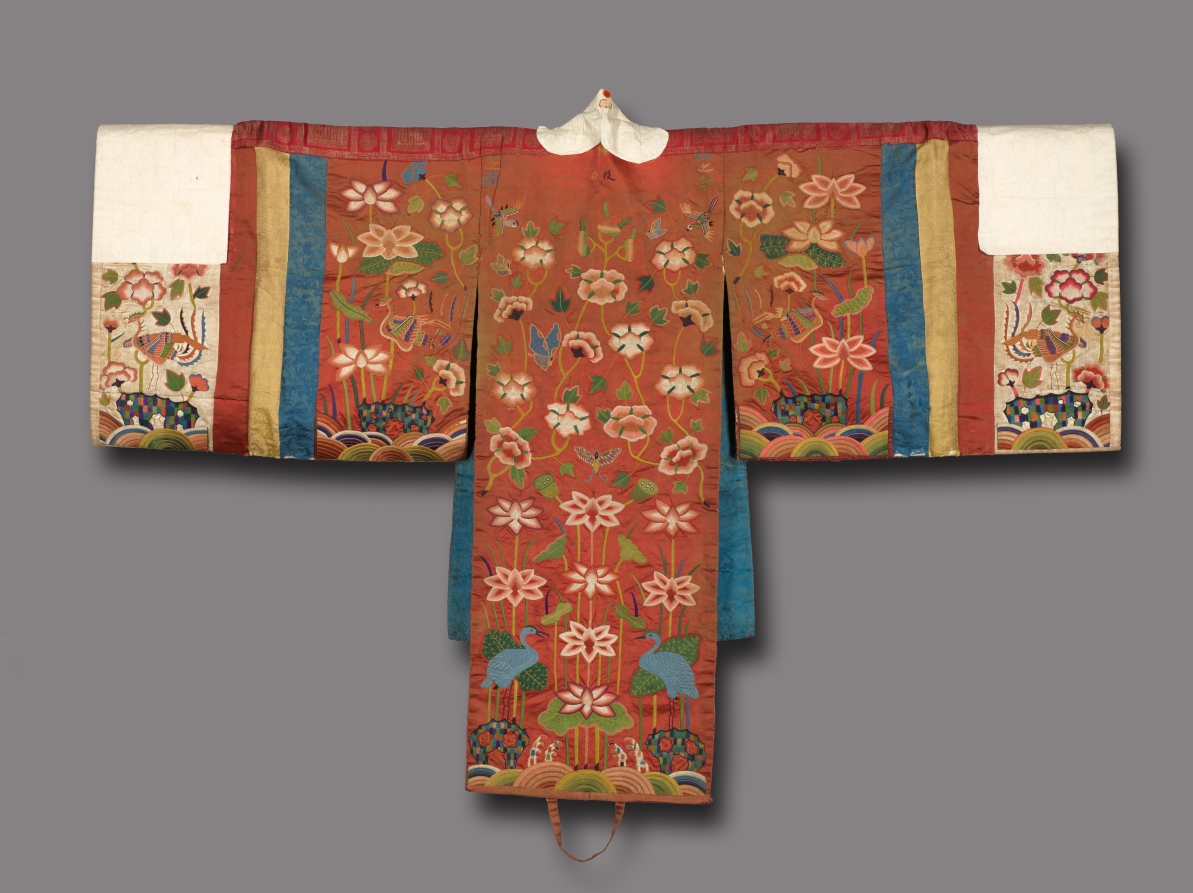
The Hwarot: A Testament to Imperial Silk Weaving’s Enduring Legacy
In the hushed ateliers of London’s Savile Row, where precision tailoring and cloth provenance are sacrosanct, we seldom pause to consider the profound heritage of silk—a fiber that has clothed emperors, brides, and dynasties for millennia. As Senior Heritage Specialist for the Lauren Fashion Heritage Lab, it is my privilege to present a scholarly artifact that bridges the ceremonial grandeur of East Asia with the tactile, material rigor we champion in bespoke tailoring. The subject: the Hwarot, a bridal robe of extraordinary materiality, woven from silk and steeped in the legacy of imperial silk weaving. This artifact is not merely a garment; it is a document of power, artistry, and the immutable bond between fiber and culture.
Materiality: The Silk of Empires
At its core, the Hwarot is a study in silk—specifically, the mulberry silk (Bombyx mori) that defined the imperial looms of Joseon-dynasty Korea (1392–1910). Unlike the coarser tussar silks of India or the wild silks of China’s hinterlands, the silk used for a Hwarot was cultivated with exacting precision. The silkworms were fed exclusively on mulberry leaves, yielding filaments of unparalleled fineness—often measuring between 1.5 and 2.5 deniers per thread. This allowed for a count of 200 to 300 warp threads per inch, a density that rivals the finest Savile Row super 150s wool. The result was a fabric that possessed both a liquid drape and a structural integrity capable of supporting intricate embroidery and gold-leaf appliqué.
The weave structure of the Hwarot is typically a satin or damask ground, often with a twill-derived pattern. This is not accidental. The satin weave, with its long floats, maximizes the luster of the silk, creating a surface that catches light like still water—a visual metaphor for the bride’s purity and the dynasty’s stability. In imperial workshops, the silk was dyed using natural pigments: cinnabar for red, indigo for blue, and safflower for pink. These dyes were not merely aesthetic; they were talismanic. Red, for instance, symbolized protection against evil spirits, while blue denoted heaven’s favor. The silk itself, before any embroidery, was a statement of imperial monopoly—only the court could commission such densities and hues.
Context: The Legacy of Imperial Silk Weaving
To understand the Hwarot, one must first appreciate the legacy of imperial silk weaving in East Asia. This is not a craft born of cottage industry but of state-controlled manufactories. In Joseon Korea, the Joseon Court Workshop (Gwansang) oversaw every stage of production, from silkworm rearing to loom operation. The silk used for a Hwarot was woven on a drawloom, a complex apparatus requiring two artisans: one to operate the treadles, another to pull the pattern cords. This technique, known as geumbak (gold-leaf imprinting), allowed for the creation of repeating motifs of phoenixes, peonies, and cranes—symbols of marital bliss, wealth, and longevity. The drawloom’s capacity for intricate repeats (often 12 to 18 inches per pattern cycle) meant that the Hwarot’s design was not merely decorative but narrative, telling a story of cosmic harmony.
Imperial silk weaving also imposed a hierarchy of materiality. The Hwarot was reserved for royal brides or those marrying into the aristocracy. Commoners wore simpler wonsam robes of ramie or cotton. This distinction was enforced by sumptuary laws that dictated thread count, color, and motif. For example, the use of gold-wrapped silk thread (geumsa) was restricted to the court. This thread, made by wrapping a thin strip of gold leaf around a silk core, was so precious that it was often recycled from previous garments. The Hwarot thus became a repository of imperial wealth—a wearable treasury.
Construction and Craft: The Savile Row Parallel
From a tailoring perspective, the Hwarot’s construction reveals a sophistication that resonates with Savile Row’s ethos of bespoke precision. The robe is cut in a T-shaped silhouette, with wide sleeves and a deep V-neckline. This simplicity belies its complexity: the garment is assembled from multiple panels, each cut on the bias to ensure the silk’s drape falls uniformly. The seams are finished with a flat-felled or French seam, a technique familiar to any London cutter, which prevents fraying and maintains the robe’s structure over decades of ceremonial use. The lining, often of a contrasting silk (typically blue or green), is attached with a floating lining—a method that allows the outer silk to move independently, reducing stress on the embroidery.
The embroidery itself is a marvel of hand-stitched precision. Using a combination of satin stitch, couching, and seed stitch, artisans would spend up to six months embroidering a single Hwarot. The motifs are not random but follow a strict iconographic code. A phoenix, for instance, must have five tail feathers (representing the five virtues), while peonies must be depicted in full bloom (symbolizing prosperity). The thread count for embroidery is astonishing: 80 to 100 stitches per square inch, using silk thread as fine as 40 denier. This density ensures that the embroidery does not pucker or distort the silk ground—a lesson in tension control that any Savile Row tailor would admire.
Preservation and Legacy: A Living Artifact
Today, the Hwarot exists as both a museum artifact and a living tradition. The National Museum of Korea in Seoul houses several examples, some dating to the 17th century. Their condition is remarkable: the silk retains its luster, the gold thread its sheen. This is due to the inherent stability of mulberry silk, which, when stored in controlled humidity (50–60%) and away from UV light, can last centuries. The legacy of imperial silk weaving is also preserved in the Intangible Cultural Heritage designation of geumbak and jogakbo (patchwork wrapping cloths), which continue to be practiced by master artisans in Korea.
For the Lauren Fashion Heritage Lab, the Hwarot is a case study in material integrity. It reminds us that silk is not merely a luxury fiber but a cultural document. The imperial looms that produced it were the precursors to the mechanized mills of Lyon and Como, yet they retained a human touch that modern manufacturing cannot replicate. In an era of fast fashion, the Hwarot stands as a testament to the slow, deliberate craft that defines true heritage. As we in Savile Row continue to champion bespoke tailoring, we would do well to remember that the Hwarot’s silk was not woven for commerce but for ceremony—a reminder that the finest cloth is always an act of devotion.
Conclusion: The Hwarot is more than a bridal robe; it is a material artifact of imperial power, a masterclass in silk weaving, and a bridge between East Asian tradition and global tailoring. Its legacy endures in every hand-finished seam and every carefully dyed thread. For the scholar, the collector, or the tailor, it offers a singular lesson: that true luxury is not about excess but about intention, provenance, and the unbroken chain of human skill.