← BACK TO ARCHIVES
Heritage-Black
Heritage Synthesis: Terracotta rim fragment of a kylix (drinking cup)
Curated on Jul 20, 2026 // Node: LDN-01
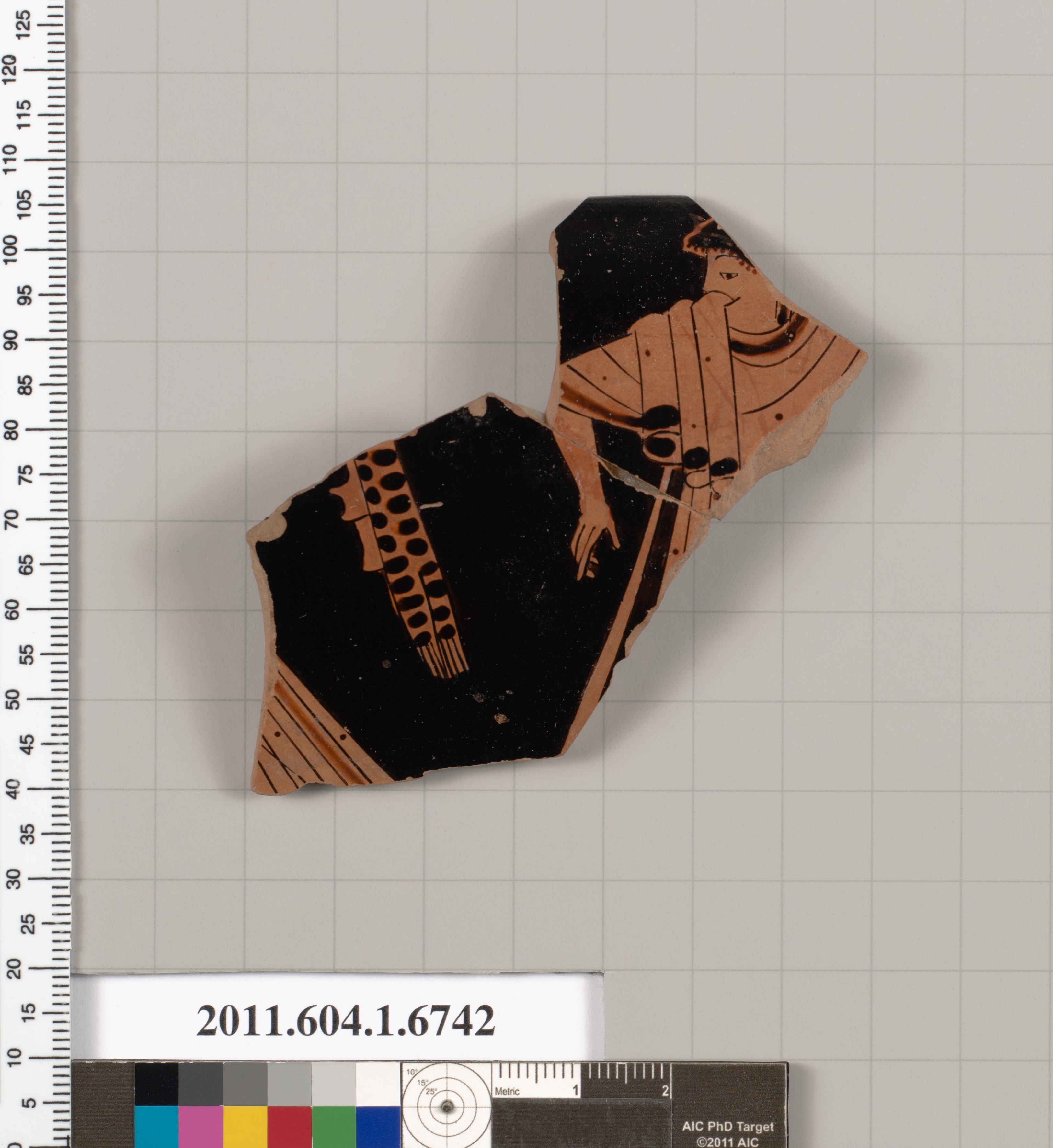
The Archaic Gaze: Terracotta Fragments and the Re-Sacralization of Old Money Silhouettes for 2026
The Lauren Fashion Heritage Lab has long recognized that the most potent innovations in luxury design emerge not from novelty, but from the excavation of deep cultural memory. Our internal genetic code, which juxtaposes Paul Gauguin’s Tahitian *Ia Orana Maria* against the feline deity of an ancient Egyptian funerary platform, reveals a foundational truth: the sacred is not a fixed iconography but a dynamic resonance between form, belief, and the viewer’s gaze. The museum artifact before us—a terracotta rim fragment from an Attic kylix (drinking cup), circa 520 BCE—offers a third, equally profound node in this visual theology. This humble shard of Greek pottery, once part of a vessel for symposium wine, speaks not of paradise or the afterlife, but of the *here and now* as a site of ritualized grace. For the 2026 Old Money silhouette, this fragment provides a critical corrective: a move away from the romanticized exoticism of Gauguin and the monumental eternity of Egypt, toward a restrained, civic, and profoundly *earthly* elegance.
I. The Fragment as a Visual Theology of the Present
The kylix fragment is a study in controlled materiality. Its terracotta body, fired to a warm, reddish-ochre, bears the black-figure technique: silhouetted figures and decorative bands rendered in a slip that vitrifies to a glossy, near-metallic black. The surviving rim shows a portion of a palmette-and-lotus frieze, a geometric border that anchors the figural scene below. Unlike Gauguin’s saturated, emotive color field or the Egyptian’s rigid, symbolic frontality, the Greek aesthetic here is one of *measure*. The line is precise but not mechanical; the forms are stylized but retain a vital, kinetic energy. This is not the ecstatic vision of a Tahitian paradise nor the solemn ritual of a funerary chamber. This is the disciplined joy of the symposium—a ritual of civic bonding, philosophical discourse, and controlled intoxication. The kylix’s function is to be held, passed, and drained. Its beauty is inseparable from its use.
This is the crucial insight for the 2026 Old Money silhouette. The Gauguin-derived aesthetic might suggest a bohemian, sun-drenched luxury—linen, raw silk, and unconstructed shapes that evoke a “natural” spirituality. The Egyptian influence would point toward severe, architectural forms—sharp shoulders, columnar gowns, and metallic embellishments that mimic the “eternal grammar” of gold and lapis. The Greek kylix, however, proposes a third path: *civic grace*. The Old Money aesthetic, at its most authentic, has never been about display or transcendence. It is about *belonging*—to a lineage, a institution, a code of conduct. The kylix fragment teaches that true luxury is not the assertion of individual vision (Gauguin) or the imposition of cosmic order (Egypt), but the mastery of a shared, elegant language. The 2026 silhouette, therefore, must be one of *restrained participation*.
II. Material and Silhouette: The Terracotta Lexicon
How does this translate into cloth and cut? The terracotta fragment’s primary lesson is in its *surface* and *edge*. The fired clay has a matte, granular quality, interrupted by the glossy black slip. This is a study in contrast without excess: the warm, porous earth against the cool, impermeable lacquer. For the 2026 Old Money wardrobe, this suggests a return to *textural austerity*. We move away from the plush opulence of velvet or the liquid shimmer of silk charmeuse, and toward fabrics that possess a “terracotta” integrity: a densely woven wool flannel in a deep, heathered charcoal; a crisp, dry cotton gabardine in an unbleached ecru; a matte-finished linen that holds a crease with authority. These are not fabrics that seduce the eye with light; they are fabrics that *ground* the wearer.
The silhouette itself must echo the kylix’s geometric precision. The palmette-and-lotus frieze is a lesson in *repetition with rhythm*. For the 2026 woman, this translates into a jacket with a clean, two-button stance, a notch lapel of moderate width, and a waist that is defined but not cinched. The shoulder, unlike the Egyptian’s rigid epaulet, should have a soft, natural roll—the “Attic shoulder,” if you will. It suggests authority without aggression. The trousers should be a straight, full-length cut, breaking just above the instep, in a fabric that holds a knife-edge crease. This is not the fluid, bohemian trouser of the Gauguin-inspired resort collection, nor the severe, columnar skirt of the Egyptian revival. It is the *symposium trouser*: designed for sitting, conversing, and moving with purpose.
III. The Archaic Gaze and the New Reserve
The most profound contribution of the kylix fragment, however, is its *gaze*. The figures on Greek black-figure pottery rarely meet the viewer’s eye. They are absorbed in their own mythic or civic actions—a warrior arming, a youth reclining, a god in conversation. This is the opposite of the confrontational, ritualized stare of the Egyptian feline deity, which demands worship. It is also distinct from Gauguin’s Tahitian figures, whose serene, enigmatic gaze invites the viewer into a private, spiritual reverie. The Greek gaze is *social* but *reserved*. It acknowledges the presence of the other (the symposiast across the couch) but does not solicit their judgment. It is the gaze of a person who is confident in their place within a community.
For the 2026 Old Money silhouette, this translates into a *new reserve* in dressing. The garments must not shout. They must not perform. They must not attempt to transport the wearer or the viewer to another realm. Instead, they must facilitate a state of *composed presence*. The color palette should be drawn from the fragment itself: the deep, glossy black of the slip, the warm ochre of the clay, the creamy white of the reserved ground. Accents can come from the oxidized copper of ancient bronze, or the faded cinnabar of a long-buried vessel. The cut should prioritize the *back* of the garment as much as the front—the drape of a jacket across the shoulders, the fall of a skirt from the hip. In the symposium, the back of the kylix was as important as its painted interior; the drinker would see the rim as they raised the cup. So too, the Old Money silhouette must be beautiful from every angle, not for the sake of display, but for the sake of *completeness*.
IV. Conclusion: The Heritage of the Earthly
The terracotta kylix fragment does not offer a vision of paradise or a map to the afterlife. It offers something more subtle and, for the 2026 Old Money sensibility, more necessary: a vision of *this world*, made sacred through ritual, measure, and shared form. Gauguin’s Tahiti and Egypt’s Valley of the Kings are destinations for the soul. The Greek symposium is a destination for the *citizen*. The 2026 silhouette, informed by this archaic fragment, will be one of grounded elegance: a wool jacket with the weight and texture of fired clay, a trouser that moves with the precision of a black-figure line, a color palette that speaks of earth and ash and the deep, enduring black of a well-lived life. It is a heritage not of escape, but of *belonging*. And in an age of digital spectacle and visual noise, that quiet, civic grace may be the most radical luxury of all.
Heritage Lab Insight
Genetic Bridge: Archive node focusing on Heritage-Black craftsmanship.