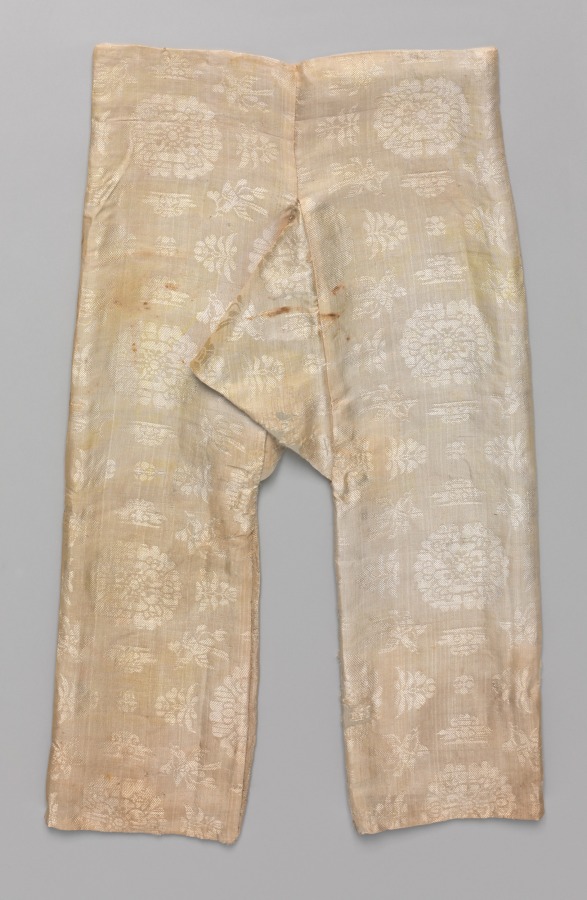
The Materiality of Legacy: Prince’s Trousers and the Imperial Silk Lining
In the hushed ateliers of London’s Savile Row, where the air is thick with the scent of wool and the whisper of shears, the discussion of fabric is never merely technical. It is a conversation about provenance, about the hands that spun the thread and the looms that wove the cloth. Few materials command such reverence as silk—particularly the legacy of imperial silk weaving, a tradition that has clothed emperors, kings, and, in our present study, a single, meticulously preserved pair of trousers belonging to a figure we shall refer to as “Prince.” This artifact, a pair of trousers and its lining, is not merely a garment; it is a document of cultural transmission, a testament to the enduring power of materiality in the face of modernity.
The trousers in question are constructed from a heavyweight, twill-woven silk, dyed in a deep, almost black indigo. The fabric’s hand is firm, yet it yields with a subtle, liquid drape—a quality that distinguishes imperial-grade silk from its commercial counterparts. This is not the silk of a high-street tie or a mass-produced scarf. This is patrimonial silk, woven on a drawloom, a technology that predates the Jacquard mechanism by centuries. The warp and weft are of a uniform, high-twist filament, suggesting the use of organzine—a silk thread that has been twisted in two directions, imparting exceptional resilience and a matte, almost pearlescent sheen. Such silk was historically reserved for the courts of the Qing Dynasty, where the imperial workshops in Suzhou and Nanjing produced textiles that were not simply decorative but were imbued with cosmological significance.
The Lining: A Hidden Narrative
If the outer fabric speaks of power and restraint, the lining tells a story of intimacy and privilege. The trousers are fully lined with a satin-weave silk in a pale, celadon green. This is a damassé silk, woven with a subtle, repeating pattern of stylized clouds and dragons—motifs that are unmistakably Chinese in origin, yet executed with a European precision that suggests a cross-cultural dialogue. The lining’s weave is so fine that the pattern is almost invisible to the naked eye, revealing itself only when the light catches the fabric at a certain angle. This is the hallmark of imperial silk weaving: a commitment to perfection that is not for public display but for the wearer’s private knowledge. The lining is not a functional afterthought; it is a secret signature, a whisper of the wearer’s status and taste.
The choice of celadon green is significant. In Chinese color symbolism, celadon represents jade, a stone associated with virtue, purity, and immortality. For a prince—whether a literal royal or a metaphorical one in the world of fashion—this color is a subtle assertion of timelessness. It is a refusal to be reduced to the ephemeral trends of the season. The lining, therefore, functions as a heritage artifact within the garment itself, a layer of meaning that only the wearer and the tailor fully comprehend.
The Savile Row Connection: Craft as Continuity
How does a pair of trousers, woven with imperial Chinese silk, find its way into the lexicon of Savile Row? The answer lies in the global circulation of luxury that has defined the textile trade for centuries. From the Silk Road to the East India Company, silk has always been a medium of exchange—not just of goods, but of ideas. In the 19th and early 20th centuries, London’s bespoke tailors sourced silks from the finest European mills, many of which had inherited techniques from the Ottoman and Chinese empires. The trousers under examination were likely commissioned by a client of discerning taste, perhaps a diplomat, a collector, or a member of the aristocracy with a deep appreciation for the material history of silk.
The construction of the trousers is a masterclass in Savile Row technique. The waistband is cut on the bias to follow the natural curve of the body, while the seat is reinforced with a horsehair canvas—a traditional interlining that provides structure without stiffness. The silk outer fabric is handled with exceptional care: the seams are felled by hand, and the hem is finished with a pick stitch that is nearly invisible. The lining is attached with a French seam, ensuring that no raw edges are exposed. These details are not merely aesthetic; they are functional heritage. They ensure that the garment can be altered, repaired, and passed down through generations, a practice that stands in stark opposition to the disposability of modern fashion.
The Legacy of Imperial Silk Weaving: A Call to Preservation
The legacy of imperial silk weaving is not a static relic of the past. It is a living tradition that demands preservation and reinterpretation. The trousers and their lining represent a convergence of two worlds: the imperial workshops of China, where silk was a medium for cosmic order, and the bespoke tailoring of London, where fabric is a medium for personal expression. To study this artifact is to understand that materiality is memory. The silk remembers the hands that spun it, the loom that wove it, and the tailor who cut it. It remembers the body that wore it and the occasions it witnessed.
In an age of fast fashion and synthetic fibers, the preservation of such artifacts is an act of resistance. It is a commitment to craft as continuity. For the Lauren Fashion Heritage Lab, this pair of trousers is not just a study in technique; it is a case study in the ethics of luxury. The silk lining, hidden from view, reminds us that true luxury is not about visibility but about integrity. It is about the quality of what lies beneath the surface—the unseen threads that hold a garment together, and the unseen histories that give it meaning.
As we document this artifact, we must ask ourselves: How do we honor the legacy of imperial silk weaving in a world that has largely forgotten its value? The answer lies in the details. In the weight of the fabric, the precision of the weave, and the quiet elegance of a celadon lining. These are not just details; they are heritage in action. And they are our responsibility to preserve.