← BACK TO ARCHIVES
Heritage-Black
Heritage Synthesis: Terracotta fragments of kylikes (drinking cups)
Curated on Jul 20, 2026 // Node: LDN-01
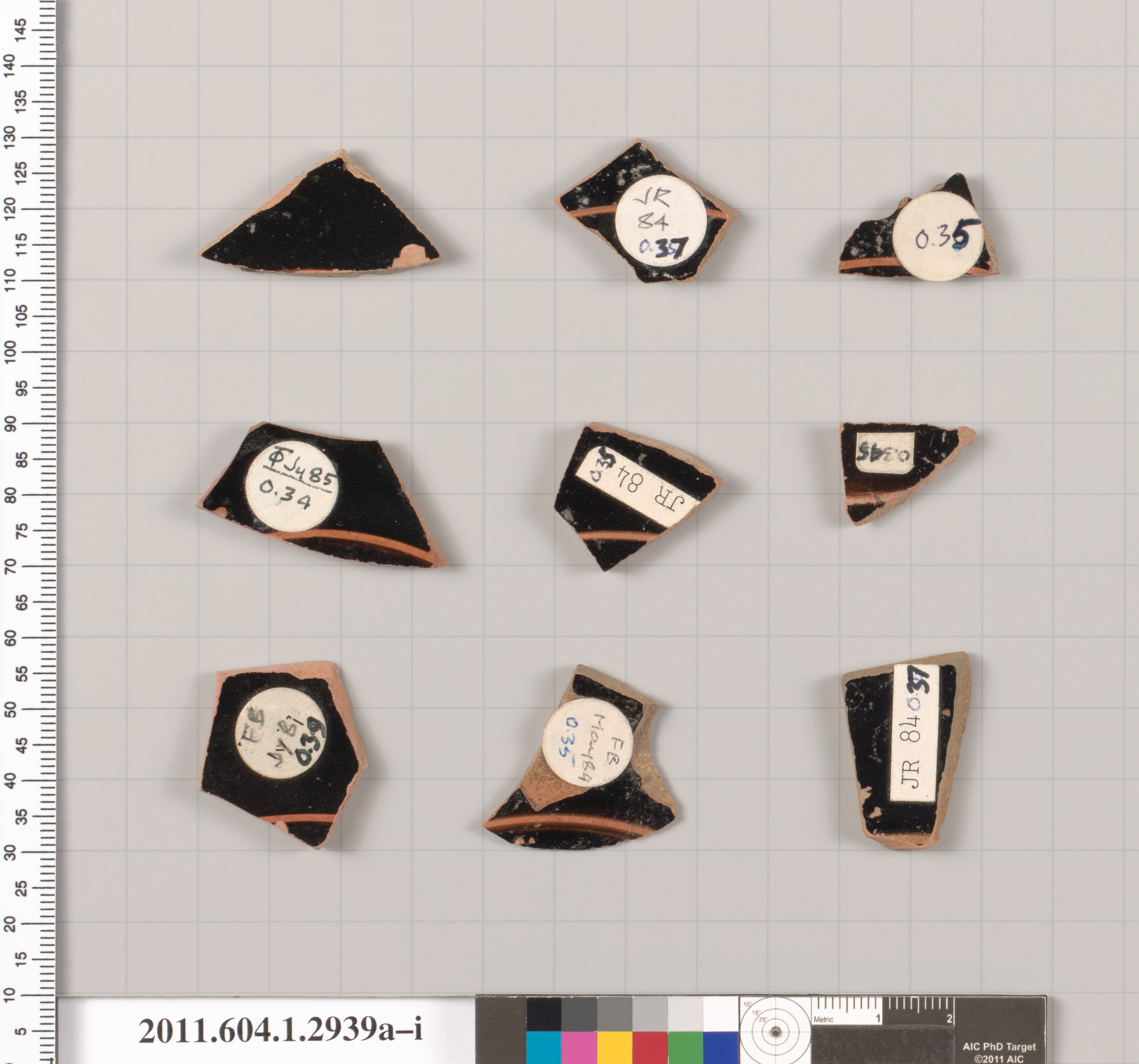
The Archaeology of Restraint: Terracotta Kylikes and the 2026 Old Money Silhouette
In the quiet dialogue between a ceramic *Bodhisattva*’s serene contour and the abstract strata of a *Fibrolite* sample, we uncovered a shared language of chromatic discipline and spatial breathing. This internal genetic code—rooted in the “wisdom of subtraction” and the poetics of negative space—now finds an unexpected yet profoundly resonant interlocutor in a set of museum artifacts: the terracotta fragments of Attic kylikes (drinking cups) from ancient Greece. These shards of everyday ritual, broken yet eloquent, offer a material and philosophical template for the 2026 Old Money silhouette. They do not shout; they *endure*. They do not dazzle; they *compose*. In their fractured surfaces and restrained geometries, we discover the heritage-black essence of a luxury that is earned, not displayed.
I. The Materiality of Silence: Terracotta as a Design Primer
The kylix fragments, fired from common Attic clay, possess a chromatic range that mirrors the *Bodhisattva*’s “moon-white and indigo-azure” gradient. Their surfaces, ranging from a warm, ochre-buff to a deep, charcoal-grey where carbon has seeped into the porous body, demonstrate a palette limited to earth tones and shadow. This is not a palette of poverty but of *intention*. The Old Money aesthetic for 2026, as synthesized from this artifact, rejects synthetic brilliance in favor of what the internal code calls “micro-gradients”—shifts in value and saturation that are barely perceptible yet deeply felt. The kylix’s terracotta, like the *Bodhisattva*’s glaze, does not demand attention; it *invites* contemplation. For the 2026 silhouette, this translates into fabrics that mimic the clay’s matte finish and subtle tonal variation: heavyweight wool flannels in charcoal, taupe, and off-black; cashmere double-faced in shades of stone and ash; and silk twills that absorb light rather than reflect it. The silhouette is not a color story; it is a *material narrative*.
The kylix’s surface texture—slightly granular, with the faint striations of the potter’s wheel—offers a direct analogue for fabric development. The *Fibrolite* sample’s “layered transparency” finds its echo in the way terracotta’s slip (a liquid clay coating) can be applied in thin, overlapping washes, creating a depth that is not painted but *built*. For 2026, this inspires a new approach to suiting: a jacket constructed from a worsted wool whose warp and weft are dyed in near-identical hues but with different saturations, producing a subtle, optical vibration—a “breathing” surface that changes with the light. This is the antithesis of fast-fashion’s flat, digital colors. It is a luxury of *process*, not pigment.
II. The Geometry of the Fragment: Silhouette as Negative Space
The kylix is defined by its *function*: a shallow bowl for wine, raised on a stem, with two horizontal handles. Its silhouette is an exercise in balanced asymmetry—the bowl’s gentle curve, the stem’s slender verticality, the handles’ outward thrust. But the fragments we study are *broken*. A rim shard, a handle stub, a section of the foot. This incompleteness is not a flaw; it is the artifact’s most potent design lesson. The internal code speaks of “necessary incompleteness” and “visual breathing zones.” The kylix fragments embody this: the missing sections force the eye to *complete* the form, engaging the viewer in an act of co-creation. The 2026 Old Money silhouette must similarly operate through *implied* structure.
Consider the new coat silhouette: a long, lean line that falls from a slightly dropped shoulder, with sleeves cut in a single, continuous piece from the body (a kimono or dolman construction). There is no defined waist, no sharp lapel. The *shape* is suggested by the fabric’s fall and the body’s movement, much as the kylix’s bowl is suggested by its remaining arc. The “handle” of the garment becomes a subtle detail: a deep side slit, a hidden pocket, a seam that traces the arm’s natural rotation. These are the *fragments* of tailoring—functional, yet poetic. The silhouette is not a closed form but an open one, inviting the wearer to inhabit the negative space between cloth and body. This is the “breathing” quality of the *Bodhisattva*’s glaze-thin areas, now translated into the drape of a cashmere coat.
III. The Ritual of the Everyday: Old Money as a Practice of Restraint
The kylix was not a ceremonial object for the elite; it was the vessel of the *symposium*—a gathering of citizens for wine, conversation, and philosophy. Its terracotta was humble, its decoration often minimal (a simple black-figure band, a reserved clay ground). Its value lay not in precious materials but in its *use* and its *form*. This is the core of the 2026 Old Money ethos: luxury as a practice of daily life, not a spectacle. The internal code’s “silent aesthetics” finds its ultimate expression in the kylix’s refusal to be precious. It was made to be held, to be passed from hand to hand, to be broken and discarded. Its beauty was contingent on its function.
For the 2026 silhouette, this translates into a wardrobe of *essential forms*: a perfectly cut trouser in a heavy wool crepe; a cashmere turtleneck whose ribbing is so fine it feels like a second skin; a silk shirt with a collar that folds like a petal. These are not “statement” pieces. They are the *terracotta* of the wardrobe—the foundational vessels that hold the wearer’s day. The “decoration” is in the construction: a hand-finished buttonhole, a seam that is felled and invisible, a hem that is weighted with a silk thread. Like the kylix’s reserved clay ground, the garment’s surface is a field of *potential*, not a canvas for logos. The 2026 Old Money silhouette is, in essence, a *symposium* of details—each one a fragment of a larger, unspoken whole.
IV. The Heritage-Black Synthesis: From Shard to Silhouette
The terracotta fragments of Attic kylikes do not provide a direct pattern for a 2026 jacket. They provide a *method*. Their lesson is one of material honesty, geometric restraint, and the beauty of the incomplete. The *Bodhisattva* taught us about negative space; the *Fibrolite* taught us about layered depth. The kylix teaches us about *time*—the time of the potter’s wheel, the time of the symposium, the time of the shard that survives centuries. The 2026 Old Money silhouette must be designed with this temporal depth. It must feel as if it has always existed, as if it is a fragment of a longer, more refined tradition.
The heritage-black category, therefore, is not a color but a *condition*: the condition of being grounded in material truth, of using restraint as a form of expression, of allowing the wearer to complete the garment through their own presence. The terracotta kylix, in its brokenness, offers a complete philosophy for the coming season: luxury is not about having more, but about *being* more—in the silence of a well-cut coat, in the weight of a wool that breathes, in the fragment of a form that suggests the whole. This is the archaeology of restraint, and it is the foundation of the 2026 Old Money silhouette.
Heritage Lab Insight
Genetic Bridge: Archive node focusing on Heritage-Black craftsmanship.