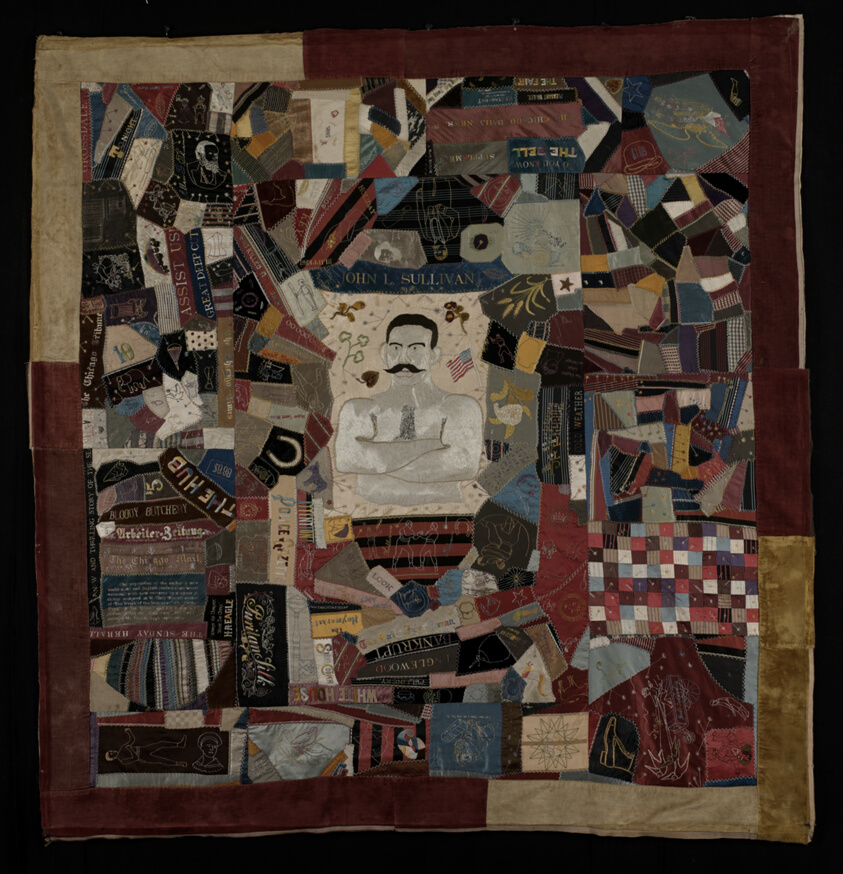
An Examination of the John L. Sullivan Quilt: Fabricating Legacy in the Gilded Age Parlour
Within the refined lexicon of gentlemanly attire, Savile Row speaks of lineage not through ostentation, but through the quiet authority of material, cut, and a profound understanding of tradition. It is a language of curated heritage. This same principle of constructing a narrative through exquisite materiality finds a remarkable, if more exuberant, parallel in the domestic sphere of the late 19th century, exemplified by the so-called John L. Sullivan "crazy" quilt. This artifact, a pieced and embroidered top of exceptional variety, operates not as mere bedding but as a deliberate tapestry of social aspiration, commemorative zeal, and masterful textile curation. Its foundation—its canvass, as it were—is the fluid elegance of silk, upon which a broader story of American identity is meticulously embroidered.
The Silk Ground: A Foundation of Status and Sensibility
To appreciate the artifact is to first acknowledge the primacy of its silk. In the 1880s, silk remained the undisputed apex of the textile hierarchy, a commodity synonymous with luxury, sophistication, and global trade. The quilt’s incorporation of plain, twill, satin, and velvet weaves in silk demonstrates a connoisseur’s eye for texture and light. The satin’s liquid sheen, the velvet’s plush depth, the crispness of a taffeta—each was selected with the same deliberate consideration a tailor affords to a bolt of English worsted or a length of Italian silk shantung for a bespoke waistcoat. This was no assemblage of scraps, but a curated collection of fabric samples, each a relic of a dress, a necktie, or a furnishing, repurposed with intent. The silk provides the essential ground of "fluid elegance," a unifying medium that elevates the entire composition from patchwork to patrimony.
Material Syntax: The Grammar of a "Crazy" Composition
The "crazy" nomenclature belies a rigorous underlying structure. Like the seemingly effortless drape of a morning coat, which conceals a complex architecture of canvas and stitch, the quilt’s apparent randomness is governed by unspoken rules. The irregular, angular patches are carefully fitted, a jigsaw of luxury. The material palette expands beyond silk to include dyed and printed cottons, fine wools, and metallic fabrics, introducing a democratic note of American industriousness alongside Old-World opulence. Ribbons, often of silk satin, act as borders and seams, functioning like the piping on a smoking jacket—a defining trim that contains and highlights.
This material syntax finds its most eloquent punctuation in the embroidery. Employing silk floss, metallic thread, and cotton, the needlework is the equivalent of hand-stitched buttonholes or monogrammed linen: the personalised signature of the maker. The stitches—feather, chain, satin—are executed with a precision that would satisfy a master tailor examining pick-stitching. They do more than adorn; they articulate, connect, and ultimately, they narrate.
Contextual Narrative: Stitching the Myth of the Boston Strong Boy
Herein lies the artifact’s profound cultural weight. It commemorates John L. Sullivan, the last heavyweight champion of bare-knuckle boxing and the first of the gloved era. Sullivan was not merely an athlete; he was a colossal figure in Gilded Age America, a symbol of rugged individualism, Irish-American ascendancy, and sheer, unadulterated power. To dedicate such a feminine, refined, and labour-intensive domestic object to this paragon of masculinity is a fascinating act of cultural alchemy.
The quilt transforms Sullivan’s brute force into a legacy suitable for the parlour. His image, likely transferred from a popular print or newspaper, is rendered in silk thread, softening his pugilistic scowl into an icon of celebrity. Embroidered motifs—shamrocks, American flags, laurel wreaths—stitch him firmly into narratives of ethnic pride and national identity. The inclusion of metallic threads catches the light, much like the gleam of a championship belt or the gilding on a frame. This artifact does not document a fight; it canonises a hero. It takes the ephemeral, often vulgar, spectacle of the prize ring and renders it permanent, respectable, and tactile, encasing Sullivan’s legacy in a cocoon of silk and careful stitchcraft.
Conclusion: A Bespoke Heritage
The John L. Sullivan quilt top, therefore, stands as a peerless example of heritage fabrication. It operates on multiple levels: as a display of textile virtuosity, with silk as its starring player; as a document of social history, mapping the intersection of celebrity, domesticity, and immigrant aspiration; and as a conscious construction of legacy. Like a Savile Row suit, it is bespoke—a one-of-a-kind creation tailored to fit a specific cultural moment and a specific legend. Its value lies not in any functional purpose as a coverlet, but in its embodiment of a process: the careful cutting, the thoughtful arrangement, the meticulous stitching of a story into being. It reminds us that heritage is not merely inherited; it is often painstakingly pieced together, from the finest materials available, and lined with the ambition of its maker. In its silent, sumptuous folds, the roar of the crowd is translated into the whisper of silk, and a champion is forever enshrined not in a ring, but in the exquisite, embroidered archive of the American home.