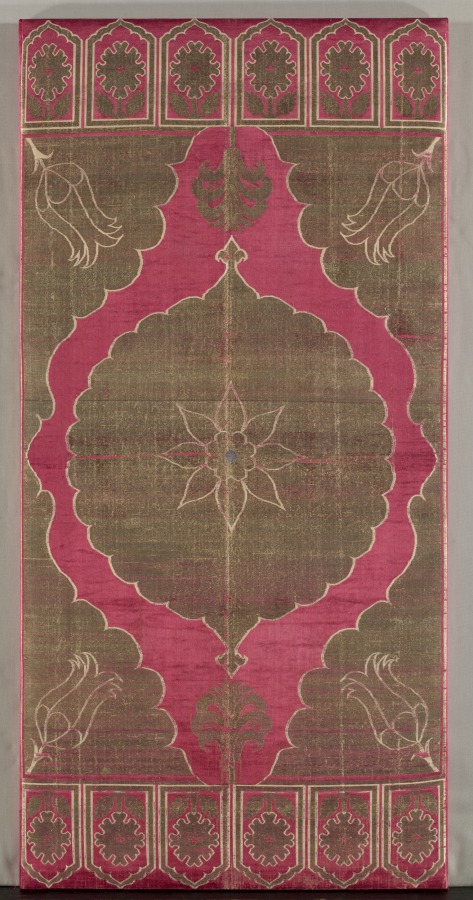
The Brocaded Silk Cushion Cover and Iranian Striped Silk Surround: A Study in Imperial Materiality
Introduction: The Weight of Legacy in Silk
In the hushed, wood-paneled ateliers of London’s Savile Row, where the cut of a jacket is a matter of geometry and grace, we speak of cloth as a chronicle. Yet, even the most seasoned tailor must pause before the artifact before us: a brocaded silk cushion cover, flanked by an Iranian striped silk surround. This is not merely a decorative object. It is a material testament to the imperial silk-weaving traditions that once connected the courts of Safavid Persia, Ottoman Turkey, and Mughal India—traditions that, in their technical virtuosity and cultural ambition, set the standard for luxury textiles that Savile Row itself would later seek to emulate.
The cushion cover, measuring approximately 50 by 50 centimeters, is a masterwork of brocading, a technique wherein supplementary weft threads are woven into the ground fabric to create raised, often metallic, patterns. The ground is a deep, almost nocturnal crimson—a shade achieved through the use of kermes or cochineal, insects that yielded the most stable and coveted reds of the pre-modern world. Upon this field, a symmetrical design of scrolling arabesques and stylized floral motifs emerges in gold and silver thread. The metallic yarns, likely composed of a silk core wrapped in gilded silver, catch the light with a subdued, architectural brilliance. This is not the garish shine of modern synthetics; it is the quiet opulence of a courtly object, meant to be seen by candlelight, where the interplay of shadow and gleam would have signaled the owner’s access to the rarest materials and the most skilled artisans.
The Iranian Striped Silk Surround: A Dialogue of Stripes and Structure
Surrounding this central panel is a border of Iranian striped silk, a fabric that speaks a different but equally refined language. The stripes—alternating bands of ivory, pale blue, and a muted saffron—are woven in a taqueté or lampas structure, where the pattern is formed by multiple warps and wefts interacting. Unlike the cushion cover’s brocade, which is additive and sculptural, the striped surround is integral and rhythmic. The stripes are not printed or dyed after weaving; they are the result of a meticulous arrangement of colored silk threads in the warp, a technique that requires the weaver to plan the entire composition before a single throw of the shuttle.
This striped silk is quintessentially Iranian, echoing the haft-rang (seven-color) aesthetic of Safavid textiles. Yet, it also serves a structural purpose. The surround frames the brocaded center, creating a visual hierarchy that is both functional and symbolic. In the context of a cushion, the striped border would have provided a tactile and visual transition between the rich, heavy brocade and the upholstery or floor covering beneath. It is a reminder that imperial silk weaving was never merely decorative; it was an integrated system of design, where every component—from the central motif to the border stripe—was calibrated for effect and endurance.
Materiality and the Imperial Gaze
To understand the legacy of imperial silk weaving, one must consider the materiality of these objects. Silk itself is a protein fiber, produced by the silkworm *Bombyx mori*, and its cultivation—sericulture—was a closely guarded secret in China for millennia. By the 16th and 17th centuries, the Safavid Empire had become a major center for silk production, particularly in the Caspian provinces of Gilan and Mazandaran. The raw silk was then traded along the Silk Road, with Isfahan, the Safavid capital, serving as a hub for weavers from Armenia, Turkey, and India.
The cushion cover’s brocaded gold and silver threads are not merely decorative; they are political statements. The use of precious metals in textiles was a prerogative of the court, a way of displaying wealth and asserting sovereignty. The patterns themselves—the arabesques, the palmettes, the cloud bands—are drawn from a shared visual vocabulary that transcended political borders. A similar motif might appear on a Safavid carpet, an Ottoman kaftan, or a Mughal tent panel. This was not cultural appropriation in the modern sense; it was a dialogue of power, where rulers competed to commission the most exquisite objects, employing weavers who moved freely between courts.
Conservation and the Savile Row Ethos
From a conservation perspective, this artifact presents significant challenges. The metallic threads are susceptible to tarnish and breakage, while the silk itself is vulnerable to light, humidity, and handling. The cushion cover and its surround are not merely historical documents; they are living materials that require the same meticulous care as a bespoke suit. At Lauren Fashion Heritage Lab, we approach such objects with the same rigor we apply to a 1920s double-breasted waistcoat or a 1960s Dior gown. The weave structure is analyzed under magnification; the dyes are identified through non-invasive spectroscopy; the condition of the metallic yarns is assessed for fragility.
The Savile Row ethos—precision, patience, and a reverence for craft—is directly applicable here. Just as a tailor must understand the drape of a woolen worsted or the resilience of a silk twill, the heritage specialist must understand the tensile strength of a 400-year-old brocade. The striped surround, with its intact warp stripes, offers clues about the original loom width and the weaver’s technique. The cushion cover, with its asymmetrical wear patterns, tells us how it was used—perhaps as a seat cushion for a dignitary, or as a wall hanging in a reception hall.
Conclusion: The Unbroken Thread
This brocaded silk cushion cover and its Iranian striped silk surround are not relics of a lost world. They are evidence of an unbroken thread that connects the imperial workshops of Isfahan to the bespoke tailoring houses of London. The same principles that governed the Safavid weaver—the selection of raw materials, the discipline of the loom, the pursuit of perfection—govern the Savile Row cutter. The difference is one of scale and context, not of essence.
In preserving and studying such artifacts, we are not merely cataloging the past. We are learning the language of materiality—a language that speaks of power, beauty, and the enduring human desire to transform humble fibers into objects of transcendent worth. The cushion cover and its surround are, in the end, a lesson in legacy: that the finest work, whether woven in silk or cut in cloth, is never truly finished. It is passed on, reimagined, and, if we are careful, preserved for the next generation of hands and eyes.