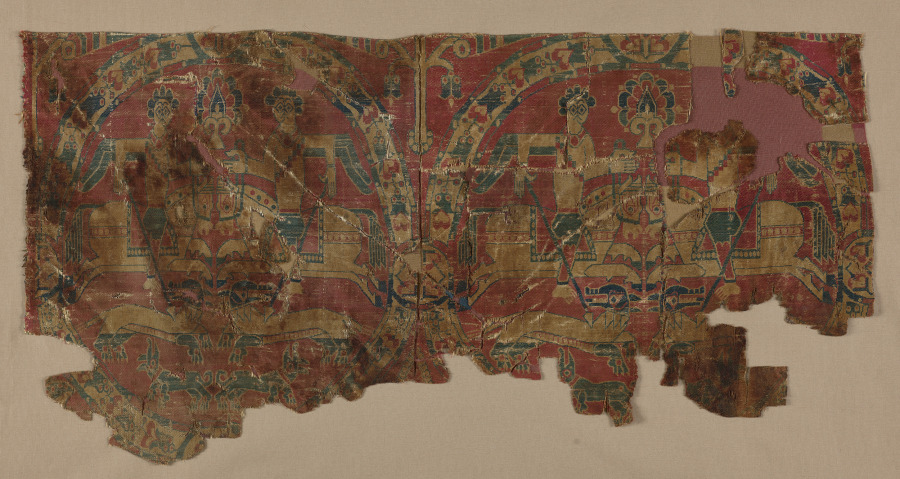
Heritage Research Artifact: Roundels with Hunters in Silk
Introduction: The Imperial Thread
In the rarefied world of heritage textiles, few artifacts command the same reverence as the Roundels with Hunters woven in silk. This piece, a testament to the legacy of imperial silk weaving, embodies the confluence of artistry, power, and materiality that defined the great silk routes and the courts they served. As a Senior Heritage Specialist at Lauren Fashion Heritage Lab, I approach this artifact not merely as a decorative object but as a document of cultural memory, a technical marvel, and a source of enduring inspiration for contemporary luxury. The roundel, a circular motif often used in ceremonial garments and furnishings, transcends its physical form to narrate a story of dominion, craftsmanship, and the timeless allure of silk.
Materiality: The Silk Imperative
Silk, the foundation of this artifact, is a material that demands precision and respect. Its natural sheen, tensile strength, and ability to absorb dye with unparalleled vibrancy made it the preferred medium for imperial weavers. The Roundels with Hunters exemplify the sophisticated techniques of compound weave structures, likely using a warp-faced or weft-faced satin ground to achieve a lustrous backdrop. The hunters, depicted in dynamic poses, are rendered through intricate brocading or lampas weaving, where supplementary wefts create raised patterns that catch light differently, lending a three-dimensional quality to the silk. This materiality is not incidental; it is deliberate. The silk’s fluidity and durability ensured that these roundels could adorn the shoulders of emperors or the walls of palaces, surviving centuries as markers of status and taste.
Iconography: The Hunt as Power Metaphor
The iconography of the hunt in these roundels is a sophisticated visual language. Hunters, often mounted on horseback or accompanied by falcons and hounds, are not mere genre scenes. They are allegories of imperial authority, reflecting the ruler’s dominion over nature and, by extension, his realm. In the context of imperial silk weaving, such motifs were standardized across the Persian, Byzantine, and Chinese traditions, yet each culture infused them with distinct symbolism. For instance, in Sasanian Persia, the hunt was a royal prerogative, symbolizing the king’s role as protector and provider. The roundel format, with its circular boundary, contains this narrative within a perfect, unbroken line—a metaphor for eternity and the cyclical nature of power. The silk’s ability to hold these intricate details, from the tension in a hunter’s bow to the texture of a horse’s mane, elevates the artifact from craft to fine art.
Technical Mastery: The Weaver’s Legacy
The production of such roundels required an extraordinary level of technical mastery. Imperial silk weaving was a state-sponsored enterprise, with workshops employing hundreds of artisans who guarded their techniques as closely as state secrets. The Roundels with Hunters likely involved a drawloom, a complex apparatus that allowed for the manipulation of individual warp threads to create repeating patterns. The weaver’s skill lay in translating a cartoon or design into a woven fabric, where every thread had to be accounted for. The silk itself was often sourced from the finest silkworms, degummed to achieve the desired luster, and dyed with natural pigments derived from insects, plants, and minerals. The result was a fabric that was not only visually stunning but also structurally resilient, capable of withstanding the rigors of ceremonial use and storage over centuries.
Cultural Context: The Silk Road and Beyond
The legacy of imperial silk weaving is inextricably linked to the Silk Road, a network of trade routes that facilitated the exchange of goods, ideas, and aesthetics. The Roundels with Hunters are a product of this cross-cultural pollination. The motif of the hunt, for example, appears in early Chinese silk textiles, where it was associated with the hunt of the emperor, and later in Byzantine silks, where it was adapted for Christian iconography. The roundel format itself, with its geometric precision, reflects influences from Central Asian nomadic cultures, who used similar motifs in felt and leather. This artifact, therefore, is not a singular creation but a synthesis of multiple traditions, each layer adding to its richness. For the modern luxury industry, this cross-cultural heritage offers a template for how to honor tradition while embracing global influences—a lesson that resonates deeply on Savile Row, where tailoring is both a craft and a conversation with history.
Preservation and Interpretation: The Heritage Specialist’s Role
As a heritage specialist, my role is to preserve not just the physical artifact but its narrative. The Roundels with Hunters require careful conservation, including controlled humidity, light exposure, and handling protocols to prevent degradation. Yet, preservation is not an end in itself. Interpretation is key. By analyzing the weave structure, dye composition, and iconographic details, we can reconstruct the context in which this silk was made and used. For instance, the presence of gold-wrapped threads or specific color palettes might indicate a royal commission, while wear patterns could suggest use as a saddle cloth or a ceremonial robe. This forensic approach allows us to tell a story that is both accurate and evocative, bridging the gap between ancient craftsmanship and contemporary design.
Contemporary Relevance: A Savile Row Perspective
For the discerning clientele of London’s Savile Row, the Roundels with Hunters offer a profound lesson in quality and narrative. The silk’s materiality—its hand, its drape, its light—is the very essence of luxury. The roundel’s design, with its balance of symmetry and dynamism, speaks to the principles of bespoke tailoring: precision, proportion, and personality. In an era of fast fashion, this artifact reminds us that true heritage is not static but iterative. The hunters, frozen in silk, are not relics; they are archetypes of the modern gentleman—active, discerning, and connected to a lineage of taste. At Lauren Fashion Heritage Lab, we draw on such artifacts to inspire collections that honor the past while defining the future. The roundel’s circular form, for example, might be reinterpreted as a pocket square pattern or a lining motif, its silk woven with the same reverence for materiality that defined its imperial origins.
Conclusion: The Enduring Thread
The Roundels with Hunters in silk are more than a heritage artifact; they are a testament to the enduring power of craftsmanship. From the imperial looms of antiquity to the ateliers of Savile Row, silk remains a medium of transformation, carrying the weight of history while adapting to new contexts. As we preserve and interpret these roundels, we affirm that luxury is not about excess but about meaning. Every thread tells a story, and it is our privilege to ensure that story continues to be told, woven into the fabric of contemporary life with the same precision and passion that defined its creation.