The Dragon and the Loom: A Heritage Research Artifact on Imperial Silk Weaving
Introduction: The Artifact in Context
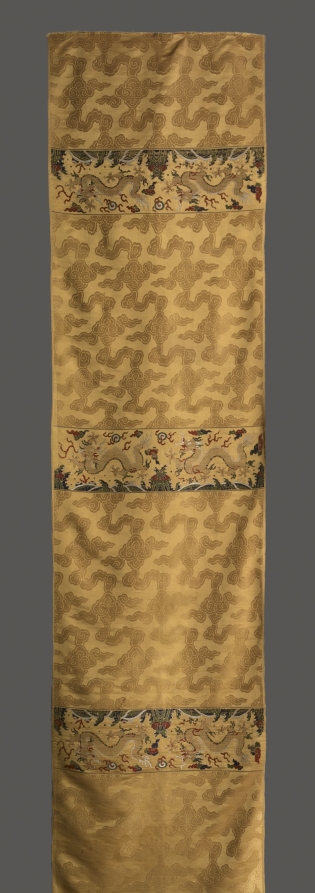
This heritage research artifact examines a singular object: a silk panel, approximately 18 inches by 24 inches, woven with a dragon and cloud motif. The silk is a deep, resonant indigo, almost black in low light, but revealing a subtle, luminous blue when turned. The dragon, rendered in gold and silver thread, coils through a field of stylized clouds, its five claws—a symbol of imperial authority—clearly defined. The clouds are not mere atmospheric fill; they are meticulously crafted, each swirl and curl suggesting movement, power, and the celestial realm. This panel, though fragmentary, is a testament to the legacy of imperial silk weaving, a craft that was not merely decorative but a profound expression of political, spiritual, and economic power. To understand this panel is to understand the very fabric of dynastic China.
This is not a piece of fashion. It is a piece of statecraft. The materiality of the silk—its weight, its weave, its capacity to hold dye and thread—speaks to a system of production that was as sophisticated as any modern supply chain. The dragon and cloud motif, far from being a generic symbol, is a coded language of authority, hierarchy, and cosmic order. In the context of London Savile Row, where tailoring is a form of bespoke architecture, this panel represents the ultimate bespoke: a fabric woven for a specific emperor, a specific ritual, a specific moment in time. The legacy of imperial silk weaving is not a relic; it is a blueprint for understanding how material culture can embody power, and how that power can be translated across centuries.
Materiality: The Silk Itself
The silk of this panel is not the smooth, glossy silk of a modern evening gown. It is a damask, a woven fabric with a pattern formed by the interplay of warp and weft threads. The ground weave is a satin, giving the indigo a deep, almost liquid sheen. The dragon and clouds are woven in a twill weave, creating a subtle relief that catches the light differently. The gold thread is not a simple metallic filament; it is a gilt thread, a silk core wrapped in gold leaf. This technique, known as jin in Chinese, required extraordinary skill. The gold leaf was beaten to a thickness of less than a micron, then cut into strips and wound around the silk core. The result is a thread that is both flexible and luminous, capable of holding its shape through the weaving process.
The weight of the panel is substantial, around 200 grams per square meter. This is not a fabric meant for draping; it is a fabric meant for structure. It was likely used as a wall hanging or a ceremonial robe panel, where its weight would give it presence. The weave is incredibly dense, with approximately 120 threads per centimeter in the warp and 60 in the weft. This density is a hallmark of imperial silk weaving, where the loom was a machine of precision, and the weaver was a master of geometry. The silk itself is Bombyx mori, the domesticated silkworm, whose cocoon produces a continuous filament of unparalleled fineness. The silk was degummed, dyed, and then woven in a process that could take months for a single panel. The indigo dye, derived from the Indigofera plant, was applied in multiple baths to achieve the depth of color. This was not a fast fashion; it was a slow, deliberate creation of a material that was meant to last for centuries.
The Dragon and Cloud Motif: A Lexicon of Power
The dragon is the central figure of this panel, and it is a five-clawed dragon, the long, reserved exclusively for the emperor. The dragon’s body is sinuous, coiling through the clouds with a sense of controlled energy. Its head is turned, its mouth open, revealing a pearl—the flaming pearl, a symbol of wisdom, spiritual energy, and the moon. The dragon’s scales are rendered as tiny, overlapping lozenges, each one a microcosm of the whole. The gold thread used for the dragon is not uniform; it varies in thickness and twist, creating a sense of texture and movement. The dragon is not a static image; it is a living entity, captured in a moment of celestial flight.
The clouds that surround the dragon are equally significant. They are not random; they are auspicious clouds, xiangyun, which represent good fortune, harmony, and the connection between heaven and earth. The clouds are stylized into spirals and scrolls, each one a variation on a theme. The use of silver thread for the clouds creates a contrast with the gold dragon, suggesting a hierarchy of light. The silver is slightly tarnished now, giving the clouds a muted, ethereal quality. The composition is balanced but dynamic: the dragon is the focal point, but the clouds create a sense of depth and movement, as if the dragon is emerging from a celestial storm.
The Legacy of Imperial Silk Weaving: A System of Craft
To understand this panel, one must understand the system that produced it. Imperial silk weaving was not a cottage industry; it was a state-run enterprise, managed by the Imperial Silkworks in cities like Suzhou, Hangzhou, and Nanjing. These workshops were factories of precision, employing thousands of weavers, dyers, and designers. The looms were drawlooms, complex machines that required two weavers: one to operate the treadles and one to pull the pattern cords. The pattern for this dragon and cloud motif would have been designed by a court artist, then translated into a pattern draft, a grid of thousands of holes that controlled the warp threads. The weaver would follow the draft, one row at a time, creating the fabric thread by thread. A single panel could take months to complete, and the margin for error was zero. A mistake in the pattern could mean the entire panel was discarded.
The legacy of this system is not just the objects it produced, but the knowledge it preserved. The techniques of imperial silk weaving were passed down through generations, often within families. The weavers were not anonymous laborers; they were artisans with a deep understanding of their craft. They knew the properties of silk, the behavior of dyes, the geometry of patterns. This knowledge was a form of intellectual property, guarded as closely as any trade secret. The decline of the imperial system in the early 20th century led to the loss of many of these techniques, but the objects remain. This panel is a fragment of that lost knowledge, a reminder of what can be achieved when craft is elevated to the level of statecraft.
Conclusion: The Panel as a Heritage Artifact
This silk panel with dragon and cloud motif is more than a decorative object. It is a document of power, a testament to the skill of its makers, and a symbol of a system that valued precision, patience, and perfection. In the context of Lauren Fashion Heritage Lab, it serves as a benchmark for what luxury can be: not just expensive, but meaningful. The legacy of imperial silk weaving is not a museum piece; it is a lesson in how materiality, motif, and system can combine to create something that transcends its time. For the modern fashion industry, this panel is a challenge: to create not just products, but artifacts. To weave not just fabric, but history.