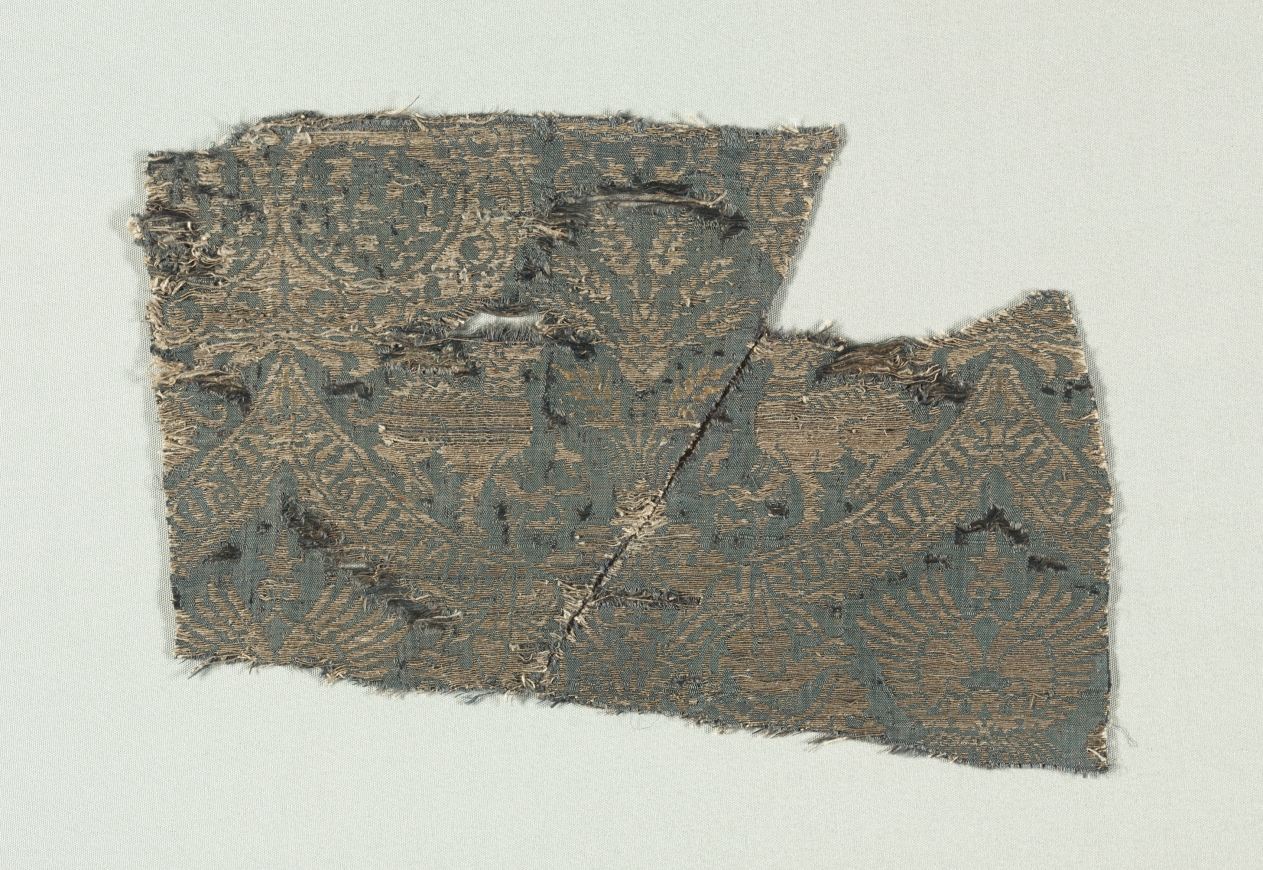
The Swaying Bands of Power: Decoding the Silk with Dogs and Arabic Script
In the hallowed ateliers of London’s Savile Row, where the cut of a coat is a silent declaration of lineage, we understand that true heritage is woven, not merely worn. The artifact before us—a fragment of silk bearing the enigmatic interplay of dogs and Arabic script within undulating, swaying bands—represents a pinnacle of imperial silk weaving, a testament to the confluence of art, power, and commerce that defined the great silk routes. As Senior Heritage Specialist for the Lauren Fashion Heritage Lab, I present this analysis not as a mere description of material, but as a scholarly dissection of a textile that speaks in the language of empires, luxury, and the enduring legacy of craftsmanship.
Materiality and the Imperial Loom
The foundation of this artifact is, unequivocally, silk. But not just any silk. This is a compound weave, likely a lampas or a samite, executed on a drawloom of exceptional complexity. The ground weave is a fine, tightly spun silk, likely from the Bombyx mori silkworm, cultivated in the imperial sericulture systems of the Safavid or Ottoman empires, or perhaps even the later Mughal courts. The weft, however, is where the narrative begins. The use of multiple weft threads—one for the ground, one for the pattern—allowed the weaver to create a polychrome effect, with the dogs and script rendered in a contrasting, often metallic or dyed silk, against a field of deep, resonant color. The swaying bands are not accidental; they are a structural feature, achieved through a technique known as “taqueté” or “lampas” weaving, where the pattern weft floats over the ground weave, creating a subtle, three-dimensional ripple. This is not a textile for the faint of heart; it is a textile of authority, designed to catch the light and command attention in the dimly lit courts of Isfahan, Istanbul, or Agra.
The Iconography of the Hunt: Dogs as Symbols of Sovereignty
The inclusion of dogs in this silk is a deliberate, deeply symbolic choice. In the Islamic and Persianate worlds, the dog—particularly the Saluki or the Tazi—was not the domestic pet of the West, but a creature of the hunt, a companion to the sovereign. The dog represented nobility, loyalty, and the mastery of nature. In the context of imperial silk, the dog is a heraldic device, a visual shorthand for the ruler’s dominion over the wild and his embodiment of the hunter-king archetype. The dogs depicted here are not static; they are in motion, their bodies elongated and stylized, their tails curved, as if caught in the very act of pursuit. This dynamism is echoed in the swaying bands that frame them, suggesting a world in perpetual, controlled motion—a metaphor for the ever-watchful, ever-moving empire. The dog, in this context, is not a symbol of servitude, but of sovereign power, a reminder that the wearer of this silk is a participant in the grand, unending hunt of statecraft.
The Calligraphy of Power: Arabic Script in Swaying Bands
The Arabic script interwoven with the dogs is not mere decoration; it is a textual assertion of authority. The script, likely executed in a Thuluth or Naskh style, is not a random selection of verses. It is almost certainly a tiraz—an inscription that names the ruler, his titles, or a benediction. In the Islamic world, tiraz textiles were a form of royal propaganda, woven into the very fabric of the court. The swaying bands that contain the script are not just aesthetic; they are a visual representation of the divine word in motion, a reminder that the ruler’s authority is both earthly and celestial. The script undulates, mimicking the movement of the dogs, creating a rhythmic, almost hypnotic pattern. This is not a static text; it is a living, breathing declaration of power. The choice of Arabic, the language of the Quran, elevates the textile from a luxury good to a sacred object, imbued with the authority of the caliph or sultan. The swaying bands, therefore, are not just a design element; they are a visual metaphor for the flow of divine and temporal power, a reminder that the empire, like the silk, is both beautiful and unyielding.
The Legacy of Imperial Silk Weaving: From the Atelier to the Archive
This artifact is a product of a sophisticated, state-sponsored industry. The imperial silk workshops of the Safavid dynasty, particularly in Isfahan, or the Ottoman imperial looms in Bursa, were not mere factories; they were centers of cultural production. The weavers were not artisans; they were artists and engineers, trained in the complex mathematics of pattern repeats and the chemistry of dyes. The silk itself was a form of soft power, a diplomatic gift, a tribute, and a marker of status. The legacy of this weaving tradition is not confined to museum cases; it lives on in the DNA of modern luxury. The Savile Row tailor, when selecting a silk for a bespoke suit or a smoking jacket, is inheriting a tradition that stretches back to these imperial looms. The swaying bands of this artifact can be seen in the subtle stripes of a fine worsted, the dogs in the heraldic motifs of a regimental tie, the Arabic script in the intricate patterns of a Paisley shawl. The legacy is one of craftsmanship, symbolism, and the unspoken language of power.
Conclusion: A Textile of Timeless Authority
In the world of Savile Row, we understand that a garment is never just a garment. It is a statement of identity, a piece of history, and a work of art. The Silk with Dogs and Arabic Script in Swaying Bands is a masterclass in this philosophy. It is a textile that speaks of empires, of the hunt, of the divine, and of the unyielding pursuit of perfection. For the Lauren Fashion Heritage Lab, this artifact is not a relic; it is a blueprint. It reminds us that the finest materials, the most complex techniques, and the most profound symbolism are not the domain of the past. They are the foundation of the future. As we continue to explore the intersection of heritage and innovation, let us remember that the swaying bands of this silk are not just a pattern; they are a rhythm of power, a rhythm that still beats in the heart of every bespoke garment, every carefully chosen fabric, every stitch that connects us to the legacy of imperial silk weaving.