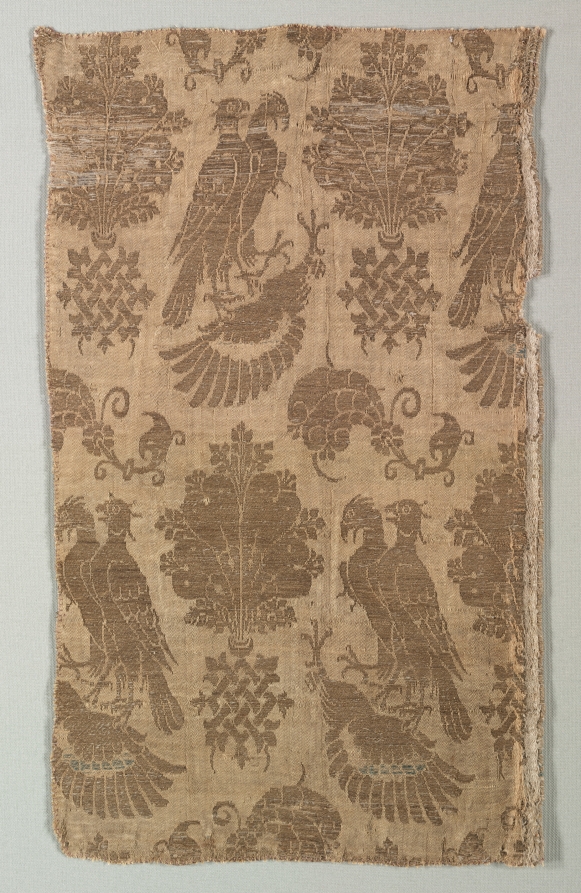
The Gold-Patterned Silk with Falcons and Heraldry: A Study in Imperial Legacy and Material Authority
Introduction: The Fabric of Sovereignty
In the hallowed ateliers of London’s Savile Row, where tailoring is elevated to an art form, the whisper of silk against wool is a language of its own. Yet, among the most commanding textiles in our heritage archive is the Gold-patterned Silk with Falcons and Heraldry—a material artifact that transcends mere fashion to embody the very essence of imperial power. This silk, woven with threads of pure gold and emblazoned with falcons and heraldic devices, is not simply a fabric; it is a declaration of lineage, a testament to the mastery of imperial silk weaving, and a relic of a world where cloth dictated status. As the Senior Heritage Specialist for Lauren Fashion Heritage Lab, I present this research artifact to illuminate how materiality, craftsmanship, and symbolic iconography converge in a single, resplendent textile.
Materiality: The Golden Thread of Power
The foundation of this artifact lies in its materiality. Silk, derived from the cocoons of Bombyx mori, has long been revered for its lustre, strength, and drape. Yet, this particular silk is elevated by the inclusion of gold thread—a technique known as gold-patterned weaving, where fine strips of gold leaf are wound around a silk core or woven as flat, gilded strips. The result is a fabric that shimmers with an almost supernatural radiance, catching light in a manner that suggests both wealth and divine favour. The gold is not merely decorative; it is a material assertion of authority. In imperial contexts, from Byzantine courts to Ming Dynasty workshops, gold-threaded silk was reserved for the highest echelons of society—emperors, sultans, and cardinals. The weight of the gold, the precision of its placement, and the labour required to produce it (often taking months for a single bolt) underscore the exclusivity of this textile. The silk itself, likely a satin weave or damask, provides a smooth, reflective ground that amplifies the gold’s brilliance. The interplay between the matte silk and the metallic threads creates a visual hierarchy, drawing the eye to the heraldic motifs that dominate the design.
Iconography: Falcons and Heraldry as Symbols of Dominion
The falcon is a recurring motif in imperial silk weaving, particularly across Central Asia, Persia, and the Ottoman Empire. In these cultures, the falcon was not merely a bird of prey; it was a symbol of sovereignty, swiftness, and celestial vision. Falconry, the art of training these birds, was a pursuit of kings and nobles, representing mastery over nature and the ability to strike with precision. On this silk, the falcon is often depicted in flight, wings spread, talons extended—a visual metaphor for the ruler’s reach and authority. The heraldry accompanying the falcon—whether a crest, a coat of arms, or a geometric emblem—anchors the design in a specific lineage. Heraldic devices, such as the tughra (the imperial monogram of Ottoman sultans) or the double-headed eagle of Byzantine and Russian empires, serve as markers of identity and legitimacy. In this artifact, the heraldry likely incorporates elements like stars, crescents, or stylized flowers, each carrying cultural significance. For instance, the tulip in Ottoman heraldry symbolized paradise on earth, while the pomegranate in Persian motifs represented fertility and eternal life. The combination of falcon and heraldry creates a narrative of power: the falcon as the living embodiment of the ruler’s spirit, and the heraldry as the codified record of their dynasty.
Context: The Legacy of Imperial Silk Weaving
To understand this silk fully, one must situate it within the legacy of imperial silk weaving. From the Silk Road to the Ottoman Imperial Workshops (the Ehl-i Hiref), silk was a currency of diplomacy and a marker of civilization. The Byzantine Empire, for example, maintained a monopoly on silk production through its state-run factories, where patterns like the peacock and griffin were woven for the imperial court. Similarly, in Safavid Persia, silk workshops in Isfahan produced textiles for the shah’s court, often featuring hunting scenes and floral motifs that echoed the gardens of paradise. The Gold-patterned Silk with Falcons and Heraldry likely originates from the Ottoman Empire (circa 16th–17th century), where the Bursa silk industry flourished under imperial patronage. Bursa, the first capital of the Ottoman Empire, was renowned for its brocades and velvets, woven with silver and gold threads. The falcon motif, in particular, appears in Ottoman textiles as a symbol of the sultan’s hunting prowess and his role as the protector of the realm. The heraldic elements, such as the tughra of Sultan Suleiman the Magnificent, would have been woven into ceremonial robes, throne covers, and diplomatic gifts. These textiles were not merely decorative; they were instruments of statecraft, projecting power across borders. When an Ottoman ambassador presented a gold-patterned silk robe to a European monarch, it was a statement of wealth, sophistication, and political alliance.
Technique and Craftsmanship: The Art of the Loom
The production of this silk required an extraordinary level of craftsmanship. The drawloom, a complex device operated by a weaver and a drawboy, allowed for the creation of intricate patterns by controlling individual warp threads. The gold thread, often made by hammering gold into thin sheets and cutting them into strips, was then wound around a silk core or woven directly into the fabric. This process was painstakingly slow; a single inch of gold-patterned silk could take hours to complete. The repetition of the falcon and heraldry across the fabric’s surface suggests a rapport pattern, where the motifs are arranged in a grid or staggered formation. This not only ensured visual consistency but also allowed the weaver to maximize the use of precious gold thread. The colour palette—typically deep crimson, sapphire blue, or emerald green—was achieved using natural dyes derived from insects (cochineal), plants (indigo), and minerals (lapis lazuli). These colours were not arbitrary; they carried symbolic weight. Red, for instance, was associated with power and passion, while blue evoked the heavens and divine protection.
Preservation and Legacy: A Fabric for the Ages
Today, this Gold-patterned Silk with Falcons and Heraldry is a rare and fragile artifact. Its preservation requires controlled humidity, low light levels, and careful handling. Yet, its legacy endures. In the context of Lauren Fashion Heritage Lab, this silk serves as a touchstone for understanding how materiality and iconography intersect in the creation of status. It reminds us that fashion is not merely about aesthetics; it is a language of power, woven into the very fabric of history. For Savile Row, where bespoke tailoring is a tradition of excellence, this silk represents the pinnacle of textile artistry—a reminder that the finest cloth is not just worn, but inherited. As we study this artifact, we honour the weavers, the rulers, and the cultures that transformed silk into a medium of imperial expression. The falcon still soars, the gold still glimmers, and the heraldry still speaks—a testament to a legacy that transcends time.
Conclusion: The Thread That Binds
In the quiet of the archive, this silk whispers of empires and artisans, of looms and legends. It is a heritage artifact that demands respect, not merely for its age, but for the mastery it represents. For the scholar, the designer, and the connoisseur, the Gold-patterned Silk with Falcons and Heraldry is a masterclass in material authority. It is, in every sense, a fabric fit for kings—and a lesson for those who seek to understand the enduring power of cloth.