← BACK TO ARCHIVES
Heritage-Black
Heritage Synthesis: Terracotta fragments of a bell-krater (deep bowl)
Curated on Jul 22, 2026 // Node: LDN-01
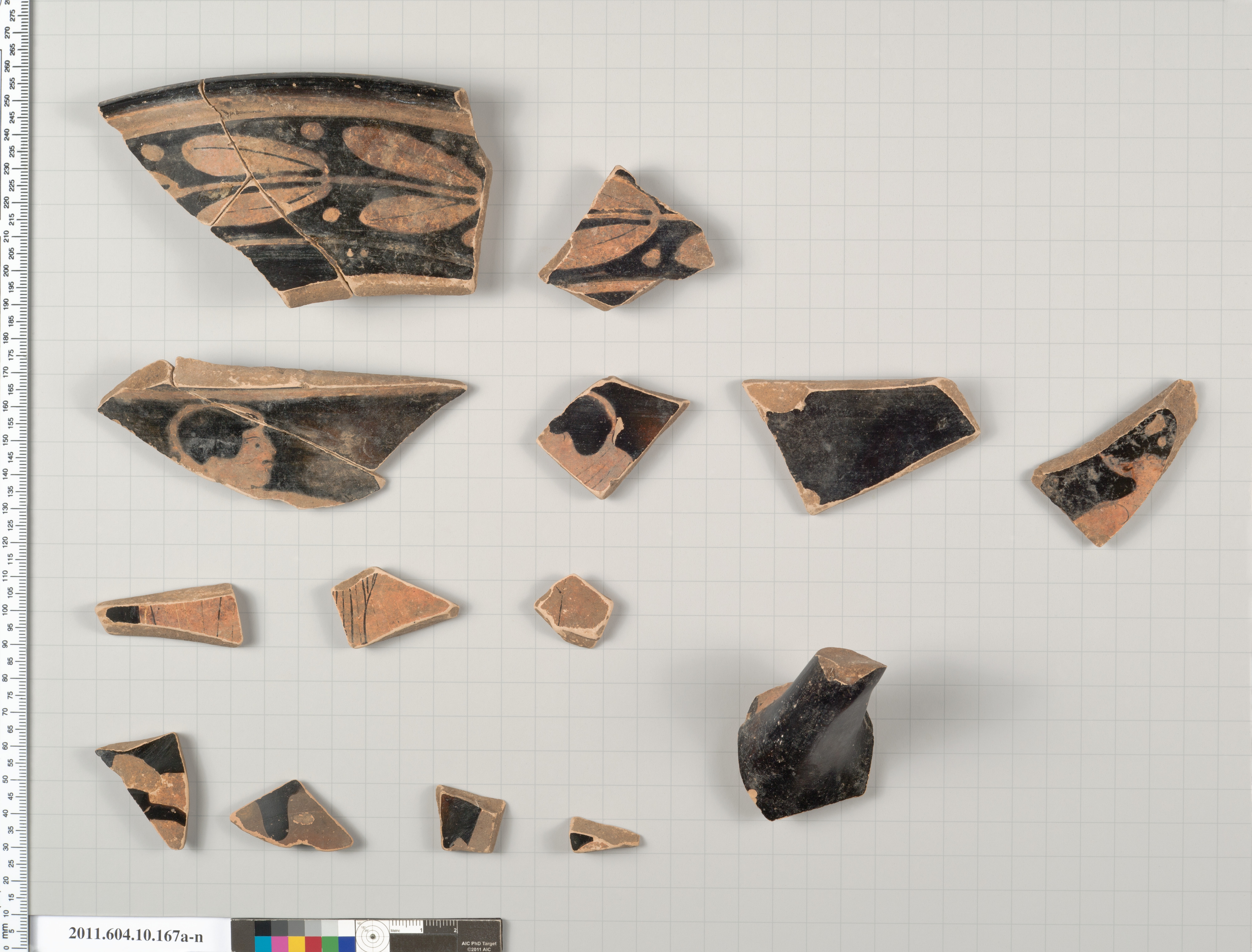
From Terracotta Fragments to Tailored Silhouettes: The Phenomenology of Etruscan Depth in 2026 Old Money Aesthetics
The internal genetic code of Lauren Fashion Heritage Lab posits a profound aesthetic paradox: the tension between narrative depth and phenomenological presence, as exemplified by the juxtaposition of Jacques-Louis David’s *The Death of Socrates* with a ceramic cup bearing the same name. This dialectic—between the “depth” of symbolic storytelling and the “depth” of pure material existence—finds a startlingly concrete analogue in the museum artifact before us: the terracotta fragments of an Etruscan bell-krater. These shards, broken yet resonant, do not merely inform the 2026 Old Money silhouette; they fundamentally challenge its foundational logic. The Old Money aesthetic, often misconstrued as static luxury, must instead be understood as a negotiation between the *narrative* of inherited status and the *phenomenological* weight of material authenticity. The Etruscan bell-krater, in its fragmentary state, becomes the key to unlocking this negotiation for the coming season.
The Bell-Krater as Anti-Narrative: A Materialist Critique of Status Symbolism
The bell-krater, a deep bowl used in antiquity for mixing wine and water, is an object of profound functional honesty. Unlike the painted Athenian kraters that depict mythological scenes—the narrative depth of David’s painting—the Etruscan terracotta fragments here are largely devoid of figurative imagery. Their “depth” is not in the stories they tell, but in the irreducible fact of their being: the rough, porous texture of the clay; the subtle variations in ochre and umber from the firing process; the palpable weight of a vessel meant to be held, lifted, and poured. This is the *existential depth* of the ceramic cup in our internal code—a depth that does not require decoding, but only *facing*.
For the 2026 Old Money silhouette, this translates into a radical rejection of overt status markers. The traditional Old Money wardrobe—a bespoke tweed jacket, a perfectly worn-in cashmere sweater—has always traded on a certain *invisibility* of wealth. Yet even this invisibility can become a narrative, a story of “quiet luxury” that is itself a performance. The Etruscan krater fragments suggest a more profound move: a shift from *quiet* to *silent*. The 2026 silhouette will not whisper of heritage; it will simply *be* heritage. This means prioritizing materials that carry their own phenomenological weight—unfinished edges, raw seams, fabrics that feel ancient rather than merely expensive. The *Heritage-Black* category, in this context, is not a color but a condition: black as the absence of narrative, as the void that forces the viewer to confront the object’s material presence.
Fragmentation as Formal Principle: Deconstructing the Tailored Line
The terracotta fragments are not a whole vessel; they are a broken one. Yet their brokenness is not a loss but a gain. Each shard retains the curve of the original krater, the trace of the potter’s wheel, the memory of a complete form. This is a crucial insight for the 2026 silhouette. The Old Money aesthetic has long prized the *unbroken line*—the seamless shoulder of a Huntsman jacket, the uninterrupted drape of a Loro Piana coat. The Etruscan fragments propose an alternative: the *broken line* as a source of deeper elegance.
Consider the silhouette of a 2026 overcoat. Instead of a single, continuous panel from shoulder to hem, imagine a construction that mimics the krater’s shards: panels that are visibly joined, seams that are not hidden but celebrated, edges that are left raw or subtly frayed. This is not deconstruction in the Rei Kawakubo sense—a violent tearing apart of form. It is a *reconstruction through fragmentation*, where the garment’s history of making is made visible. The “depth” of such a garment lies not in its flawless finish but in its honest articulation of parts. The wearer does not *tell* a story of craftsmanship; the garment *is* the story of its own making, a phenomenological presence that demands to be faced, not read.
Texture as Temporality: The Patina of the Hand
The Etruscan bell-krater’s surface is not smooth. It bears the marks of the potter’s fingers, the irregularity of hand-coiling, the subtle undulations of a form that was not machined but coaxed from clay. This texture is a record of time—not the historical time of the Etruscan civilization, but the *durational time* of the object’s creation. For the 2026 Old Money silhouette, this suggests a radical revaluation of fabric texture.
The current season’s obsession with “buttery soft” cashmere or “liquid” silk represents a desire for a surface that erases its own making. The Etruscan fragments demand the opposite: a fabric that retains the memory of its construction. Think of a heavy wool tweed whose irregularities are not flaws but features—slubs, nubs, variations in weave that speak to the hand of the weaver. Think of a linen that is not pressed to glassy perfection but left with the creases and folds of its own history. The *Heritage-Black* of such a fabric is not a color but a temporal density: black as the accumulation of time, as the patina of use, as the depth that comes from being *lived in* rather than *designed for*.
The Balance of Narrative and Silence: The 2026 Old Money Synthesis
The internal code’s final insight is that the answer lies not in choosing between David’s narrative depth and the cup’s existential depth, but in balancing them. The 2026 Old Money silhouette must achieve this balance: it must carry the weight of heritage (the narrative of status, of family, of tradition) while simultaneously existing as a pure material presence (the phenomenological fact of the garment itself).
How does this manifest? Consider a double-breasted suit in a heavy, unlined wool. The silhouette—the broad shoulders, the suppressed waist, the classic lapel—is a direct quotation from the archives of Savile Row. This is the *narrative* depth: the suit tells a story of 1930s elegance, of inherited taste, of a lineage that stretches back through generations. But the fabric is not a perfect, pristine worsted. It is a woolen tweed, rough to the touch, with visible slubs and a slightly uneven dye. The seams are not pressed flat but left with a subtle ridge. The buttons are horn, but they are not polished to a high gloss; they retain the matte texture of the animal. This is the *existential* depth: the suit does not just *refer* to heritage; it *is* heritage, a material object that demands to be felt, not just seen.
Conclusion: The Fragment as Future
The Etruscan bell-krater fragments are not a relic of a dead past; they are a blueprint for a living future. They teach us that the deepest elegance is not the most perfect, but the most *true*—the most honest about its own materiality, its own making, its own time. For the 2026 Old Money silhouette, this means a turn away from the polished, the seamless, the narratively overdetermined. It means embracing the fragment, the seam, the irregularity, the patina. It means finding depth not in what a garment *says*, but in what it *is*. In the silence of the terracotta, we hear the future of fashion: a heritage that is not told, but felt.
Heritage Lab Insight
Genetic Bridge: Archive node focusing on Heritage-Black craftsmanship.