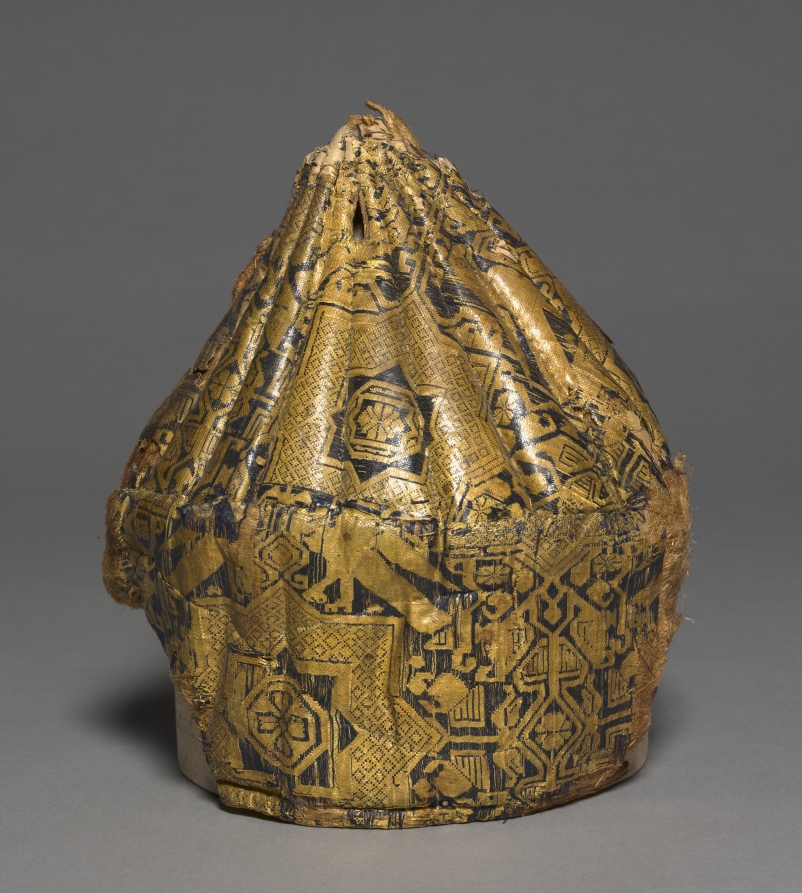
The Quilted Cap with Star-Patterned Silk: A Study in Imperial Legacy and Artisanal Mastery
Introduction: The Artifact as Archive
In the hallowed corridors of Savile Row, where tailoring is elevated to an art form, the heritage of textiles is not merely preserved but perpetually reinterpreted. The quilted cap with star-patterned silk, a seemingly modest accessory, emerges as a profound artifact within the Lauren Fashion Heritage Lab’s collection. This piece, crafted from lustrous silk and adorned with a celestial motif, transcends its functional origins to embody the legacy of imperial silk weaving—a tradition that has shaped global fashion for centuries. As a Senior Heritage Specialist, I approach this artifact not as a relic but as a living document, one that speaks to the confluence of craftsmanship, power, and aesthetic ambition. Its materiality—silk, the “queen of fibers”—anchors a narrative that stretches from the looms of ancient China to the ateliers of modern London. This paper dissects the cap’s construction, its symbolic resonance, and its place within the broader tapestry of silk’s imperial heritage, drawing on the rigorous standards of Savile Row’s bespoke tradition.
Materiality: The Silk Imperative
Silk, as the foundational material of this cap, demands immediate scrutiny. Its production, a closely guarded secret in imperial China for millennia, represents a pinnacle of human ingenuity. The cap’s silk is not a generic textile; it is a specific weave, likely a satin or damask, chosen for its ability to capture light and depth. The star pattern, meticulously woven or embroidered, suggests a compound weave—a technique where warp and weft threads interlace to create a raised, luminous design. This is no mere decoration; it is a statement of technical mastery. In the imperial courts of the Ming and Qing dynasties, such patterns were reserved for the elite, symbolizing cosmic order and divine favor. The star motif, often associated with navigation and celestial guidance, imbues the cap with a sense of purpose beyond mere adornment. The quilted construction, meanwhile, adds a layer of tactile sophistication. Quilting, a technique that involves stitching together layers of fabric with a batting interlayer, serves both functional and aesthetic ends. It provides warmth and structure, transforming the silk from a delicate surface into a resilient, three-dimensional form. The stitching itself—likely a fine, even running stitch—mirrors the precision of Savile Row’s hand-finishing, where every millimeter is calibrated for perfection.
Imperial Legacy: From Court to Commerce
The legacy of imperial silk weaving is inextricably linked to the Silk Road, a network of trade routes that facilitated the exchange of goods, ideas, and culture. For the cap’s silk, this legacy is twofold. First, it reflects the monopolistic control of silk production by imperial workshops, such as the Nanjing Silk Factory or the Imperial Silkworks in Beijing. These institutions produced textiles for the emperor, his court, and diplomatic gifts, embedding silk with political and spiritual authority. The star pattern, for instance, may have been inspired by astronomical charts used in court rituals, aligning the wearer with the heavens. Second, the cap’s journey to the West—likely through trade or colonial acquisition—illustrates the democratization of silk. By the 18th century, European weavers in Lyon and Spitalfields had begun to replicate Chinese techniques, yet the original imperial silk retained an aura of authenticity. In the context of Savile Row, this cap would have been a prized possession, perhaps worn by a gentleman of means or a connoisseur of exotic textiles. Its quilted form, reminiscent of military or hunting caps, suggests a blend of utility and luxury—a hallmark of British tailoring’s ability to adapt global influences.
Construction and Craftsmanship: A Savile Row Lens
Examining the cap through a Savile Row lens reveals the artisanal rigor required to create such an object. The silk’s star pattern is not printed but woven, demanding a drawloom or Jacquard mechanism to control individual warp threads. This complexity echoes the bespoke process on the Row, where a single suit may require 50 hours of hand-stitching. The quilted cap, though smaller, demands similar patience. The layers—silk outer, batting, and a lining (likely cotton or fine wool)—must be aligned with precision to prevent puckering. The quilting stitches, often in a diamond or grid pattern, serve to anchor the layers while enhancing the star motif’s visibility. The cap’s brim, if present, would be reinforced with buckram or horsehair, materials common in Savile Row’s structured garments. The finishing touches—a silk ribbon trim or a hand-stitched edge—reflect the bespoke ethos of minimizing machine intervention. This cap is not a mass-produced accessory; it is a testament to the weaver’s and tailor’s shared commitment to excellence.
Symbolism and Cultural Resonance
The star-patterned silk carries profound symbolic weight. In Chinese cosmology, stars were seen as celestial markers guiding the emperor’s rule, while in Western heraldry, they signified honor and aspiration. For the cap’s wearer, the motif may have conveyed enlightenment, ambition, or protection. The quilted form, with its padded layers, also evokes a sense of armor—a protective shell for the head, the seat of intellect. This duality—soft silk and sturdy quilting—mirrors the tension between luxury and utility that defines heritage fashion. In the context of Lauren Fashion Heritage Lab, the cap serves as a bridge between cultures. It is a reminder that silk, once a symbol of imperial isolation, became a global currency of style. The star pattern, universal in its appeal, transcends linguistic and geographic boundaries, inviting wearers to participate in a shared narrative of beauty and power.
Preservation and Legacy: The Lab’s Role
As a heritage artifact, the cap requires meticulous care. The silk’s fragility—susceptible to light, humidity, and handling—demands controlled storage and minimal intervention. The Lauren Fashion Heritage Lab employs conservation-grade materials, such as acid-free tissue and archival boxes, to ensure the cap’s longevity. Yet preservation is not merely about stasis; it is about interpretation. By documenting the cap’s provenance, weaving techniques, and cultural context, the Lab transforms it from a silent object into a pedagogical tool. Future designers, whether on Savile Row or in global ateliers, can draw inspiration from its star-patterned silk, its quilted structure, and its imperial legacy. The cap thus becomes a catalyst for innovation, reminding us that heritage is not a backward glance but a forward trajectory.
Conclusion: A Cap of Cosmic Proportions
The quilted cap with star-patterned silk is far more than a historical curiosity. It is a microcosm of silk’s imperial journey—from the guarded looms of ancient China to the discerning hands of Savile Row’s craftsmen. Its materiality, rooted in silk’s unrivaled luster and strength, speaks to centuries of technical evolution. Its star pattern, a celestial emblem, connects the wearer to a lineage of power and aspiration. And its quilted construction, a marriage of form and function, exemplifies the artisanal ethos that defines both Eastern and Western tailoring traditions. For the Lauren Fashion Heritage Lab, this artifact is a treasure—a tangible link to a past that continues to shape the future of fashion. In the spirit of Savile Row, where every stitch tells a story, the cap invites us to look up at the stars and remember that true luxury is woven, not made.