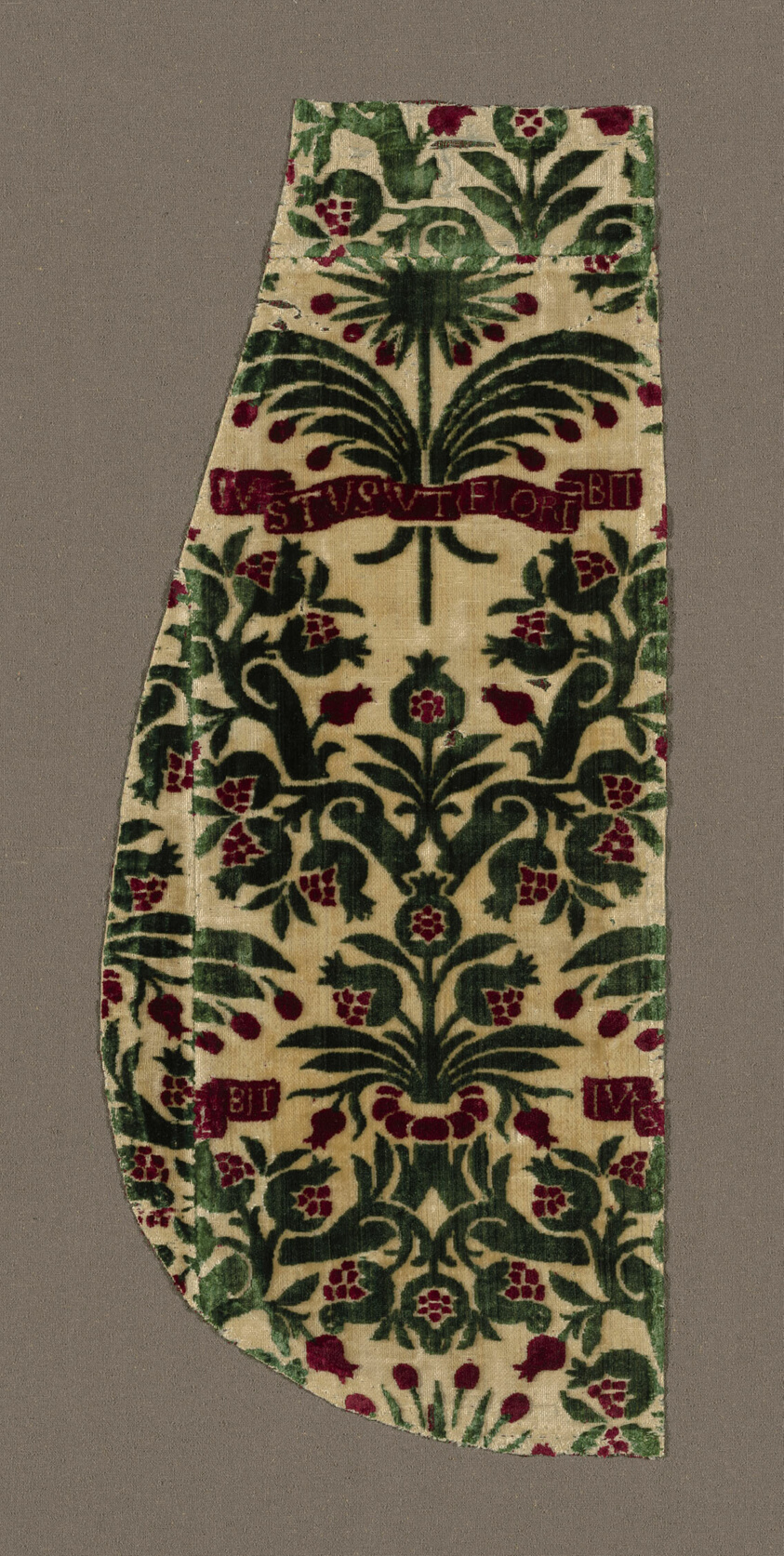
An Examination of Material Authority: The Silk Velvet Chasuble Fragment
To engage with this artifact—a portion of a chasuble in silk, satin weave, cut solid velvet—is to conduct an audit of material supremacy. One does not merely observe it; one assesses its inherent credentials. In the lexicon of cloth, where worsteds and linens have their established quarters, silk occupies the freehold of absolute distinction. This particular manifestation, the cut velvet upon a satin ground, represents not a mere textile but a calculated exercise in hierarchical texture and controlled luminescence. It is, in essence, a fabric of command.
The Foundation: Satin Weave as Strategic Ground
The foundation of this artifact’s authority lies in its satin weave structure. This is not a matter of simple aesthetics; it is a technical prerequisite for gravitas. The satin weave, with its long floats of warp threads, creates an uninterrupted, mirror-like surface. It is the cloth equivalent of a flawless bespoke lapel roll—a seamless, continuous plane that captures and refracts light with a profound, quiet intensity. This ground provides the essential liquidity, the fluid elegance that is the sine qua non of classic silk craftsmanship. It is the silent, supportive canvas, the impeccable understructure upon which the narrative of the velvet is built. Without this depth of field, provided by the satin’s inherent sheen, the subsequent pile would lack its dramatic counterpoint and its regal bearing.
The Assertion: The Grammar of Cut Solid Velvet
If the satin ground is the strategic reserve, the cut velvet is the assertive statement. The term ‘solid’ here is pivotal; it denotes a uniform, dense pile of singular colour, a monolithic expression of depth and plushness. The process is one of deliberate construction and decisive subtraction. Wires are inserted into the loom to create loops; these loops are then precisely severed. This act of cutting is the critical point of transformation, releasing the fibres to stand erect, creating that tactile, luminous pile that defines velvet’s character. The contrast achieved—the cool, liquid depth of the satin against the warm, light-absorbing and emitting velveteen hills—is the core of its drama. It is a study in binary excellence: shine and matte, smooth and plush, reflection and absorption. This is not ornamentation; it is structural rhetoric woven directly into the material.
Context and Consequence: The Chasuble as Client Garment
The application of this superlative cloth to a chasuble is a matter of profound contextual logic. The chasuble, the outermost sacramental garment, operates under a strict sartorial brief: it must convey supreme significance, facilitate dignified movement, and command space through presence alone. The silk velvet chasuble meets this brief with peerless aptitude. Its material weight ensures a drape of consequential fluidity, the cloth moving with the celebrant as a single, authoritative form. The visual depth of the velvet, shifting between shadow and light with every motion, creates a living, luminous field appropriate to its sacred theatre. In this context, the craftsmanship transcends decoration to become semiotic; the cloth itself communicates hierarchy, solemnity, and a connection to a lineage of artisanship that is itself a form of devotion. It is, in the truest sense, a garment built for performance under the most exacting of spotlights.
A Legacy of Calculated Refinement
To conclude, this fragment is a testament to a specific, unimpeachable standard. It speaks of a world where material selection is the primary strategic decision, where the inherent properties of silk—its tensile strength, its capacity for brilliant dye, its acoustic dampening—are leveraged to their utmost. The combination of satin and cut velvet represents the apex of this philosophy: two complementary yet contrasting expressions of silk’s potential, unified to create a whole greater than the sum of its impeccable parts. It embodies a principle understood on Savile Row and in the historic silk ateliers of Lyon alike: that true luxury is not additive, but integral. It is not applied to the surface but engineered into the very warp and weft. This artifact, therefore, stands as a material benchmark. It is a quiet, potent reminder that before one can cut a garment, one must first understand the profound and authoritative language of the cloth itself.