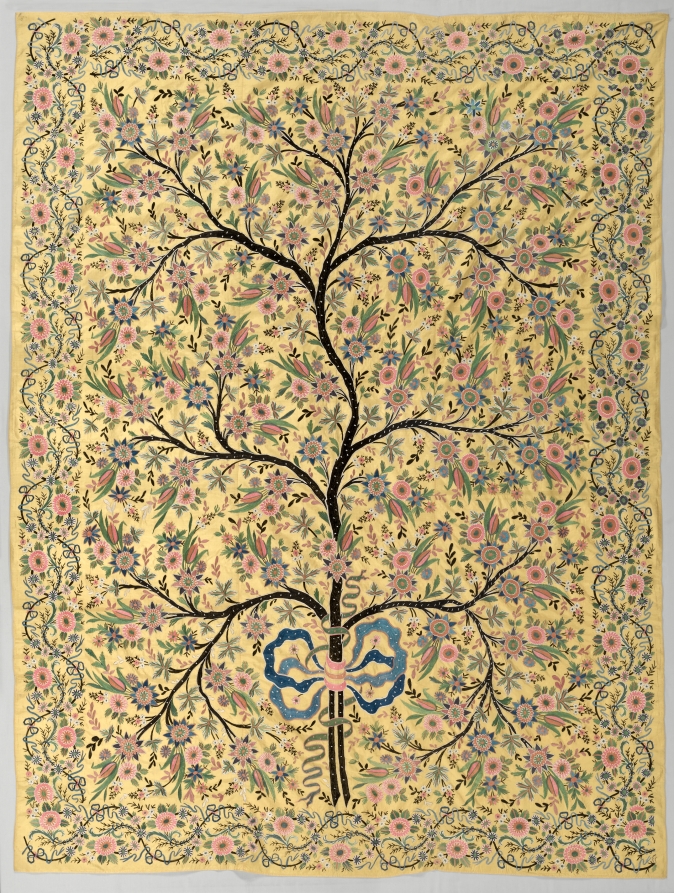
The Embroidered Tree of Life: A Testament to Imperial Silk Weaving and Enduring Craftsmanship
In the hallowed corridors of London’s Savile Row, where precision tailoring and heritage fabrics converge, the silk hanging with an embroidered tree of life stands as a profound artifact of imperial ambition and artisanal mastery. This piece, woven from the finest silk filaments and adorned with intricate embroidery, encapsulates a legacy that transcends mere decoration. It is a narrative of power, trade, and the relentless pursuit of perfection that defines the world’s most esteemed textile traditions. For the connoisseur of heritage, this hanging is not merely an object; it is a chronicle of silk’s journey from the imperial looms of Asia to the ateliers of the West, where it continues to inspire generations of craftsmen.
Materiality: The Silk Threads of Empire
The materiality of this artifact is its first and most commanding statement. Silk, derived from the cocoons of Bombyx mori, has long been revered for its unparalleled luster, strength, and drape. In the context of imperial silk weaving, particularly during the Ming and Qing dynasties, silk was not merely a fabric but a currency of status and diplomacy. The hanging’s base is a densely woven silk satin, its surface reflecting light with a subtle sheen that speaks to the meticulous sericulture and weaving techniques perfected over centuries. The embroidery, executed with silk threads of varying thicknesses, employs a combination of satin stitch, couching, and seed stitch to create the tree of life motif. This motif, with its sinuous branches, stylized leaves, and symbolic fruits, is rendered in hues of deep indigo, vermilion, and gold—colors that were once reserved for imperial courts due to the prohibitive cost of natural dyes. The gold thread, likely wrapped around a silk core, adds a tactile richness that elevates the piece from craft to art. Each stitch is a testament to the embroiderer’s discipline, a quality that resonates with the bespoke ethos of Savile Row, where every seam is a mark of honor.
Context: The Legacy of Imperial Silk Weaving
To understand this hanging, one must situate it within the grand tapestry of imperial silk weaving. The tree of life motif, ubiquitous in Persian, Indian, and Chinese art, was adapted by imperial workshops to symbolize cosmic order, fertility, and the emperor’s divine mandate. During the Qing dynasty (1644–1912), the Imperial Silk Workshops in Suzhou, Hangzhou, and Nanjing produced textiles of extraordinary complexity for the Forbidden City. These workshops were governed by strict protocols: only the finest silkworms were selected, and weavers underwent decades of apprenticeship to master the drawloom, a device that allowed for intricate patterns. The tree of life hanging, likely created for a palace interior or a ceremonial purpose, would have been part of a larger decorative scheme—perhaps adorning a throne room or a private chamber. Its survival is a rare privilege, as many such pieces were destroyed during political upheavals or repurposed for their gold content. The hanging’s presence today is a direct link to that era of opulence, where silk was not just a material but a medium for asserting cultural and political hegemony.
The legacy of imperial silk weaving extends beyond the East. By the 17th and 18th centuries, silk from China and India flooded European markets via the East India Companies. Savile Row tailors, who began to emerge in the late 18th century, quickly recognized silk’s potential for waistcoats, cravats, and ceremonial garments. The tree of life motif, in particular, found favor among British aristocracy, who commissioned embroidered silks for their country houses. This cross-cultural exchange enriched both traditions: European weavers adopted the motif, while Asian artisans incorporated Western floral elements. The hanging thus embodies a global dialogue, one that continues in the contemporary work of heritage houses like Henry Poole & Co. and Gieves & Hawkes, where silk remains a cornerstone of bespoke tailoring.
Conservation and the Art of Preservation
Preserving such an artifact requires an understanding of silk’s fragility. Silk fibers are protein-based and susceptible to light, humidity, and pollutants. The hanging’s embroidery, with its metallic threads, is particularly vulnerable to tarnish and breakage. Conservators employ techniques that mirror the patience of its creators: they use low-light storage, controlled environments, and minimal intervention. For the heritage specialist, this hanging is a case study in the tension between preservation and display. Should it be exhibited in a museum, where light exposure is inevitable, or kept in a climate-controlled archive, where its beauty remains hidden? The answer lies in the artifact’s purpose: to educate and inspire. At the Lauren Fashion Heritage Lab, we advocate for rotational display, allowing the public to witness the craftsmanship while minimizing damage. This approach honors the silk’s legacy as a living artifact, not a relic.
Relevance to Modern Craftsmanship
The tree of life hanging is not a historical curiosity; it is a benchmark for quality. In an era of fast fashion and synthetic fabrics, this artifact reminds us of the value of slowness and skill. The embroiderer’s hands, guided by generations of knowledge, produced a piece that can never be replicated by machine. For the modern tailor or designer, studying such a hanging offers insights into color harmony, texture contrast, and the narrative power of motif. The tree of life, with its roots in ancient symbolism, speaks to our enduring need for connection—to nature, to heritage, and to the hands that made it. This is the essence of luxury: not rarity alone, but the story embedded in every thread.
In conclusion, the silk hanging with embroidered tree of life is a masterwork of imperial silk weaving, a material testament to the convergence of art, power, and trade. Its preservation at the Lauren Fashion Heritage Lab ensures that future generations of craftsmen and scholars can study its techniques and appreciate its cultural significance. As we continue to explore the legacy of silk, this artifact stands as a silent teacher, reminding us that true heritage is not static but alive, waiting to be reinterpreted by those who understand its worth.