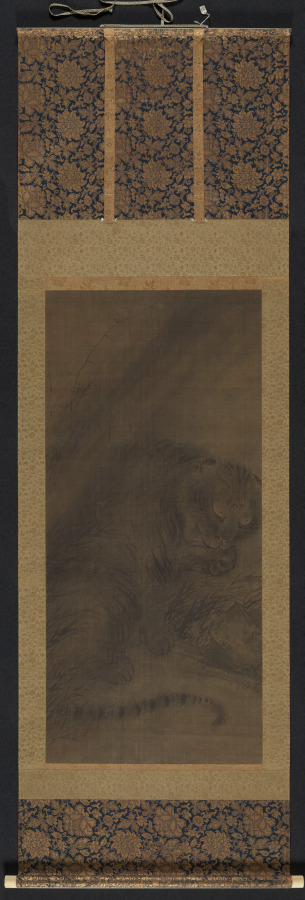
The Tiger in Silk: A Heritage Artifact of Imperial Weaving
Introduction: The Artifact as a Living Legacy
In the hallowed corridors of London’s Savile Row, where tailoring is both craft and creed, the heritage of silk weaving from imperial China stands as a testament to the intersection of artistry, power, and nature. This artifact—a silk panel depicting a tiger, woven during the Qing Dynasty (1644–1912)—is not merely a textile; it is a narrative of dominion, a symbol of martial prowess, and a masterclass in materiality. For the Lauren Fashion Heritage Lab, this piece serves as a critical lens through which we examine the legacy of imperial silk weaving, its technical virtuosity, and its enduring influence on contemporary luxury. The tiger, rendered in lustrous silk, embodies the tension between the wild and the refined, a duality that resonates deeply with the bespoke ethos of Savile Row.
Materiality: Silk as a Medium of Power
Silk is the foundational material of this artifact, and its selection is no accident. In imperial China, silk was more than a fabric; it was a currency of status, a medium for political communication, and a vehicle for spiritual expression. The production of silk—from the cultivation of mulberry trees to the delicate unwinding of cocoons—was a state-controlled enterprise, overseen by imperial workshops that jealously guarded their techniques. The silk used in this tiger panel is of the highest grade, known as kesi (cut silk), a tapestry-weave technique that allows for intricate, pictorial designs. Unlike standard brocades, kesi involves discontinuous wefts, enabling the weaver to create sharp, vivid images with a painterly quality. The tiger’s stripes, for instance, are rendered in alternating threads of gold and deep amber, catching light to simulate the animal’s muscular tension. The materiality of silk here is not passive; it is an active participant in the artifact’s meaning. The fabric’s natural sheen mimics the tiger’s coat, while its fragility underscores the ephemeral nature of power—a reminder that even the mightiest empires are woven from threads that can unravel.
The Tiger: Symbolism and Craftsmanship
The tiger holds a revered place in Chinese iconography. As the king of beasts in East Asian cosmology, it represents courage, authority, and protection. In imperial contexts, the tiger was often associated with military generals, its image emblazoned on banners, robes, and ceremonial objects to invoke strength and deter evil spirits. This particular panel likely adorned a high-ranking official’s court robe or a ceremonial hanging in a palace. The tiger is depicted mid-stride, its head turned to face the viewer, eyes inlaid with tiny knots of black silk that create an unsettling, lifelike gaze. The weavers employed a technique called jacquard (though predating the mechanical loom) to achieve the subtle gradations of fur texture, using up to 12 different shades of silk thread. The background is a deep, imperial yellow—a color reserved for the emperor and his closest kin—suggesting that this artifact was not merely decorative but imbued with political significance. The tiger’s claws, rendered in metallic gold thread, are exaggerated, almost talon-like, reinforcing its role as a guardian against chaos. This level of detail required months of labor by master weavers, whose names were often lost to history, their artistry subsumed into the imperial brand.
Context: The Legacy of Imperial Silk Weaving
The imperial silk weaving workshops of Suzhou, Hangzhou, and Nanjing were the epicenters of this craft, operating under the direct patronage of the Ming and Qing emperors. These ateliers produced textiles that were not only functional but also diplomatic—gifts to foreign dignitaries, tributes to vassal states, and markers of the emperor’s cosmic mandate. The tiger panel, however, belongs to a more intimate category: it was likely part of a chaopao (court robe) or a guahua (wall hanging) used in the Forbidden City. The legacy of this weaving tradition is twofold. First, it established a standard of technical excellence that continues to influence luxury textile production today. The kesi technique, for instance, is still practiced by a handful of artisans in Suzhou, though the market for such labor-intensive work has dwindled. Second, the imperial system created a hierarchical language of design—colors, motifs, and materials were codified to denote rank. A tiger, for example, was a third-rank symbol, below the dragon but above the leopard, reflecting the wearer’s position in the bureaucracy. This semiotic precision resonates with Savile Row’s own language of tailoring, where every stitch, button, and lapel width communicates status and identity.
Relevance to Contemporary Luxury and Savile Row
For the Lauren Fashion Heritage Lab, this artifact is a touchstone for understanding how heritage can inform modern design. The tiger in silk is not a relic but a resource—a repository of techniques, symbols, and material wisdom that can be adapted for contemporary audiences. In the context of Savile Row, where bespoke tailoring is the ultimate expression of individuality, the tiger panel offers lessons in precision, narrative, and material integrity. Consider the work of a Savile Row tailor: each garment is a bespoke artifact, woven from the client’s story and the tailor’s expertise. Similarly, the imperial weaver translated the emperor’s authority into silk, using thread as a medium for political and spiritual messaging. Today, a Savile Row house might reinterpret the tiger motif in a silk tie or a lining, using modern jacquard looms to replicate the kesi effect. The key is to honor the materiality—silk’s drape, its luminosity, its weight—while respecting the cultural origins. This is not appropriation but appreciation, a dialogue between past and present that enriches both.
Conclusion: The Thread That Binds
The tiger in silk is more than an artifact; it is a thread connecting imperial ambition, artisanal mastery, and contemporary luxury. Its materiality—silk—is a testament to the enduring power of natural fibers, while its iconography speaks to universal themes of strength and protection. For the Lauren Fashion Heritage Lab, this piece serves as a case study in how heritage can be preserved, studied, and reimagined. As we continue to explore the intersections of fashion, history, and culture, the tiger reminds us that the finest textiles are not merely worn but inhabited—they carry the weight of stories, the sheen of power, and the texture of time. In the quiet of a Savile Row fitting room, where a client’s silhouette is traced in chalk, the ghost of that imperial weaver lingers, threading the needle between tradition and tomorrow.