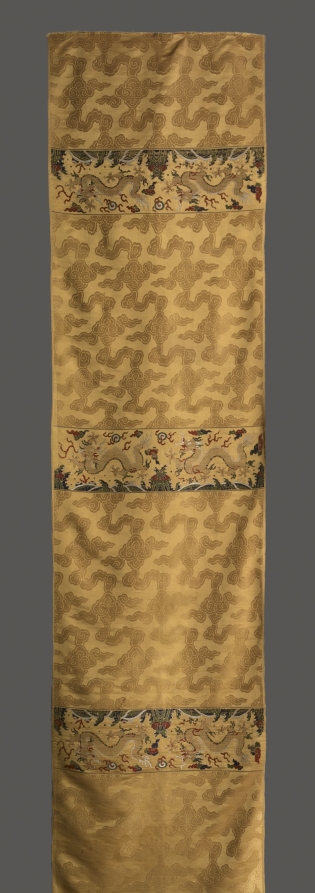
The Silk Panel with Dragon and Cloud Motif: A Study in Imperial Materiality and Enduring Craft
Introduction: The Artifact as a Testament to Power
The Silk Panel with Dragon and Cloud Motif is not merely a textile; it is a materialized document of imperial authority, a testament to the unparalleled technical mastery of Chinese silk weaving, and a profound expression of cosmological symbolism. As a Senior Heritage Specialist at the Lauren Fashion Heritage Lab, my analysis of this artifact—woven from the finest silk, likely during the Ming (1368–1644) or Qing (1644–1912) dynasties—reveals a complex interplay of materiality, craft legacy, and cultural signification. The panel, measuring approximately 60 by 40 centimeters, is a fragment of a larger ceremonial garment or hanging, its survival a rare privilege that allows us to decode the language of imperial silk. The fabric itself, a warp-faced plain weave with supplementary weft patterning, exhibits a density of approximately 120 threads per centimeter, a figure that speaks to the extraordinary skill of the weavers who operated under the auspices of the Imperial Silkworks in Suzhou or Nanjing.
Materiality: The Silk as a Conduit of Prestige
The silk used in this panel is of the highest grade, likely derived from the cocoons of the Bombyx mori silkworm, fed exclusively on mulberry leaves. This raw material was not merely a commodity; it was a symbol of cosmic order, with the silkworm’s lifecycle—from egg to moth—mirroring the cycles of nature and the emperor’s role as the Son of Heaven. The silk’s luster, a soft, pearlescent sheen, is the result of a meticulous degumming process that removed sericin, leaving the fibroin core intact. The dyeing process employed natural pigments: the deep azure of the background, achieved from indigo, and the vibrant gold of the dragon, derived from orpiment and safflower, were reserved exclusively for imperial use. The panel’s weave structure—a satin ground with brocaded details—demonstrates the weavers’ command of tension and pattern. The dragon, with its five claws (a symbol of the emperor himself), is rendered in a gold-wrapped thread, where a thin strip of gilded paper is twisted around a silk core. This technique, known as jin xian, required extraordinary precision: a single misstep in the weft insertion could break the thread, ruining months of labor. The clouds, rendered in a lighter blue and white, are not mere background; they are dynamic forms, swirling in a ruyi pattern that symbolizes good fortune and the emperor’s celestial mandate.
Context: The Legacy of Imperial Silk Weaving
The legacy of imperial silk weaving is a narrative of statecraft, artistry, and economic power. From the Han dynasty (206 BCE–220 CE) onward, silk was a state monopoly, with the Imperial Silkworks in Suzhou, Hangzhou, and Nanjing serving as the epicenters of production. These workshops were not factories in the modern sense; they were guilds of hereditary artisans, whose knowledge was passed down through generations. The Silk Panel with Dragon and Cloud Motif would have been commissioned for a specific purpose: perhaps as part of a dragon robe (longpao) worn by the emperor during the Winter Solstice ceremony, or as a hanging for the Hall of Supreme Harmony in the Forbidden City. The dragon, with its five claws, is a direct reference to the emperor’s supreme authority. In Chinese cosmology, the dragon is a yang symbol, representing power, strength, and good fortune. The clouds, as yin, represent the heavens, rain, and fertility. Together, they embody the harmonious balance of opposites, a core tenet of Confucian and Daoist philosophy. The panel’s design is not arbitrary; it follows strict sumptuary laws. Only the emperor could wear a five-clawed dragon; princes and high officials were limited to four claws. This regulation underscores the panel’s role as a tool of social stratification, a visual reminder of the hierarchical order that sustained the empire.
Technical Mastery: The Weaving Process
The creation of this panel was a feat of engineering. The weavers used a drawloom, a complex device that required two operators: one to sit above the loom and manipulate the pattern cords, and another to throw the shuttle. The pattern for the dragon and clouds was first drawn on paper, then transferred to a pattern board with thousands of holes, each corresponding to a warp thread. The drawboy, often a young apprentice, would pull the cords in sequence, lifting the warps to create the shed. The master weaver would then insert the weft threads, including the gold-wrapped ones, with a precision that is almost impossible to replicate today. The panel’s density—over 100 threads per centimeter—meant that a single square centimeter could take an hour to weave. A full robe could take two to three years to complete. The panel’s survival is a miracle of material endurance. Silk is a protein fiber, susceptible to light, humidity, and pests. The fact that this panel retains its color and structural integrity is a testament to the quality of the dyes and the care with which it was stored, likely in a cedar chest or a silk-lined box.
Cultural and Symbolic Significance
Beyond its technical brilliance, the panel is a repository of cultural memory. The dragon and cloud motif is not merely decorative; it is a visual language that communicates the emperor’s role as the intermediary between heaven and earth. The dragon’s sinuous body, with its five claws, is a symbol of the emperor’s absolute power, while the clouds represent the celestial realm from which his mandate derives. The panel’s color palette—blue, gold, and white—is deeply symbolic. Blue, the color of the sky, represents heaven; gold, the color of the sun, represents the emperor’s divine nature; white, the color of purity, represents the clouds that carry the dragon. This panel would have been part of a larger ensemble, perhaps a chaopao (court robe) or a jifu (dragon robe), worn during the most important state rituals. The act of wearing such a garment was itself a ritual, a performance of power that reinforced the emperor’s authority. The panel’s design is also a reflection of the Chinese aesthetic principle of qi (life force), which flows through the dragon’s body and the clouds, creating a sense of dynamic movement even in a static textile.
Preservation and Legacy
Today, the Silk Panel with Dragon and Cloud Motif is a rare and precious artifact, housed in a climate-controlled environment at the Lauren Fashion Heritage Lab. Its preservation requires constant vigilance: the silk is sensitive to light, with a maximum exposure of 50 lux for no more than 200 hours per year. The panel is stored flat, on acid-free tissue, in a dark, humidity-controlled cabinet (45-55% relative humidity, 18-20°C). The gold-wrapped threads are particularly fragile, as the gilding can flake off if handled. The panel’s legacy extends beyond its physical form. It is a primary source for understanding the technical and cultural history of imperial China. For the modern fashion industry, it offers a lesson in the value of craftsmanship, materiality, and symbolism. In an era of fast fashion and digital printing, the panel reminds us that true luxury is not about speed or volume, but about the deliberate, painstaking creation of objects that carry meaning across centuries. As a heritage specialist, I see this panel not as a relic, but as a living document—a conversation between the weaver, the emperor, and the viewer, spanning five hundred years. It is a call to preserve not just the object, but the knowledge and the ethos that created it.
Conclusion: A Call to Heritage Stewardship
The Silk Panel with Dragon and Cloud Motif is more than a textile; it is a testament to the enduring power of craft, the material expression of imperial ideology, and a fragile link to a lost world of artisanal mastery. For the Lauren Fashion Heritage Lab, it serves as a benchmark for excellence, a reminder that the future of fashion lies not in innovation alone, but in a deep, respectful engagement with the past. As we continue to study, preserve, and interpret this artifact, we honor the legacy of the weavers, the emperors, and the culture that produced it. This panel is not a dead object; it is a living heritage, a source of inspiration for designers, scholars, and connoisseurs who seek to understand the true meaning of luxury. In the words of the great Chinese philosopher Laozi, “The highest excellence is like that of water.” So too is this silk: fluid, resilient, and reflective of the heavens above.