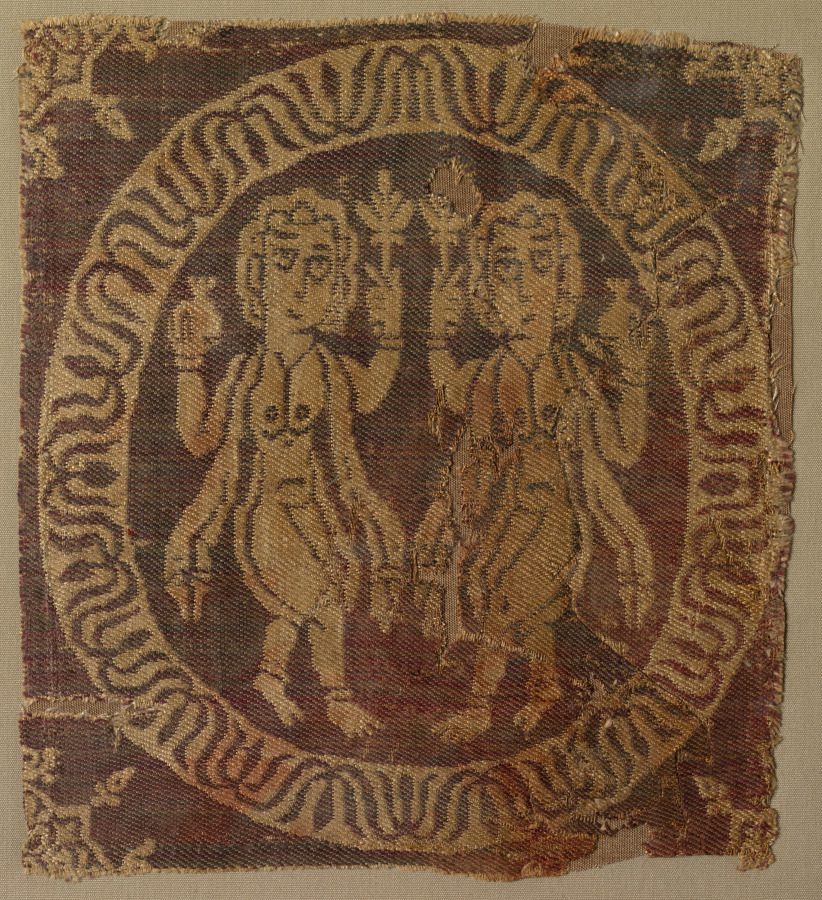
An Exegesis in Thread: The Nude Female Dancer from a Tunic
To the untrained eye, it is merely a fragment. A whisper of colour and form against the relentless march of time. To the connoisseur, however, this artifact—a panel depicting nude female dancers, liberated from the confines of a tunic woven in silk—represents a confluence of technical mastery, imperial ideology, and profound aesthetic daring. It is not simply a textile; it is a manifesto in weft and warp, a bold statement from the loom that speaks to the very apex of a civilisation’s confidence and its complex relationship with the human form, nature, and divinity.
The Foundation: Imperial Silk and the Currency of Power
One must first appreciate the stage upon which this scene is set: the ground of imperial silk. This is not a mere fabric, but a technology of state. From the Sericulture Secretariats of Byzantium to the meticulous ateliers of Tang China or Sassanian Persia, the production of high-quality silk was a closely guarded, state-monopolised endeavour. The very possession of such a tunic denoted proximity to imperial power—it was a wearable patent of nobility. The silk itself, with its luminous depth and capacity to hold colour with a jewel-like intensity, was a canvas of supreme prestige. Its fluid drape and subtle sheen would have animated the dancers with every movement of the wearer, making the figures partake in a silent, elegant dance of their own, a secondary performance dictated by the rhythms of the body beneath.
Anatomy of a Revelation: Technique as Narrative
The depiction of the nude female form in this context is an act of extraordinary artistic and technical ambition. We are not observing a crude representation, but a celebration rendered through the most complex language of the loom: likely a samite or a fine taqueté weave. The weaver, an anonymous master, has employed a discontinuous weft technique, perhaps even early forms of lampas, to achieve the subtle modulation of flesh tones, the delicate curvature of a limb, the suggestion of musculature and grace under motion. Each dancer is not drawn, but built—thread by thread—into existence. The sinuous lines that define them are a testament to a deep understanding of both anatomy and the inherent behaviour of silk thread, its tensile strength and lustre exploited to create contours that catch the light as living skin might. This is not mere decoration; it is figurative art of the highest order, translated into the binary code of raised and lowered warps.
Contextual Symbology: The Dancer as Cosmic Intermediary
The subject matter elevates the technical achievement into the realm of the symbolic. The nude female dancer, in the context of late antique and early medieval imperial cultures, was rarely a mere object of earthly delight. She was a multivalent symbol. In the classical tradition, she could represent a Maenad in ecstatic worship of Dionysus, a force of untamed nature. In Near Eastern and Central Asian iconography, she often served as an apsara or celestial nymph, a denizen of paradise whose dance was an expression of cosmic harmony and divine favour. Her nudity was not profane, but rather denoted a state of purity, a freedom from worldly constraint, and a direct, unadorned connection to the primal forces of life, fertility, and celestial joy.
To adorn a tunic—a garment enclosing the imperial body—with such figures was to make a profound statement. It enveloped the wearer in a field of divine symbolism. It suggested that the ruler was the axis mundi, around whom celestial harmonies played out; that his court was a reflection of the heavenly court. The dancers become intermediaries, their eternal performance a testament to the prosperity and cosmic sanction bestowed upon the empire and its sovereign.
The Savile Row Perspective: A Legacy of Bespoke Symbolism
From our vantage point, we discern a parallel, though not an equivalence, with the philosophy of the finest bespoke tailoring. A garment from Savile Row is not merely clothing; it is an articulation of identity, status, and personal mythology, crafted with uncompromising materials and techniques that border on the obsolescent. So too with this tunic. It was the ultimate in bespoke imperial regalia. The silk was the equivalent of the purest, most exclusive woolens or cashmere. The weaving technique demanded the same reverence for inherited craft as the hand-stitching of a canvassed lapel. The narrative of the dancers was the client’s chosen motif—not a family crest, but a grander, mythological declaration of one’s place in the universal order.
The true heritage here lies in this unity of material, technique, and narrative. The silk afforded the luminosity. The master weaver’s skill granted the narrative its eloquent form. The imperial ideology provided the audacious subject. One cannot be separated from the others without diminishing the whole. This fragment invites us to consider the wearer: a figure of immense power, moving through court or ceremony, carrying upon his very person a silent, shimmering vision of paradise, a declaration that under his rule, the divine dance of harmony and abundance was perpetually enshrined.
In conclusion, this artifact transcends its category. It is a scholarly document woven in silk. It speaks of an empire’s technical capability, its aesthetic confidence, and its desire to wear its cosmology as casually as we might wear a well-cut suit. It reminds us that the greatest luxury is never just the material, but the depth of meaning and the pinnacle of skill that the material is persuaded to hold. The nude dancers, forever caught in their elegant motion, are not merely decorations; they are the embodied soul of an imperial legacy, dancing on, long after the loom has fallen silent and the empire itself has turned to dust.