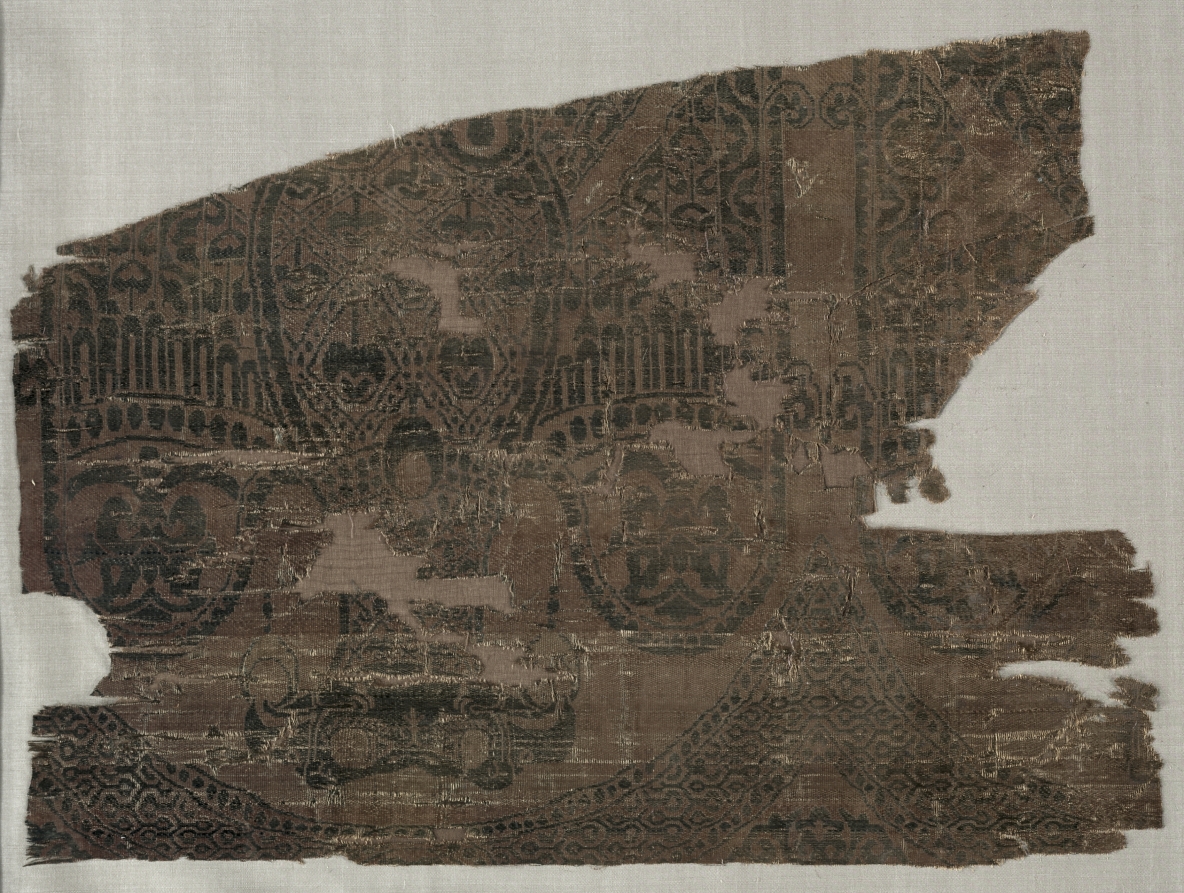
Heritage Research Artifact: Samite Fragments with Double-Headed Eagles from the Tomb of Saint Bernard Calvo
Introduction: A Thread of Imperial Legacy
In the hallowed silence of the Cathedral of Vic, Catalonia, beneath the stone effigy of Saint Bernard Calvo, Bishop of Vic (d. 1243), lay fragments of silk that whisper across centuries. These are not mere textiles; they are samite—a dense, twill-woven silk of Byzantine and early medieval provenance—bearing the double-headed eagle, a motif synonymous with imperial authority, from the Holy Roman Empire to the Palaiologan dynasty. As a Senior Heritage Specialist at the Lauren Fashion Heritage Lab, I present this artifact as a case study in materiality, power, and the enduring legacy of imperial silk weaving. This paper examines the samite fragments through the lens of their physical composition, historical context, and symbolic resonance, drawing on the precision and understated authority of London’s Savile Row—where cloth is never merely cloth, but a statement of lineage and craft.
Materiality: The Silk of Empires
The fragments, now housed in the Museu Episcopal de Vic, are composed of wild silk (Bombyx mori, likely sourced from Byzantine or Islamic workshops), dyed with madder and woad to achieve a deep crimson and indigo palette. Samite, from the Old French samit and Latin hexamitum (six-threaded), is a compound weave where the warp and weft interlace to create a lustrous, almost metallic surface. In these fragments, the double-headed eagle is rendered in gold-wrapped silk thread—a technique requiring immense skill, where the weft is gilded with beaten gold leaf over a silk core. The weave structure is a twill 2/1, allowing the pattern to emerge with a raised, sculptural quality. The density of the weave—approximately 40 warps per centimeter—speaks to the sophistication of late medieval looms, likely in Constantinople or Palermo, where imperial workshops monopolized such production.
Material analysis reveals traces of alum mordant and kermes (crimson dye from the Kermes vermilio insect), indicating a palette reserved for the highest echelons of society. The silk’s condition—fragmented, with losses due to burial and humidity—nonetheless preserves the crispness of the eagle’s talons and the symmetry of its dual heads. This is not a fabric for daily wear; it is a ceremonial textile, likely a pallium or altar cloth, commissioned for a bishop’s tomb to signify his role as a mediator between earthly and divine power.
Context: The Legacy of Imperial Silk Weaving
The double-headed eagle motif is a heraldic device with roots in Hittite and Roman iconography, but its medieval revival is inextricably linked to the Byzantine Empire and the Holy Roman Empire. In Byzantine court culture, silk weaving was a state monopoly, regulated by the Eparch of Constantinople. The double-headed eagle symbolized the emperor’s dominion over both East and West, a visual claim to universal sovereignty. By the 12th century, this motif was adopted by the Hohenstaufen dynasty, particularly Frederick II, who used it to assert his imperial authority over Italy and Germany. The fragments from Saint Bernard Calvo’s tomb—dated to the mid-13th century—coincide with the height of Hohenstaufen influence in the Mediterranean, when Sicilian and Byzantine workshops exchanged techniques and motifs.
Saint Bernard Calvo, a bishop and diplomat, served under King James I of Aragon, a period of intense cultural exchange between Christian, Muslim, and Jewish communities. The presence of samite in his tomb suggests a connection to the Silk Road trade networks, which funneled raw silk from China and Central Asia through Persia and into the Mediterranean. However, the weaving technique—particularly the use of gold thread—points to a Byzantine or Sicilian workshop, where imperial patronage ensured the survival of classical weaving traditions. The fragments are thus a material artifact of the “silk diplomacy” that characterized medieval courts: silk as a gift, a tribute, and a marker of status.
Symbolism: The Eagle and the Bishop
The double-headed eagle on these fragments is not merely decorative; it is a theological and political statement. In Christian iconography, the eagle represents St. John the Evangelist, whose gospel soars to divine heights. For a bishop like Calvo, the eagle motif could signify his role as a spiritual guide, lifting his flock toward salvation. Yet the dual heads also evoke the temporal power of the Church, which claimed authority over both spiritual and secular realms. This duality mirrors the bishop’s own position: a servant of God and a counselor to kings.
The choice of samite—a fabric associated with imperial coronations and liturgical vestments—elevates Calvo’s tomb from a simple burial to a symbolic throne. The gold thread, which would have shimmered in candlelight, created an aura of divine light, reinforcing the bishop’s sanctity. In the context of the 13th-century Reconquista, where Christian kingdoms vied for dominance, the use of an imperial motif also asserted Aragon’s ambitions as a Mediterranean power. The fragments thus serve as a heraldic bridge between the Byzantine past and the emerging nation-states of Europe.
Conservation and Legacy: A Call to Craft
Today, the samite fragments are preserved under controlled conditions at the Museu Episcopal de Vic, where they are studied by textile historians and conservators. The fragility of the silk—subject to desiccation and fiber fracture—demands minimal handling and specialized storage. Yet their legacy endures. For the Lauren Fashion Heritage Lab, these fragments are a masterclass in material storytelling. They remind us that silk is not a passive medium; it is an active participant in history, carrying the weight of empire, faith, and artistry.
In the spirit of Savile Row—where a bespoke suit is a dialogue between cloth and client—these samite fragments speak of a time when fabric was a language of power. The double-headed eagle, now a motif in contemporary fashion (from Gucci to Alexander McQueen), traces its lineage to such artifacts. As heritage specialists, our duty is to decode these threads, to understand the craftsmanship that produced them, and to ensure that their story is not lost to the dust of centuries. The samite of Saint Bernard Calvo is not a relic; it is a living testament to the enduring dialogue between materiality and meaning.
Conclusion: The Thread Unbroken
The samite fragments from the tomb of Saint Bernard Calvo are more than archaeological curiosities. They are primary documents of imperial silk weaving, embodying the technical mastery, political ambition, and spiritual aspiration of the medieval world. Through their materiality—silk, gold, and dye—they connect us to the looms of Constantinople, the courts of Palermo, and the cathedrals of Catalonia. For the Lauren Fashion Heritage Lab, they affirm that heritage is not static; it is a living thread, woven into the fabric of our present. As we continue to study and conserve such artifacts, we honor the artisans who wove them and the histories they carry. The double-headed eagle still flies—not over battlefields, but in the quiet, meticulous work of preservation and interpretation.