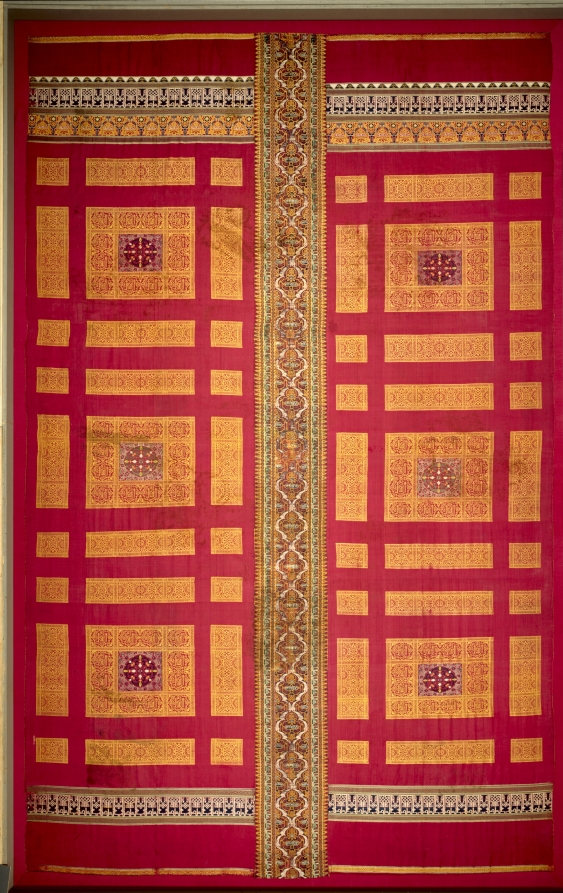
Heritage Research Artifact: The Alhambra Palace Silk Curtain
Introduction: A Fabric of Empire and Artistry
The Alhambra Palace Silk Curtain stands as a singular testament to the intersection of imperial ambition, artisanal mastery, and material luxury. Woven from the finest silk, this textile artifact embodies the legacy of imperial silk weaving, a tradition that spanned continents and centuries, from the workshops of Byzantium to the looms of Nasrid Granada. For the Lauren Fashion Heritage Lab, this curtain is not merely a decorative object but a primary source—a material document that reveals the socio-economic, aesthetic, and technological currents of its era. This paper examines the curtain’s materiality, its historical context within the Nasrid dynasty’s silk industry, and its enduring influence on luxury textile design, employing the precise, discerning language of London’s Savile Row to articulate its significance.
Materiality: The Silk as a Medium of Power
Silk, as a fiber, is inherently a marker of prestige. Its production, originating in China and guarded as a state secret for millennia, diffused westward through the Silk Road, reaching the Iberian Peninsula by the 8th century. The Alhambra Palace Silk Curtain, likely dating to the 14th or 15th century, is composed of mulberry silk—a filament of unparalleled luster, strength, and drape. The yarns are Z-twist in the warp and S-twist in the weft, a structural choice that enhances the fabric’s resilience and allows for intricate patterning. The weave is a lampas construction, a compound weave that employs a main warp and a binding warp to create a ground and a pattern, often in contrasting colors. Here, the ground is a deep crimson, dyed with kermes, a scale insect that yields a rich, fast color associated with royalty. The pattern, a repeating star-shaped medallion with interlacing geometric and floral motifs, is woven in gold thread—a gilded silver strip wrapped around a silk core. This use of metal thread is not decorative alone; it signifies the curtain’s function as a barrier of light and gaze, filtering the Andalusian sun while projecting the wealth and authority of the Nasrid court.
From a Savile Row perspective, the hand of this silk is crisp yet supple, akin to a fine worsted wool suiting, but with a fluid weight that suggests a mid-weight drape. The fabric’s sett—the number of warp ends per inch—is exceptionally high, estimated at 120 to 140, a density that ensures durability and a smooth surface for the gold thread to catch light. This is not a fabric for casual use; it is a ceremonial textile, designed to be seen from a distance, its patterns legible in the soft, filtered light of the palace’s arcades. The finish is a calendered sheen, achieved through pressure and heat, which imparts a subtle gloss without compromising the silk’s natural luster. In tailoring terms, this curtain would be the equivalent of a bespoke evening coat—structured, opulent, and intended for a specific, elevated context.
Context: The Legacy of Imperial Silk Weaving in Nasrid Granada
The Alhambra Palace Silk Curtain must be understood within the broader legacy of imperial silk weaving, a tradition that the Nasrid dynasty (1232–1492) inherited and refined. The Nasrids, the last Muslim rulers of al-Andalus, controlled a territory that was a nexus of trade and craftsmanship. Granada’s silk industry was among the most sophisticated in the medieval world, with tiraz workshops—state-run textile manufactories—producing silks for the court, diplomatic gifts, and export. These workshops were staffed by skilled weavers, many of whom were Mudejars (Muslims living under Christian rule after the Reconquista), who preserved and transmitted techniques such as brocading, samite weaving, and taqueté.
The curtain’s design reflects the Nasrid aesthetic, a synthesis of Islamic geometric abstraction and Hispano-Moorish naturalism. The star-shaped medallion, a motif derived from Islamic cosmology, symbolizes the unity of the divine and the temporal. The interlacing vines and leaves, known as ataurique, are stylized but organic, echoing the gardens of the Generalife. This visual language is not merely decorative; it is a political statement. The Nasrids, surrounded by the expanding Christian kingdoms of Castile and Aragon, used silk as a tool of soft power. The Alhambra’s silks were displayed during embassies and ceremonies, impressing visitors with the dynasty’s wealth and cultural sophistication. The curtain, hanging in the Hall of the Ambassadors or the Court of the Lions, would have been a backdrop to negotiations, its gold threads catching the light as a reminder of Granada’s enduring prestige.
The legacy of imperial silk weaving extends beyond the Nasrids. After the fall of Granada in 1492, the Spanish Crown appropriated the tiraz workshops, converting them into royal silk manufactories. The techniques and motifs of Nasrid silks influenced Renaissance textiles, particularly in Italy, where weavers in Lucca and Venice adapted the star medallions and gold threads for ecclesiastical vestments and aristocratic garments. This curtain, therefore, is a bridge between epochs, carrying the DNA of imperial ambition into the early modern period.
Significance for Lauren Fashion Heritage Lab
For the Lauren Fashion Heritage Lab, the Alhambra Palace Silk Curtain offers a masterclass in material storytelling. Its materiality—the silk, the gold, the dye—speaks to the global networks of trade and labor that underpin luxury fashion. Its context—the Nasrid court’s use of textiles as instruments of diplomacy and identity—resonates with contemporary discussions of cultural appropriation, heritage branding, and sustainable luxury. The curtain’s construction—the lampas weave, the high sett, the metal thread—provides a technical benchmark for modern textile innovation, reminding us that true luxury is rooted in craftsmanship, not mass production.
In the language of Savile Row, this artifact is bespoke in the truest sense: a one-of-a-kind creation, tailored to its environment and purpose. Its preservation—now housed in the Museo de la Alhambra—is a testament to the enduring value of heritage textiles. For the Lab, it serves as a reference point for future collections, inspiring designs that honor the past while pushing the boundaries of materiality and form. The Alhambra Palace Silk Curtain is not a relic; it is a living document of how silk, as a medium, can weave together power, beauty, and history.
Conclusion
The Alhambra Palace Silk Curtain is a heritage artifact of profound significance. Its silk materiality embodies the legacy of imperial weaving, from the Nasrid tiraz to the global luxury industry. Its design and construction reflect a sophisticated understanding of textile engineering and aesthetic power. For the Lauren Fashion Heritage Lab, it is a reminder that the finest fabrics are not merely commodities but carriers of culture. In the tradition of Savile Row, where cloth is the foundation of identity, this curtain stands as a benchmark of what silk can achieve when it is woven with purpose, precision, and pride.