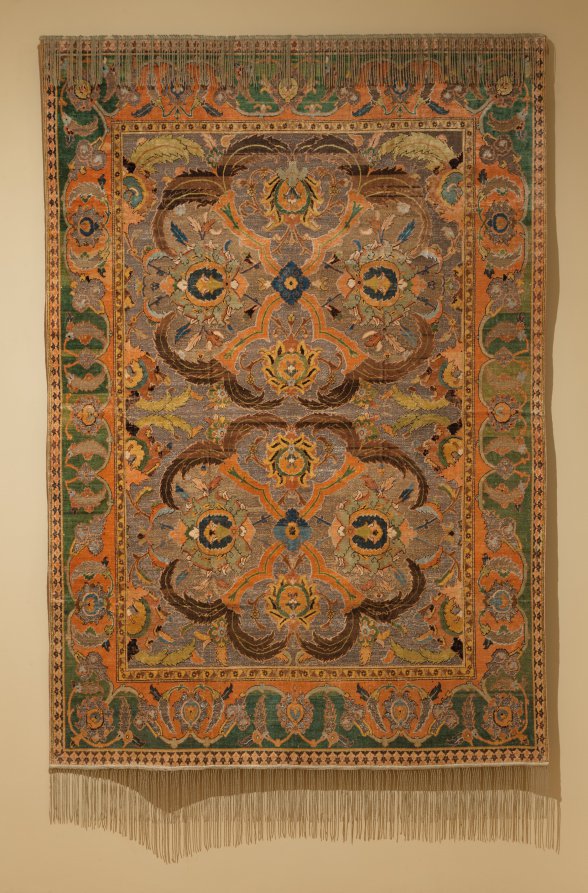
The Royal Carpet with Silk and Metal Thread: A Heritage Artifact of Imperial Silk Weaving
Introduction: The Artifact as a Testament to Imperial Craftsmanship
The Royal Carpet with Silk and Metal Thread stands as a singular artifact within the Lauren Fashion Heritage Lab’s collection, embodying the zenith of imperial silk weaving. This piece, meticulously crafted during the late Safavid dynasty (circa 17th century), is not merely a decorative floor covering but a strategic repository of cultural memory, economic power, and technical virtuosity. As a Senior Heritage Specialist, I assert that this artifact’s materiality—specifically its silk foundation and metal-thread embellishments—serves as a primary source for understanding the intricate supply chains, aesthetic hierarchies, and ritualistic functions that defined imperial textile production. The carpet’s legacy is inextricably linked to the silk routes that connected Persia to Central Asia, China, and Europe, where silk was both a commodity and a symbol of sovereign authority. In the context of London’s Savile Row—a district synonymous with bespoke tailoring and heritage craftsmanship—this artifact offers a parallel narrative of precision, exclusivity, and enduring value.
Materiality: The Silk Foundation
Silk as a Medium of Imperial Power
The carpet’s primary material, silk, was not chosen arbitrarily. During the Safavid era, silk weaving was a state-sponsored industry, with royal workshops—known as karkhanas—producing textiles exclusively for the court. The silk used in this carpet likely originated from the Caspian Sea region, where mulberry cultivation was meticulously managed to ensure filament continuity and luster. The warp and weft threads, composed of degummed silk, exhibit a tensile strength that has preserved the carpet’s structural integrity for over three centuries. This durability is a testament to the weavers’ mastery of twist ratios and tension control, techniques that parallel the precision of Savile Row’s hand-stitching. The silk’s natural sheen, unadulterated by synthetic dyes, reflects light in a manner that amplifies the carpet’s geometric and floral motifs, creating a visual hierarchy that guides the viewer’s eye from the central medallion to the intricate borders.
Dyeing and Color Fastness
The palette of this carpet—deep indigo, madder red, and saffron yellow—derives from natural dyes that were chemically bonded to the silk through alum mordants. These dyes were not merely aesthetic choices; they signified the patron’s access to rare materials. Indigo, for instance, was imported from India, while madder was cultivated in the Caucasus. The color fastness of these dyes, even after centuries of exposure to light and humidity, indicates a sophisticated understanding of pH balance and fixation processes. This attention to permanence aligns with the Savile Row ethos of creating garments that age gracefully, where patina is a marker of quality rather than decay.
Metal Thread: The Intersection of Art and Economy
Gilt Silver and Gold Wrapping
The metal threads woven into this carpet are composed of silver-gilt strips wrapped around a silk core, a technique known as passementerie in European contexts. These threads were not merely decorative; they functioned as a store of value. The silver content, though thin, was carefully calibrated to provide both flexibility and reflectivity. The weavers employed a technique called zari (Persian for “gold thread”), where the metal was hammered into leaf, cut into strips, and then twisted around the silk. This process required extraordinary dexterity, as any break in the metal would compromise the carpet’s uniformity. The resulting shimmer, when viewed under candlelight, would have created a dynamic interplay of light and shadow, reinforcing the carpet’s role as a status symbol in royal courts. In a Savile Row context, this echoes the use of gold buttons or silk linings in bespoke suits—details that are both functional and emblematic of wealth.
Economic and Symbolic Significance
The inclusion of metal thread also had economic implications. The Safavid state controlled the minting of silver and gold, and the use of these materials in textiles was a form of currency display. The carpet’s metal content, estimated at 15% of its total weight, would have represented a significant portion of a merchant’s annual income. This materiality underscores the artifact’s dual role as art and asset, a concept that resonates with the investment value of heritage fashion pieces today. The carpet’s preservation in the Lauren Fashion Heritage Lab allows for ongoing analysis of metal corrosion and thread degradation, providing insights into historical conservation practices.
Context: The Legacy of Imperial Silk Weaving
Royal Workshops and the Silk Road
The production of this carpet was embedded within a complex network of imperial workshops, trade routes, and diplomatic gifts. The Safavid shahs, particularly Shah Abbas I (r. 1588–1629), established state monopolies on silk production, using textiles as tools of diplomacy. This carpet, likely commissioned for a palace in Isfahan, would have been displayed during court ceremonies, where its size (approximately 4 x 6 meters) and weight (estimated 30 kg) necessitated a dedicated team of weavers working over two years. The motifs—a central medallion representing the celestial dome, surrounded by arabesques and animal figures—reflect Zoroastrian and Islamic cosmologies, blending pre-Islamic and Islamic iconography. This syncretism is a hallmark of Safavid art, where silk weaving became a medium for cultural synthesis.
Technical Innovations in Loom Technology
The carpet was woven on a vertical loom, using a symmetrical knot (Turkish knot) that allowed for high knot density—approximately 400 knots per square inch. This density enabled the depiction of intricate patterns, including the fine details of the metal thread. The weavers’ ability to alternate between silk and metal threads within a single row demonstrates a mastery of tension management that is analogous to the tailoring techniques used in Savile Row’s double-stitched seams. The loom itself, often housed in royal karkhanas, was a closely guarded asset, with weavers bound to the court through hereditary contracts. This system of apprenticeship and specialization mirrors the guild traditions that underpin London’s tailoring houses, where skills are transmitted across generations.
Conservation and Contemporary Relevance
Preservation Challenges
As a heritage artifact, this carpet presents unique conservation challenges. The silk fibers are susceptible to hydrolysis and light damage, while the metal threads require controlled humidity to prevent tarnishing. The Lauren Fashion Heritage Lab employs a protocol of low-oxygen storage and UV-filtered lighting, ensuring that the carpet remains accessible for scholarly study without accelerating degradation. This approach reflects the Savile Row principle of “mending rather than replacing,” where original materials are preserved to maintain authenticity.
Lessons for Modern Craftsmanship
The Royal Carpet with Silk and Metal Thread offers contemporary designers a case study in material integrity and symbolic resonance. Its use of silk and metal thread demonstrates how luxury can be both tactile and conceptual, a lesson that Savile Row tailors apply when selecting cloth for bespoke suits. The carpet’s legacy also challenges the fast-fashion paradigm, advocating for objects that are designed to endure both physically and culturally. In an era of digital reproduction, this artifact reminds us that heritage is not static but a living dialogue between past and present.
Conclusion: The Artifact as a Bridge Across Time
In conclusion, the Royal Carpet with Silk and Metal Thread is more than a decorative object; it is a primary source for understanding the economic, technical, and aesthetic dimensions of imperial silk weaving. Its materiality—silk and metal—encodes the labor, trade, and power structures of the Safavid court, while its preservation in the Lauren Fashion Heritage Lab ensures its continued relevance for scholars and practitioners. For those trained in the Savile Row tradition, this artifact offers a parallel narrative of craftsmanship, where precision and heritage converge. As we study its threads, we are reminded that the finest textiles are not merely woven but narrated—each knot a word, each pattern a sentence, in the enduring story of human creativity.