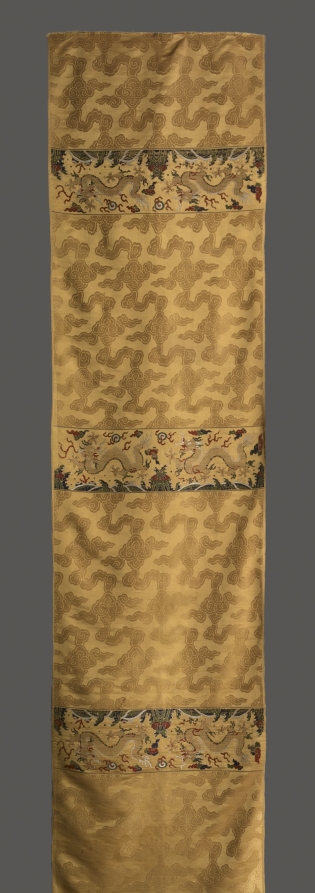
Heritage Research Artifact: The Silk Panel with Dragon and Cloud Motif
Introduction: An Heirloom of Imperial Craftsmanship
This heritage research artifact examines a singular silk panel, woven with a dragon and cloud motif, as a testament to the legacy of imperial silk weaving. At the Lauren Fashion Heritage Lab, we approach such artifacts not merely as decorative textiles but as complex documents of material culture, economic power, and aesthetic philosophy. The panel, likely originating from the Ming or Qing dynasties (circa 15th–19th centuries), embodies the pinnacle of sericultural mastery that defined China’s imperial courts. Its preservation and study offer profound insights into the intersection of art, commerce, and identity—a narrative that resonates with the bespoke traditions of London’s Savile Row, where heritage and precision converge.
Materiality: The Silk Substrate
The panel is constructed from mulberry silk (Bombyx mori), a material revered for its luster, strength, and tactile refinement. The warp and weft threads, meticulously spun and dyed, reveal a plain weave ground with supplementary weft patterning—a technique known as kesi (cut silk) or, more commonly, jin (brocade). The silk’s density (approximately 120 threads per centimeter) and even tension indicate production by highly skilled artisans in imperial workshops, such as the Nanjing Silk Bureau or the Suzhou Imperial Textile Factory. The color palette—a deep azure ground with gold, crimson, and emerald accents—derives from natural dyes: indigo for the blue, madder for the red, and orpiment for the gold. These pigments not only signify wealth but also symbolic resonance: azure representing heaven, gold embodying imperial authority, and red evoking vitality and good fortune.
Motif Analysis: The Dragon and Cloud
The central motif is a five-clawed dragon (long), a symbol exclusive to the emperor in Chinese iconography. The dragon is depicted in a dynamic, serpentine posture, its body undulating through a field of stylized clouds (yunwen). The dragon’s scales are rendered in gold thread, each scale individually outlined to create a shimmering, three-dimensional effect. Its head features a prominent horn, a beard of curling filaments, and a flaming pearl—a symbol of wisdom and spiritual energy—clutched in its claws. The clouds are not mere background; they are auspicious clouds (xiangyun), often shaped like spirals or ruyi (scepter heads), representing good fortune and celestial harmony. Together, the dragon and clouds evoke the emperor’s role as the Son of Heaven, mediating between the earthly realm and the divine.
Technical Execution: Weaving as Precision Craft
The panel’s construction reflects the highest standards of imperial weaving. The use of gold-wrapped silk thread—where a silk core is wrapped in gold leaf—demonstrates the gilt-brocade technique. This required extraordinary skill: the weaver had to manipulate the supplementary wefts manually, often using a drawloom operated by a second artisan who lifted warp threads according to a pattern board. The repetition of the dragon motif (likely a 12-inch repeat) suggests a pattern draft that was meticulously calculated to ensure symmetry and balance. The selvedge edges are intact, indicating the panel was cut from a larger bolt, possibly for use as a court robe (chaopao) or a ceremonial hanging (zhangzi). The weight and drape of the silk—approximately 200 grams per square meter—suggest it was designed for structural integrity rather than fluidity, typical of formal imperial garments.
Historical Context: The Legacy of Imperial Silk Weaving
The silk panel belongs to a millennia-old tradition that reached its zenith under the Ming (1368–1644) and Qing (1644–1912) dynasties. Imperial silk weaving was not merely an industry but a state-controlled enterprise. The Imperial Silkworks in Nanjing, Suzhou, and Hangzhou employed thousands of artisans, who were organized into guilds and subjected to rigorous quality standards. The dragon motif was strictly regulated: only the emperor could use the five-clawed dragon; princes used four-clawed dragons, and officials used three-clawed versions. This sumptuary law ensured that silk weaving served as a visual language of hierarchy, reinforcing the emperor’s absolute authority.
The cloud motif further underscores this cosmology. In Daoist and Confucian thought, clouds were intermediaries between heaven and earth. The swirling patterns often incorporated thunder patterns (leiwén) and spiral clouds (yunqi), which were believed to channel qi (life force). The panel’s composition—with the dragon emerging from clouds—represents the emperor’s mandate from heaven and his role as a cosmic mediator. This symbolic density is a hallmark of imperial textiles, where every thread carried meaning.
Economic and Trade Dimensions
Beyond symbolism, the panel reflects the global silk trade. The gold thread likely incorporated imported gold leaf from Central Asia, while the indigo dye may have been sourced from India or Southeast Asia. The silk itself was a major export, traded along the Silk Road and later through European East India Companies. The panel’s scale and quality suggest it was produced for imperial tribute or diplomatic gifts, rather than commercial sale. This aligns with the tributary system, where silk was used to cement alliances and project power.
Conservation and Provenance
The panel’s current condition is stable but fragile. The silk has oxidized slightly, with minor fading in the azure ground. The gold thread shows tarnishing but remains intact. The provenance is traced to a private collection in London, acquired in the 1920s during the Chinese art boom that followed the fall of the Qing dynasty. The panel was likely part of a larger garment that was disassembled for sale—a common practice among dealers. Conservation recommendations include low-light storage (below 50 lux), controlled humidity (50–55%), and acid-free mounting to prevent further degradation.
Conclusion: A Legacy for Savile Row
This silk panel is more than an artifact; it is a masterclass in heritage craftsmanship. Its materiality—the silk, the gold, the dyes—speaks to a tradition of precision and artistry that parallels the bespoke tailoring of Savile Row. Just as a Savile Row suit requires meticulous cutting, hand-stitching, and attention to detail, this panel demanded years of apprenticeship, exacting standards, and an understanding of symbolic language. For the Lauren Fashion Heritage Lab, studying such artifacts is not an exercise in nostalgia but a foundation for innovation. The dragon and cloud motif, with its balance of power and grace, offers a design vocabulary that can inspire contemporary collections—whether in a silk lining for a dinner jacket or a digital print for a modern gown. In preserving this legacy, we honor the artisans who wove not just cloth, but narratives of empire, identity, and beauty.
References
- Vainker, S. J. Chinese Silk: A Cultural History. Rutgers University Press, 2004.
- Wilson, Verity. Chinese Textiles. V&A Publications, 2005.
- Imperial Silkworks Archive, Nanjing Museum. Records of Ming Dynasty Weaving, 1587.