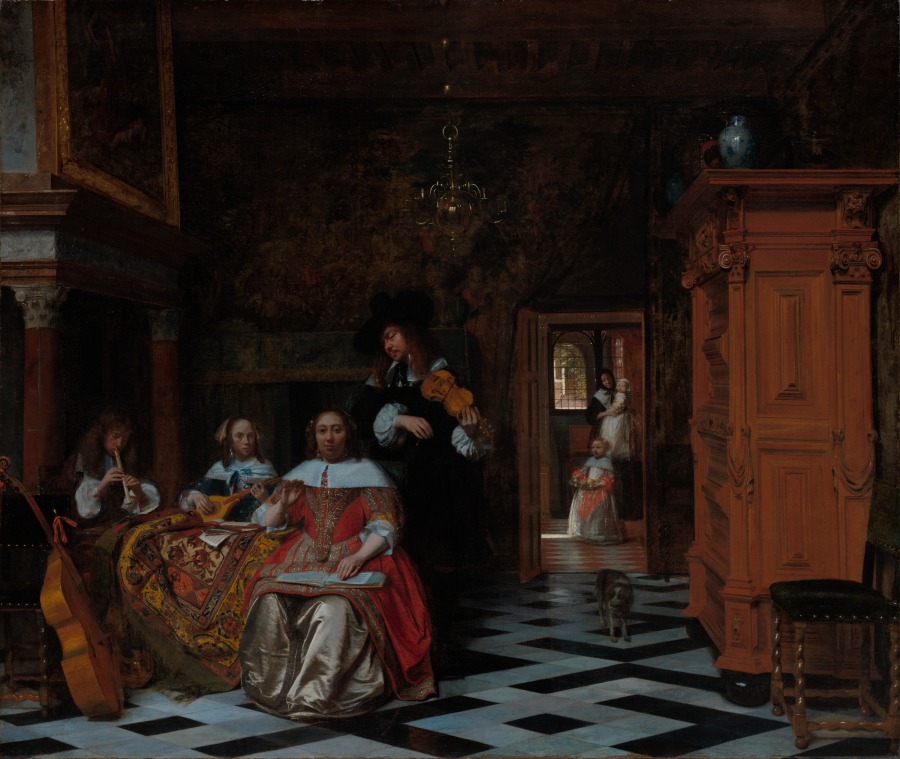
A Scrutiny of Line and Luminescence: The Domestic Concert as Woven Testament
To apprehend the artifact in question—a portrait of a familial ensemble engaged in musical performance, rendered not in pigment but in silk—one must first dismiss any notion of the merely decorative. This is not an illustration; it is an architectural achievement in thread. The substrate itself, a length of flawless kesi silk, speaks of a legacy so profound it commands silence before appreciation. Imperial silk weaving, particularly the slit-tapestry technique of kesi, originated not as a craft but as a sovereign technology. Its purpose: to translate the celestial order, the authority of the dragon, and the harmony of the cosmos into wearable, displayable testament. That this pinnacle of technical and artistic endeavour has been deployed to capture a scene of domestic concord is, in itself, a statement of profound cultural significance. It represents not a dilution of imperial language, but its sophisticated democratisation—the application of a grammar once reserved for emperors to articulate the virtues of the scholarly gentry home.
The Loom as Atelier: A Technical Dissection
Observe, if you will, the material intelligence manifest in every square inch. The kesi technique, whereby wefts of coloured silk are woven only where their specific hue is required, creates discrete blocks of colour and, necessarily, minute vertical slits between them. This is not a limitation but the very source of its genius. The artisan-weaver, working from the reverse of the tapestry, must possess the foresight of a master strategist. Each decision is final; there is no over-painting. The crisp, calligraphic lines defining the edge of a pipa's neck, the subtle modulation of shade on a silk sleeve as it catches the implied light, the intricate fretwork of a side table—all are built pixel by meticulous pixel of silk thread. The lustre is inherent, not applied. The deep, resonant indigo of a scholar's robe absorbs light, while the pale, creamy silk of a daughter's gown reflects it, creating a visual harmony that mirrors the auditory harmony it depicts. The material, thus, is not a passive ground but an active participant in the narrative, its very luminosity and texture performing meaning.
Composition as Social Symphony
The scene’s arrangement is a masterclass in coded communication. The family is positioned not as isolated individuals, but as interconnected components of a single, harmonious instrument. The patriarch, often centred or slightly offset, handles a stringed instrument like the guqin—an artefact synonymous with scholarly refinement and philosophical depth. His posture is erect yet relaxed, his expression one of absorbed contemplation rather than performance. This is the anchor of the composition, the foundational bass note. Flanking him, perhaps a son with a flute, representing the conduit of breath and spirit, and a daughter gently plucking a pipa, her demeanour one of graceful focus. The mother may be depicted listening, her hands resting lightly on a tea service, completing the circle of cultural cultivation. Every object within the woven frame is curated: the scholar’s rock, the calligraphy scroll partially unfurled, the pruned orchid. Each is an emblem of a specific virtue—resilience, literary accomplishment, understated beauty. Together, they form a complete ecosystem of Confucian ideal, where aesthetic discernment is inseparable from moral cultivation.
Legacy in the Weave: From Imperial Atelier to Familial Chronicle
This is where the artifact transcends its immediate subject. By employing the exacting, historically loaded medium of imperial silk tapestry to depict this private scene, a powerful assertion is made. The family declares itself a microcosm of the well-ordered state. The harmony they produce musically is presented as analogous to the social and political harmony governed by a virtuous emperor. The investment in such a portrait was immense, requiring months, if not years, at the loom of a master weaver. It was, therefore, less a casual commission than a deliberate act of legacy-building—a permanent, luminous record of familial unity, cultural sophistication, and social standing. Unlike an oil painting, which can be replicated, the kesi portrait is inherently unique, its very fibres a testament to the specific time, place, and patronage that brought it into being.
Conclusion: An Enduring Resonance
To conclude, this woven portrait of a family playing music stands as a peerless artifact of heritage. It represents the confluence of technical supremacy, social narrative, and philosophical depth, all encoded within the luxurious language of silk. It speaks of a world where beauty was not an accessory but an infrastructure, where the domestic sphere was seen as the essential theatre for civilised values, and where the most revered imperial craft could be harnessed to celebrate the quiet, profound symphony of familial life. The threads may be silent, but to the discerning eye, they resonate with the echoes of plucked strings and the enduring hum of a perfected cultural ideal. It is, in the final estimation, a masterpiece of quiet assertion—a declaration that within these walls, governed by harmony and respect, lies the true essence of an enduring civilisation.