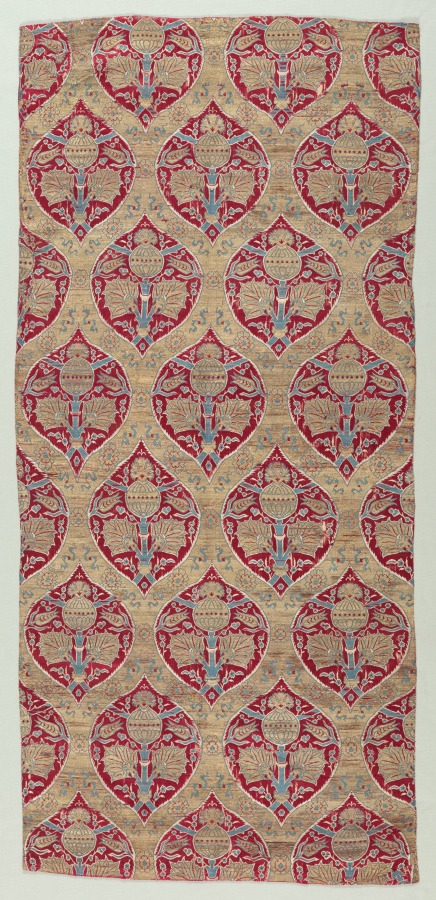
The Ogival Lattice: An Anatomy of Imperial Authority in Silk
To comprehend the ogival lattice, one must first dismiss the modern inclination towards mere ornament. This is not decoration; it is architecture. In the hand of the imperial silk weaver, it became a manifestation of structured power, a geometric assertion of order upon the fluid, organic world. The ogival form—a pointed arch, derived from sacred geometry and Eastern architectural triumphs—transcends its stone-bound origins when rendered in filament. Its repetition across the field of silk creates a framework, a cellular structure of immense strength and visual sovereignty. The introduction of a pronounced horizontal band, however, is the masterstroke. It is the counterbalance, the deliberate and sobering intervention within the vertical aspiration of the arches.
Materiality as Prerogative: The Silk Ground
Silk, in this context, is far more than a substrate. It is the non-negotiable prerequisite. The legacy of imperial weaving is, at its core, a narrative of controlled scarcity and technological supremacy. The cultivation of the silkworm, the reeling of filaments of consistent micron, the creation of a warp capable of holding the immense complexity of a pattern loom—these were state secrets, industries guarded as jealously as any treasury. The resulting cloth possessed a luminosity, a depth of colour, and a tensile strength that lesser fibres could not aspire to. It accepted dye with a jewel-like intensity and, when woven into an ogival lattice, the play of light across the subtle relief of the weave would animate the geometry, making it appear not printed upon the surface but emerging from within the very matrix of the cloth. This was material as message: the empire commanded not only men and land, but the very essence of nature’s most luxurious product, refining it into a symbol of its own cultivated order.
Deconstructing the Motif: Lattice and Band
The ogival lattice operates on principles of implied infinity. Each arch, a self-contained universe of symmetry, links seamlessly with its neighbours, suggesting a network extending beyond the garment’s edge—a visual metaphor for boundless dominion. The precision of its execution, the absolute regularity of the repeat, speaks of a bureaucratic mind, of pattern books and loom configurations that brook no deviation. It is the visual language of the court, of ritual, and of a hierarchy expressed through regulated splendour.
The horizontal design element, however, introduces a narrative tension. It may manifest as a band of contrasting foliate scrollwork, a stripe of intricate calligraphy, or a simpler ribbed texture. Its function is tripartite. First, it acts as a structural anchor, grounding the vertical lift of the arches, providing a visual datum line that speaks of stability and foundation. Second, it serves as a hierarchical demarcation. In a robe, this band would often align with the hem, cuff, or chest, delineating the body of the wearer according to imperial sumptuary codes, segmenting the field of glory into prescribed zones. Third, it represents a stylistic dialogue, often incorporating motifs from other artistic traditions—perhaps a cloud collar motif or a wave pattern—thereby weaving a subtler story of cultural assimilation or conquered aesthetics into the fabric of power.
The Legacy of the Loom: From Imperial Atelier to Modern Idiom
The transition of this motif from the rarefied air of the imperial workshop to a broader lexicon of luxury is a study in dilution and adaptation. The ogival lattice, stripped of its specific symbolic weight, retains its inherent authority. It communicates a heritage of rigour and an expectation of excellence. In the context of a modern atelier—be it in Lyons, Como, or beyond—the successful interpretation of this pattern hinges on a respect for its intrinsic logic. The scale must be considered with an architect’s eye; the density of the weave must support the geometry without clumsiness; the horizontal element must be integrated, not merely applied.
To commission a cloth featuring an ogival lattice with horizontal banding today is to engage with this deep legacy. It is to understand that one is not selecting a ‘pattern’ but investing in a continuity of craftsmanship. The silk must be of a weight and handle worthy of the design’s provenance. The colours, even if modernised, should acknowledge the depth and subtlety achieved through historical dye mastery. The result should feel neither like costume nor pastiche, but rather a conscious, respectful evolution—a garment that carries within its very threads the quiet, formidable confidence of the imperial loom, translated for a contemporary silhouette.
In final analysis, the ogival lattice with horizontal design in silk is a testament to the fact that true luxury is never arbitrary. It is a calculated, intelligent, and historically resonant articulation of form. It reminds us that the most enduring symbols of power are not those that shout, but those that demonstrate an unassailable command over complexity, rendering it into something of serene and structured beauty. To wear such a pattern is to align oneself with a lineage where textile was not mere attire, but a deliberate and potent instrument of statecraft and identity. It is, in the most profound sense, a fabric of authority.