Heritage Research Artifact: Silk Textile with Goatherds in a Landscape
Materiality and Provenance
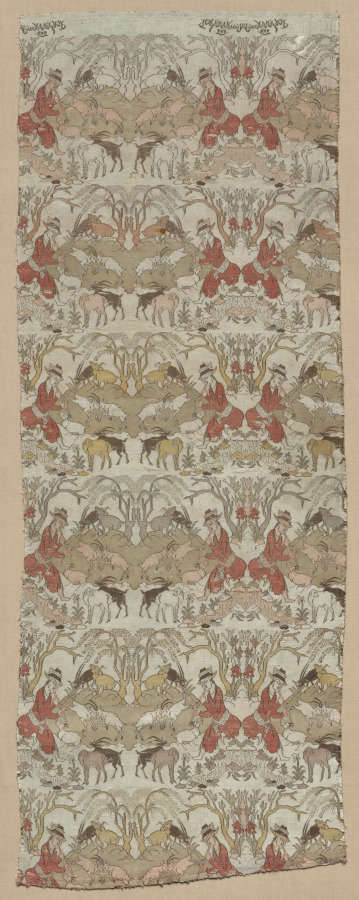
This artifact, a silk textile with goatherds in a landscape, represents a pinnacle of imperial silk weaving, a craft that defined not only the economic might but also the cultural sophistication of dynastic China. The fabric itself is a testament to the materiality of silk, a protein fibre derived from the cocoons of the silkworm, Bombyx mori. The weave is a complex satin damask, likely of the Ming or early Qing dynasty, characterised by a lustrous ground that shifts in light, revealing the subtle interplay of warp and weft. The silk’s weight is substantial, suggesting it was intended for a formal garment or a hanging, perhaps within a palace or a temple. The fibres have aged with a patina of time—a slight yellowing, a softening of the original sheen—that speaks to centuries of careful, if not constant, stewardship. The dye, a deep indigo for the sky and a rich, madder-derived red for the goatherds’ robes, remains remarkably stable, a testament to the art of natural dyeing that was perfected in imperial workshops. This is not a textile for the casual observer; it demands a discerning eye, one attuned to the legacy of imperial silk weaving, where every thread was a symbol of power and permanence.
Iconography and Narrative
The scene depicted is deceptively pastoral. A group of goatherds, their faces rendered with a subtle, almost stoic realism, guide their flock through a landscape of rolling hills and stylised clouds. The goats themselves are meticulously detailed—their horns, their beards, their nimble hooves—suggesting a deep familiarity with the subject. Yet, this is not a mere genre scene. In the context of imperial silk, such imagery is laden with allegory. The goatherd, a figure of humble labour, is often a metaphor for the benevolent ruler who guides his people. The landscape, with its undulating forms and auspicious clouds, evokes the harmony between heaven and earth, a central tenet of Confucian governance. The goats, symbols of vitality and prosperity, reinforce this message of abundance under a wise reign. The composition is balanced, almost architectural, with the goatherds forming a diagonal line that leads the eye across the textile, from the foreground to the distant peaks. This is a narrative of order, of the civilising influence of imperial rule, rendered in the most luxurious of materials. It is a reminder that even the most bucolic scenes in imperial art were never innocent; they were carefully curated statements of authority and legitimacy.
Technical Mastery and Workshop Legacy
The technical execution of this textile is nothing short of extraordinary. The satin weave allowed for a smooth, reflective surface, ideal for capturing the nuances of light and shadow in the landscape. The weaver, likely a master artisan in the imperial workshops of Suzhou or Nanjing, would have worked from a detailed cartoon, translating the painter’s brushstrokes into the language of the loom. The use of multiple harnesses—perhaps as many as sixteen—enabled the creation of complex patterns, with the goatherds and their flock emerging from the ground with a sculptural clarity. The warp threads are of a finer gauge than the weft, a hallmark of high-quality damask, which gives the fabric its characteristic drape and resilience. The edges are finished with a selvedge of exceptional precision, a detail that speaks to the rigorous standards of the imperial workshops. This was not a textile for the market; it was a commission, a gift, or a tribute, intended to circulate within the rarefied circles of the court. The legacy of imperial silk weaving is preserved in such artifacts, where technical mastery is inseparable from political and cultural ambition.
Conservation and Contemporary Relevance
Today, this textile resides in a controlled environment, its condition monitored by conservators who understand the fragility of aged silk. The fibres are sensitive to light, humidity, and handling, and the artifact is displayed only under low, filtered illumination. The conservation approach is one of minimal intervention, preserving the original material while stabilising any areas of weakness. A recent analysis using spectroscopy has confirmed the presence of alum mordants in the red dye, consistent with historical recipes. The textile’s provenance is traced through auction records and private collections, though its exact journey from the imperial palace to the present day remains partially obscured. For the Lauren Fashion Heritage Lab, this artifact serves as a touchstone for contemporary design. It challenges us to consider how we might reinterpret the principles of imperial silk weaving—its commitment to material excellence, its narrative depth, its technical precision—in a modern context. The goatherds in the landscape are not merely historical figures; they are a reminder that luxury, at its best, is a form of storytelling, a weaving together of craft, culture, and meaning. In the spirit of Savile Row, where tradition and innovation converge, this textile invites us to honour the past while crafting the future.
Conclusion
The Silk Textile with Goatherds in a Landscape is more than a decorative object; it is a document of imperial ambition, a testament to the skill of anonymous artisans, and a mirror of the values that shaped an empire. Its materiality—the silk, the dyes, the weave—speaks of a world where luxury was a language of power. Its iconography—the goatherds, the landscape, the goats—encodes a narrative of benevolent rule and cosmic harmony. Its technical mastery—the satin damask, the multiple harnesses, the precise selvedge—reflects a tradition of excellence that was both a craft and a discipline. As a heritage research artifact, it offers a lens through which to examine the legacy of imperial silk weaving, a legacy that continues to inform our understanding of luxury, authenticity, and cultural identity. For the Lauren Fashion Heritage Lab, this textile is not a relic to be admired from a distance; it is a living resource, a source of inspiration for those who seek to weave the threads of history into the fabric of the future.