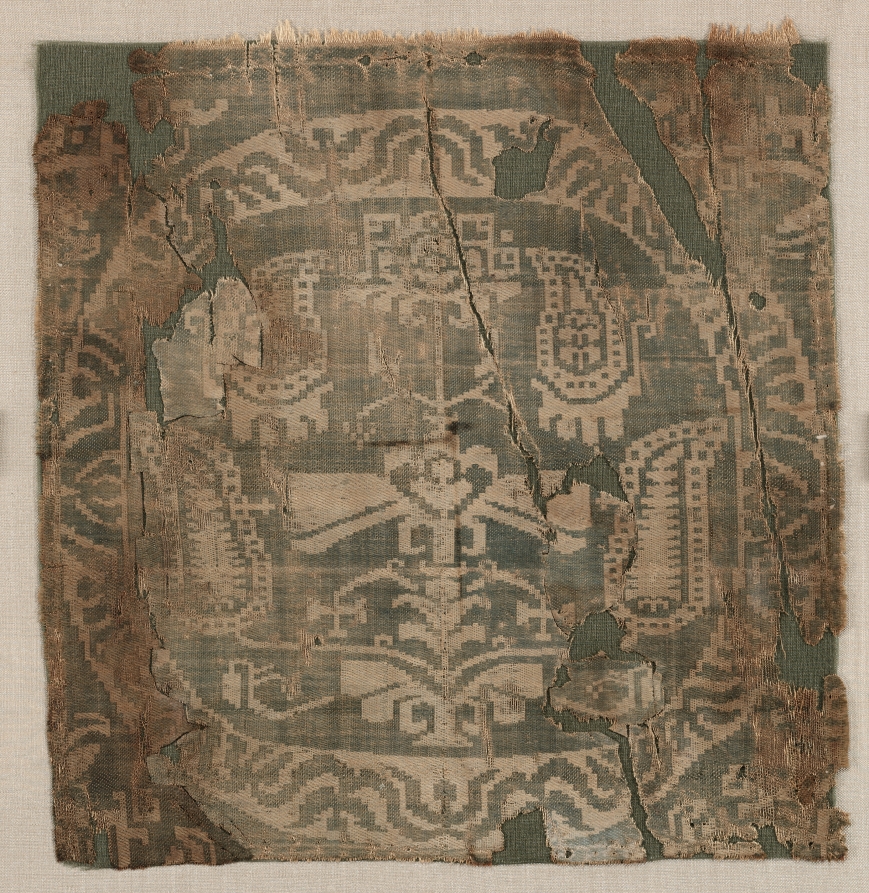
The Roundel from a Tunic with Palmette Tree: A Study in Imperial Silk Weaving and the Enduring Legacy of Craft
Introduction: A Fragment of Imperial Grandeur
The subject of this heritage research artifact—a Roundel from a Tunic with Palmette Tree, executed in silk—represents far more than a decorative textile fragment. It is a tangible relic of imperial silk weaving, a practice that for millennia served as a barometer of political power, economic might, and artistic sophistication across Eurasia. This roundel, likely originating from the Sasanian or early Islamic periods (circa 6th–8th centuries CE), embodies the pinnacle of technical mastery and symbolic language that defined the silk trade routes from Byzantium to Persia and beyond. At Lauren Fashion Heritage Lab, we approach such artifacts not merely as historical curiosities but as foundational blueprints for understanding the intersection of materiality, status, and enduring design principles—principles that continue to resonate in the bespoke tailoring traditions of London’s Savile Row.
Materiality: The Silk as a Conduit of Power
Silk, as a material, has always been synonymous with luxury, exclusivity, and imperial ambition. The Roundel from a Tunic with Palmette Tree is woven from a fine, lustrous silk, likely sourced from the sericulture centers of the Silk Road—perhaps from the workshops of Constantinople, Ctesiphon, or later, the Abbasid caliphates. The fiber’s natural sheen and tensile strength allowed for the creation of intricate patterns that could withstand the rigors of ceremonial use. In the context of imperial silk weaving, the choice of silk was not arbitrary; it was a deliberate assertion of dominion over distant lands and complex supply chains. The roundel’s materiality speaks to a system where raw silk was as valuable as gold, and its transformation into finished textiles was a state-sponsored endeavor. The weave structure—likely a compound twill or taqueté—demonstrates a sophisticated understanding of warp and weft manipulation, enabling the depiction of the palmette tree with precise, almost architectural clarity. This technical prowess is a direct antecedent to the rigorous hand-finishing techniques employed by Savile Row tailors, where the integrity of the fabric is paramount.
Iconography: The Palmette Tree as a Symbol of Eternity and Authority
The central motif of the roundel—the Palmette Tree—is a recurring symbol in imperial silk weaving, representing life, regeneration, and divine order. In Sasanian and early Islamic art, the palmette often served as a stylized representation of the Tree of Life, a concept that transcended religious and cultural boundaries. The roundel’s composition typically features a central tree with symmetrical, radiating palmettes, flanked by addorsed animals or mythical creatures, such as lions or griffins. This symmetry is not merely aesthetic; it reflects the cosmic balance that the emperor or caliph was believed to uphold. The palmette tree, with its roots in ancient Mesopotamian and Persian iconography, was a visual shorthand for the ruler’s role as the intermediary between heaven and earth. For Lauren Fashion Heritage Lab, this iconographic analysis is critical: it reveals how pattern and motif can encode power dynamics and cultural narratives. The same principle applies to the understated yet potent heraldry woven into the linings of a Savile Row suit—a subtle assertion of lineage and taste.
Context: The Legacy of Imperial Silk Weaving and Its Influence on Tailoring
The legacy of imperial silk weaving extends far beyond the courts of antiquity. The technical innovations and aesthetic principles developed in the production of roundels like this one laid the groundwork for the European silk industries of the Renaissance and beyond. By the 17th century, London’s Spitalfields weavers were producing silks that rivaled those of Lyon and Venice, drawing directly on the patterns and techniques transmitted along the Silk Road. This heritage is particularly relevant to Savile Row, where the tradition of using the finest silks for linings, pocket squares, and bespoke accessories is a direct continuation of the imperial silk weaving ethos. The roundel’s circular format, often used as a decorative appliqué or medallion on tunics, mirrors the precision required in tailoring—where every seam, buttonhole, and stitch must align with the garment’s overall architecture. The palmette tree’s repetitive, balanced design also informs the principles of pattern cutting and fabric matching, where symmetry and flow are non-negotiable.
Conservation and Interpretation: A Living Artifact
At Lauren Fashion Heritage Lab, we treat the Roundel from a Tunic with Palmette Tree as a living artifact—one that demands both rigorous conservation and creative interpretation. The silk’s fragility, evidenced by the subtle fading of its dyes (likely derived from madder, indigo, or kermes) and the occasional warp displacement, requires controlled environmental conditions: stable humidity (45–55%), low light levels (under 50 lux), and minimal handling. Yet, the artifact’s value is not solely in its preservation. We engage with it as a source of design inspiration, analyzing its color palette, motif scaling, and weave density to inform contemporary collections. For instance, the roundel’s use of negative space—the void between the palmette fronds—offers a lesson in restraint that is echoed in the clean lines of a Savile Row jacket. The artifact also serves as a pedagogical tool for our apprentices, who study its construction to understand the evolution of textile engineering. This approach ensures that the legacy of imperial silk weaving is not ossified in a museum case but is actively woven into the fabric of modern craftsmanship.
Conclusion: The Roundel as a Testament to Timeless Craft
The Roundel from a Tunic with Palmette Tree is more than a historical object; it is a testament to the enduring dialogue between material, maker, and meaning. In the context of imperial silk weaving, it represents the pinnacle of a globalized trade network that valued artistry as much as commerce. For Lauren Fashion Heritage Lab, it is a reminder that true luxury is not ephemeral but is built on generations of knowledge, precision, and respect for the medium. As we continue to uphold the standards of London Savile Row, we look to artifacts like this roundel not as relics of a bygone era, but as living blueprints for the future of bespoke tailoring. The palmette tree stands eternal, its branches reaching across centuries to remind us that the finest work is always rooted in heritage.