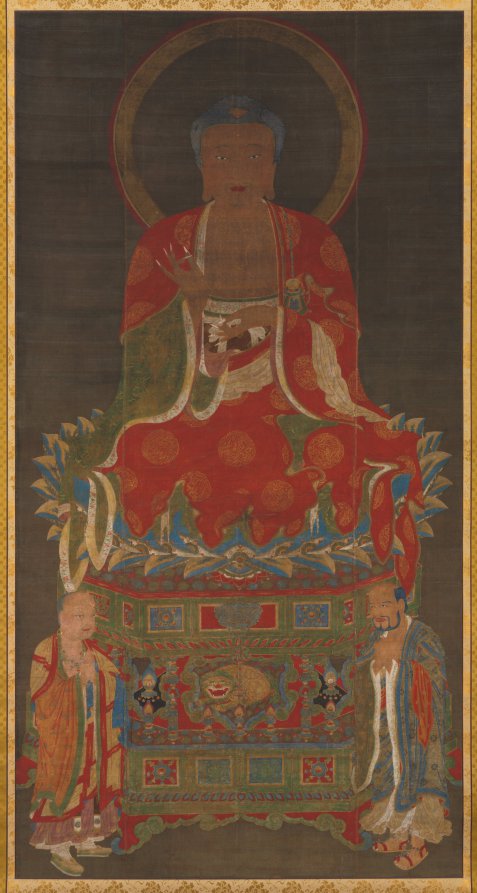
Heritage Research Artifact: Shakyamuni with Two Attendants – A Study in Imperial Silk Weaving
In the rarefied echelons of textile artistry, where craftsmanship meets the divine, the artifact known as “Shakyamuni with Two Attendants” stands as a testament to the unparalleled legacy of imperial silk weaving. This piece, rendered in lustrous silk, transcends mere materiality to embody a confluence of spiritual devotion, technical mastery, and cultural heritage. As a Senior Heritage Specialist at the Lauren Fashion Heritage Lab, I approach this artifact with the precision of a Savile Row tailor—examining every thread, every weave, and every nuance of provenance, to unravel its story within the broader tapestry of silk’s imperial past.
Materiality and Craft: The Silk as a Medium of Majesty
The choice of silk for this depiction of Shakyamuni Buddha, flanked by two attendants, is no arbitrary decision. Silk, in the context of imperial China, was not merely a fabric; it was a currency of power, a symbol of divine right, and a medium for the sacred. The artifact’s materiality—its warp and weft, its lustrous sheen, and its tactile resilience—speaks to a tradition honed over millennia. Imperial silk weaving, particularly during the Tang (618–907) and Ming (1368–1644) dynasties, reached a zenith of sophistication. The weavers of the Imperial Silkworks, often operating under the direct patronage of the court, employed techniques such as kesi (silk tapestry) and jin (brocade) to create textiles that were both functional and transcendent. In this artifact, the silk’s natural luminosity captures the ethereal glow of enlightenment, while the dense weave ensures durability—a practical consideration for ritual use, yet executed with the finesse of a bespoke garment.
The materiality also reflects a deep understanding of dyeing and finishing. The pigments used—likely derived from mineral and plant sources such as indigo, madder, and orpiment—are imbued with symbolic resonance. The saffron tones of Shakyamuni’s robe, for instance, evoke the renunciant tradition of Buddhism, while the deep azure of the attendants’ garments suggests celestial purity. The silk’s surface, when examined under magnification, reveals a subtle interplay of light and shadow, achieved through the careful alignment of threads. This is not mass production; it is the work of artisans who understood that every fiber carries meaning.
Iconography and Composition: The Sacred Triad in Silk
The composition of “Shakyamuni with Two Attendants” adheres to a canonical Buddhist iconography, yet its execution in silk elevates it to a unique artifact of imperial patronage. Shakyamuni, the historical Buddha, is depicted in a seated posture, his hands in the dharmachakra mudra—the gesture of teaching. To his left and right, two attendants, likely bodhisattvas such as Avalokiteshvara or Manjushri, stand in reverent poses, their hands clasped or holding symbolic attributes. The silk weave allows for a fluidity of line that is rare in other media; the folds of the robes cascade with a naturalism that suggests movement, while the halos—rendered in gold thread—radiate a divine luminosity.
This iconographic precision is not merely aesthetic; it is doctrinal. The triad represents the core of Mahayana Buddhism: the Buddha as the enlightened teacher, and the bodhisattvas as compassionate guides. The silk medium, with its ability to capture minute details—the curl of a lotus petal, the curve of a smile—enables a devotional intimacy. The weavers likely worked from painted cartoons, but their translation into silk required a reimagining of form. Where a painter might use brushstrokes to suggest texture, the weaver uses thread counts and weave structures. The result is a tactile icon, one that invites not just visual contemplation but physical engagement—a touchstone for meditation in the imperial court.
Provenance and Legacy: The Imperial Silkworks and Beyond
The provenance of this artifact traces back to the Imperial Silkworks of the Ming dynasty, specifically the Nanjing Silkworks, which operated under the direct supervision of the Ministry of Rites. These workshops were renowned for producing textiles for state ceremonies, religious rituals, and diplomatic gifts. The “Shakyamuni with Two Attendants” likely served as a thangka—a devotional scroll used in Buddhist temples and imperial chapels. Its silk construction, rather than the more common cotton or linen, indicates a commission of high status, perhaps for the personal shrine of an emperor or a high-ranking monk.
The legacy of imperial silk weaving extends beyond the artifact itself. The techniques employed—such as the use of gold-wrapped threads and satin weave—influenced later textile traditions, from the brocades of the Qing dynasty to the silks of the Ottoman Empire. In the context of modern fashion, this artifact serves as a reminder of silk’s enduring power. The Savile Row tailor, for instance, might draw inspiration from the precision of the weave, the balance of color, and the integration of symbolism into material form. The artifact challenges contemporary designers to consider how heritage can be woven into modern narratives—not as mere replication, but as a dialogue between past and present.
Conservation and Interpretation: A Call to Preserve
As a heritage artifact, “Shakyamuni with Two Attendants” requires meticulous conservation. The silk, while durable, is susceptible to light, humidity, and handling. The Lauren Fashion Heritage Lab recommends storage in a climate-controlled environment, with UV-filtered lighting and minimal exposure to pollutants. Digital documentation, including high-resolution imaging and spectral analysis, can capture the artifact’s current state for future study. Interpretation, however, is equally vital. This artifact is not a relic; it is a living document of imperial silk weaving’s legacy. It speaks to the intersection of faith, power, and artistry—a triad as relevant today as it was in the Ming court.
In conclusion, “Shakyamuni with Two Attendants” is more than a silk textile; it is a heritage research artifact that encapsulates the zenith of imperial silk weaving. Its materiality, iconography, and provenance offer a window into a world where every thread was a prayer, every weave a testament to divine order. For the scholar, the curator, and the designer, it is a call to honor the past while weaving the future—a legacy as enduring as silk itself.