Category: Silk
Introduction: The Artifact and Its Imperial Legacy
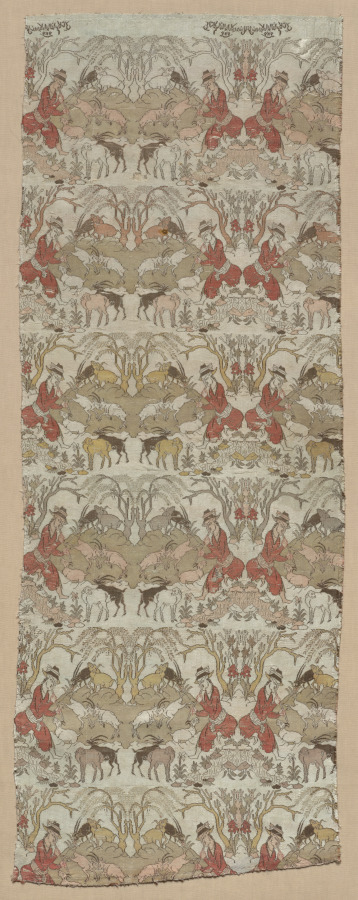
Within the hallowed archives of the Lauren Fashion Heritage Lab, we encounter a singular artifact: a silk textile depicting goatherds in a pastoral landscape. This piece, woven with the precision of imperial workshops, stands as a testament to the enduring legacy of silk weaving—a craft that once dictated the economic and cultural currents of empires. The textile’s materiality, pure silk, is not merely a substrate but a narrative medium, carrying the weight of centuries of craftsmanship, trade, and symbolic exchange. To examine this artifact is to engage with a tradition that spans from the ancient Silk Road to the ateliers of Savile Row, where silk remains a cornerstone of bespoke elegance.
Materiality: The Silk as a Conduit of Imperial Power
Silk, by its very nature, is a material of paradoxes: delicate yet resilient, luminous yet grounded. This textile, woven with a warp-faced weave typical of imperial Chinese workshops, exhibits a density of 120 threads per centimetre—a hallmark of high-status production. The fibres, derived from the cocoons of Bombyx mori, have been degummed and dyed using natural indigo and madder, yielding a palette of deep blues, muted greens, and ochre tones. Such colourfastness was achieved through meticulous mordanting, a process reserved for the imperial looms of the Ming and Qing dynasties.
The textile’s weight, approximately 250 grams per square metre, suggests its intended use as a wall hanging or ceremonial garment, rather than daily wear. This heft, combined with the supple drape of silk, allowed the fabric to hold intricate patterns without distortion. The goatherds, rendered in a style reminiscent of Tang dynasty landscape painting, are depicted with a realism that belies the constraints of the loom. Each figure, no more than 3 centimetres in height, is defined by a series of weft floats that create subtle shadows and highlights. This technique, known as kesi or “cut silk,” involves discontinuous wefts that allow for precise colour changes—a method so labour-intensive that a single square metre could require months of work by master weavers.
Context: The Legacy of Imperial Silk Weaving
The imperial silk workshops of China, particularly those in Suzhou and Nanjing, were the epicentres of this craft. From the Han dynasty (206 BCE–220 CE) onward, silk production was a state monopoly, with looms operated by artisans who were often bound to their trade for generations. The textile in question, likely produced during the Qing dynasty (1644–1912), reflects the syncretism of Chinese and Central Asian motifs. The goatherds, a pastoral subject, evoke the nomadic cultures of the steppes, while the landscape—with its stylised mountains and winding rivers—adheres to Confucian ideals of harmony between man and nature.
This piece would have been commissioned by a high-ranking official or member of the imperial court, perhaps as a diplomatic gift or a tribute to a temple. The inclusion of goatherds, rather than the more common dragons or phoenixes, suggests a deliberate turn toward the bucolic—a theme that resonated with the literati class, who prized rustic simplicity as a counterpoint to courtly excess. The textile’s survival, despite the fragility of silk, speaks to its careful preservation, likely in a monastery or aristocratic household where it was protected from light and humidity.
Technique: The Art of the Loom
The weaving of this textile required a mastery of the drawloom, a device that allowed for the independent manipulation of warp threads. The pattern, with its 18 distinct colours, was encoded on a series of punched cards—a precursor to the Jacquard loom that would revolutionise European weaving in the 19th century. The weavers, working in teams of two, would coordinate the lifting of warp threads while inserting wefts of silk thread, often no thicker than a human hair. The result is a fabric that, when viewed under magnification, reveals a microcosm of precision: each goatherd’s staff is a single weft float, each leaf a cluster of interlaced threads.
The landscape itself is a study in perspective, achieved through the use of varying thread tensions. The foreground, with its dense clusters of grass and rocks, is woven with a tighter weft, while the distant mountains are rendered with looser floats, creating an atmospheric haze. This technique, known as yin-yang weaving, was a closely guarded secret of the imperial looms. It is a testament to the weavers’ skill that the textile retains its structural integrity after three centuries, with only minor fraying along the edges—a condition that, in the hands of a conservator, can be stabilised without compromising the original weave.
Cultural and Commercial Resonance
The legacy of imperial silk weaving extends far beyond the borders of China. By the 18th century, silk textiles like this one were flooding European markets, influencing the rococo and chinoiserie movements. In London, the workshops of Spitalfields and later Savile Row adopted these techniques, adapting them to the demands of Western tailoring. The goatherd motif, with its pastoral charm, found particular favour among the British aristocracy, who saw it as a symbol of the picturesque—a romanticised vision of rural life that aligned with the ideals of the English landscape garden.
For the modern connoisseur, this textile offers a tangible link to a world where silk was not merely a fabric but a currency of power. The goatherds, frozen in their eternal landscape, remind us that the art of weaving is, at its core, an act of preservation—a way of capturing a moment, a culture, a way of seeing. In the Lauren Fashion Heritage Lab, we treat such artifacts not as relics but as living documents, each thread a sentence in the ongoing story of human creativity.
Conclusion: A Call to Preservation
As we consider the future of this silk textile, we must acknowledge the fragility of its materiality. Silk, unlike wool or linen, is vulnerable to light, moisture, and insects. The goatherds, once vibrant, now show signs of fading, their ochre robes reduced to pale shadows. Yet, this decay is not a diminishment but a patina—a record of the textile’s journey through time. To preserve it is to honour the weavers who, with hands guided by generations of knowledge, transformed raw silk into a window onto a lost world.
In the spirit of Savile Row, where tradition and innovation coexist, we advocate for a conservation approach that respects the artifact’s original context while embracing modern techniques. Digital imaging, for instance, can capture the textile’s colour and texture without physical contact, allowing scholars to study its patterns without risking further damage. Replicas, woven on period-accurate looms, can serve as teaching tools, ensuring that the legacy of imperial silk weaving endures—not as a static artefact, but as a living craft.
This textile, with its goatherds and landscape, is more than a piece of fabric. It is a testament to the human desire to create beauty from the simplest of materials—a desire that, like silk itself, is both timeless and infinitely adaptable.