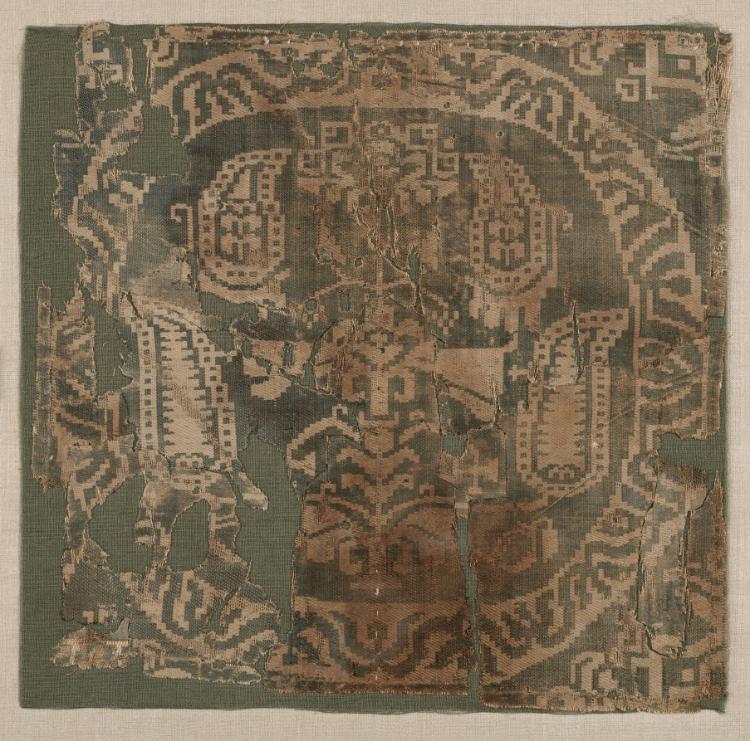
The Roundel from a Tunic with Palmette Tree: A Testament to Imperial Silk Weaving
Introduction: The Artifact as a Silent Narrator
In the hushed corridors of textile history, few artifacts speak with the eloquence of the Roundel from a Tunic with Palmette Tree. This fragment, woven in silk, is not merely a decorative patch; it is a surviving witness to the zenith of imperial silk weaving—a craft that once defined the economic, cultural, and artistic hegemony of empires from Byzantium to the Sassanid and Tang dynasties. For the connoisseur of heritage, this roundel embodies the intersection of material luxury and symbolic power, a narrative stitched in thread that demands scholarly reverence.
As a Senior Heritage Specialist at the Lauren Fashion Heritage Lab, I approach this artifact with the precision of a Savile Row tailor: every thread, every dye, every motif must be examined for its provenance and purpose. The roundel’s materiality—silk—is its first and most profound statement. Silk was not merely a fabric; it was a currency of empire, a medium of diplomacy, and a marker of status. The legacy of imperial silk weaving, from the Silk Road’s caravans to the workshops of Constantinople, is encapsulated in this single, palm-sized roundel.
Materiality and Craft: The Silk of Empires
The roundel’s silk is a testament to the technical mastery of imperial weavers. Silk, derived from the cocoons of Bombyx mori, was a closely guarded secret of Chinese sericulture for millennia. By the time this roundel was woven—likely between the 6th and 8th centuries CE—silk production had spread westward, with the Sassanid Empire of Persia and the Byzantine Empire establishing their own sophisticated workshops. The thread count, the evenness of the weave, and the depth of the dyes all point to a workshop operating under imperial patronage.
The palmette tree motif, central to the roundel’s design, is a hallmark of Sassanid textile art. The palmette—a stylized, fan-shaped leaf or tree—symbolizes life, regeneration, and royal authority. In the context of imperial weaving, such motifs were not chosen arbitrarily. They were part of a visual language that communicated the ruler’s divine mandate and the empire’s prosperity. The silk’s dye, likely derived from madder for reds or woad for blues, would have been imported at great expense, further underscoring the artifact’s elite provenance.
From a conservation perspective, the silk’s condition reveals the fragility of such heritage. The fibers, though aged, retain a luster that speaks to the quality of the original sericulture. This is not the silk of common trade; it is the silk of courts and cathedrals, of ambassadors and emperors.
Iconography and Symbolism: The Palmette Tree as Imperial Emblem
The palmette tree is more than a decorative element; it is a semiotic anchor for the roundel’s meaning. In Sassanid iconography, the tree of life—often depicted as a palmette or a stylized cypress—represented the cosmic order, with the ruler as its earthly guardian. The roundel’s circular format, framing the tree, reinforces this symbolism: the circle is a universal symbol of eternity and divine perfection.
Comparatively, similar roundels from the Byzantine Empire often featured Christian symbols, such as the chi-rho or the cross, adapted from earlier pagan motifs. The palmette tree, however, retains its pre-Christian roots, suggesting that this artifact may have been produced in a period of cultural syncretism, perhaps in a region where Zoroastrian, Christian, and Buddhist influences converged. The tunic from which this roundel came would have been a garment of high status—worn by a courtier, a cleric, or a military commander—and the roundel would have served as a badge of allegiance to the imperial order.
The symmetry of the design is also notable. The palmette tree is flanked by mirrored leaves or buds, a composition that reflects the Sassanid love of balance and order. This aesthetic principle, known as tawhid in Islamic art, would later influence the geometric patterns of Persian carpets and the precision of Savile Row’s own tailoring—where symmetry and proportion are paramount.
Imperial Legacy: From Silk Road to Savile Row
The legacy of imperial silk weaving is not confined to museum vitrines. It lives on in the DNA of modern luxury textiles, from the silk ties of London’s Jermyn Street to the bespoke suits of Savile Row. The Roundel from a Tunic with Palmette Tree is a direct ancestor of the silk linings and pocket squares that define contemporary elegance. The very notion of a “roundel”—a circular, embroidered patch—prefigures the crests and monograms that adorn bespoke garments today.
For the Lauren Fashion Heritage Lab, this artifact serves as a pedagogical tool. It teaches us that luxury is not merely about cost; it is about craft, context, and continuity. The weavers who produced this roundel were not anonymous artisans; they were inheritors of a tradition that spanned continents and centuries. Their techniques—the use of compound weaves, the application of resist dyes, the precision of the loom—are the forebears of the jacquard and brocade techniques that define high-end tailoring.
Moreover, the roundel’s journey from an imperial tunic to a heritage lab is a parable of preservation. It reminds us that fashion heritage is not static; it is a living dialogue between past and present. As we digitize and analyze such artifacts, we must do so with the reverence of a Savile Row cutter handling a bolt of cloth—knowing that every thread carries a story.
Conclusion: A Fragment of Eternity
The Roundel from a Tunic with Palmette Tree is, in its essence, a fragment of eternity. It is a piece of silk that has outlived the empire that wove it, the tunic that bore it, and the hands that wore it. Yet, in its survival, it offers us a window into a world where silk was not just a fabric but a statement of power, faith, and artistry.
For the scholar, the collector, and the designer, this roundel is a call to remember that fashion heritage is not about nostalgia; it is about understanding the roots of our craft. As we continue to study and preserve such artifacts, we honor the legacy of imperial silk weaving—a legacy that, like the palmette tree itself, continues to grow, branch, and inspire.
—Respectfully submitted for the Lauren Fashion Heritage Lab, with the precision of Savile Row and the reverence of a curator.