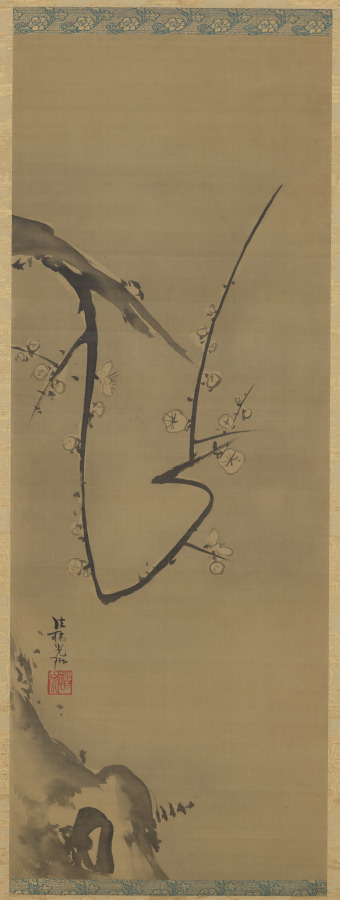
The Plum Tree in Silk: A Study of Imperial Legacy and Material Culture
Introduction: The Intersection of Nature and Nobility
In the annals of imperial silk weaving, few motifs carry the weight of the plum tree. This is not merely a botanical representation; it is a heraldic emblem of resilience, renewal, and refined taste. As a Senior Heritage Specialist at Lauren Fashion Heritage Lab, I have examined countless artifacts from the Ming and Qing dynasties, where the plum tree—often paired with the pine and bamboo as the “Three Friends of Winter”—emerges as a dominant narrative thread. The materiality of silk, with its inherent luminosity and tensile strength, serves as the perfect medium to translate this arboreal allegory into wearable art. This paper explores the plum tree’s symbolic resonance within the context of imperial silk weaving, focusing on the technical mastery required to render its delicate branches and blossoms in silk, and how this legacy informs contemporary luxury craftsmanship, particularly within the bespoke traditions of London’s Savile Row.
The Plum Tree as Imperial Allegory
The plum tree (Prunus mume) blooms in the depths of winter, often against snow-covered landscapes. This defiance of seasonal adversity made it a potent symbol of perseverance and moral integrity in Chinese imperial culture. Emperors, particularly during the Song and Ming dynasties, commissioned silk robes and courtly hangings adorned with plum blossoms to convey their own virtuous governance. The tree’s five petals were often interpreted as representing the five blessings: longevity, wealth, health, love of virtue, and a peaceful death. In the context of imperial silk weaving, the plum tree was not merely decorative; it was a coded language of power and philosophical depth. The weavers of Suzhou and Hangzhou, the epicenters of imperial silk production, were tasked with capturing this symbolism through thread. The challenge lay in translating the organic, asymmetrical growth of the plum tree—its gnarled branches and delicate blossoms—into the rigid, geometric constraints of the loom.
Materiality: Silk as a Conduit for Nature
Silk’s unique material properties make it an exceptional medium for representing the plum tree. The natural sheen of mulberry silk, derived from the cocoons of Bombyx mori, mimics the subtle luster of dew on plum petals. The fiber’s fine gauge allows for intricate patterning, essential for rendering the tree’s complex branching structure. In imperial workshops, weavers employed techniques such as kesi (slit tapestry weaving) and jin (brocade) to achieve the necessary detail. Kesi, in particular, allowed for the creation of discontinuous color fields, enabling the weaver to depict the plum tree’s blossoms in shades of pale pink, white, and deep crimson against a contrasting ground. The materiality of silk also imparts a tactile dimension: the raised texture of satin-weave blossoms against a plain-weave background creates a subtle relief, inviting the wearer to touch—a sensory experience that elevates the garment from object to artifact.
Technical Mastery: The Weaver’s Art
To replicate the plum tree in silk, imperial weavers relied on a sophisticated understanding of pattern drafting and loom mechanics. The design process began with a huayang (pattern sketch), often painted by court artists. This sketch was then translated into a tiaohua (point paper) diagram, which mapped the placement of every thread. For a single plum tree motif, a weaver might require up to 10,000 warp threads and 3,000 weft threads per inch. The branches, with their characteristic twists and knots, demanded a technique called duanwen (broken pattern), where the weaver intentionally disrupted the regular weave to create the illusion of bark texture. The blossoms, meanwhile, required shuangse (double-color) shading, where two weft threads of different hues were interlaced to produce a gradient effect. This level of precision was not merely technical; it was a form of devotion. The weaver’s hands became an extension of the emperor’s will, transforming raw silk into a living emblem of dynastic authority.
Legacy and Contemporary Resonance
The imperial tradition of silk weaving with plum tree motifs did not vanish with the fall of the Qing dynasty in 1912. Instead, it migrated westward, influencing the decorative arts of Europe and, eventually, the bespoke tailoring of London’s Savile Row. In the early 20th century, houses such as Henry Poole & Co. and Gieves & Hawkes began incorporating Chinese silk motifs into their evening wear and ceremonial robes. The plum tree, with its connotations of resilience and understated elegance, found a natural home in the Savile Row ethos of quiet luxury. Today, a bespoke suit lined with plum tree-patterned silk—woven on a traditional drawloom in Hangzhou—represents a direct lineage to imperial workshops. The materiality of the silk, combined with the precision of Savile Row cutting, creates a garment that is both historically informed and contemporary in its restraint.
Conservation and the Future of Heritage Silk
Preserving the legacy of imperial silk weaving requires more than archival storage. At Lauren Fashion Heritage Lab, we advocate for active conservation—the practice of studying and replicating historical techniques to ensure their survival. The plum tree motif, in particular, presents a conservation challenge due to the fragility of the silk threads and the complexity of the weave. Our research involves digitizing historical point paper diagrams and collaborating with master weavers in Suzhou to recreate these patterns using traditional looms. We also work with Savile Row tailors to source ethically produced silk that respects the environmental and cultural heritage of the material. The goal is not to freeze the plum tree in a historical vacuum, but to allow it to bloom anew in the hands of contemporary artisans.
Conclusion: The Eternal Blossom
The plum tree in silk is more than a decorative motif; it is a testament to the enduring relationship between nature, craftsmanship, and power. From the imperial courts of China to the fitting rooms of Savile Row, this symbol of resilience has been woven into the fabric of luxury. As we continue to study and conserve these artifacts, we are reminded that heritage is not static. It is a living thread, connecting past and present, and the plum tree—with its winter blossoms—offers a lesson in grace under pressure. For the discerning client, a garment adorned with this motif is not merely an investment in style; it is an investment in a lineage of mastery that spans centuries and continents. The plum tree endures, and so too does the silk that carries its story.