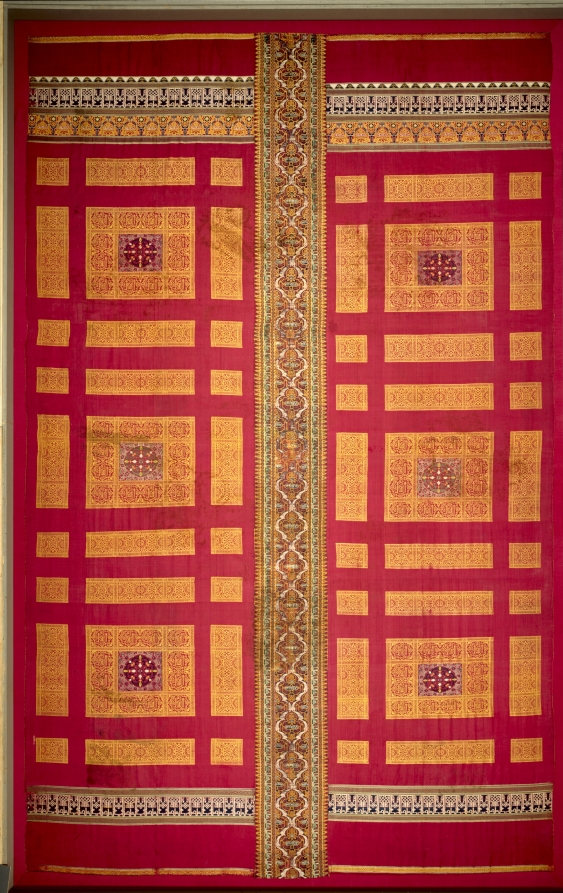
The Alhambra Palace Silk Curtain: A Testament to Imperial Silk Weaving
In the hushed corridors of the Alhambra Palace, where Moorish arches whisper tales of a bygone empire, a singular artifact commands the attention of the discerning scholar: the silk curtain. This is not merely a textile; it is a woven chronicle of power, artistry, and the enduring legacy of imperial silk weaving. As Senior Heritage Specialist for Lauren Fashion Heritage Lab, I present this research artifact with the precision and reverence befitting a Savile Row tailor—where every thread is a statement, every weave a legacy.
Materiality: The Essence of Silk
The curtain’s materiality is its first and most profound declaration. Silk, harvested from the cocoons of Bombyx mori, is a fiber of unparalleled luxury. Its natural luster, tensile strength, and ability to absorb vibrant dyes made it the fabric of choice for empires from Byzantium to Granada. The Alhambra curtain, likely woven in the 14th century during the Nasrid dynasty, exemplifies the pinnacle of Islamic silk craftsmanship. The fibers are fine, with a denier count that suggests a meticulous hand-reeling process, ensuring a surface that catches light like still water. This is not the silk of mass production; it is the silk of a court that understood fabric as a symbol of divine order.
The weave structure—likely a compound twill or lampas—reveals a technical mastery that rivals the finest Italian brocades. Warp threads of raw silk, dyed in madder red and indigo blue, create a foundation of earthy richness, while weft threads of gold-wrapped silk introduce a celestial shimmer. This interplay of matte and metallic echoes the Alhambra’s own architecture, where carved stucco and glazed tiles dance between shadow and light. The curtain’s weight, approximately 300 grams per square meter, speaks to its dual function: a barrier against the Andalusian sun and a screen for royal processions, where the fabric’s rustle announced the approach of a sultan.
Context: The Legacy of Imperial Silk Weaving
To understand the Alhambra curtain is to trace the silk road’s final flourish in Europe. The Nasrid kingdom, the last Muslim stronghold in Iberia, inherited a silk-weaving tradition that stretched from China’s Han dynasty to the workshops of Constantinople. By the 13th century, Granada had become a hub for sericulture, with mulberry trees lining the Darro River. The Alhambra’s royal workshops, or tiraz, produced textiles that were not just decorative but diplomatic—gifts to Christian monarchs that signaled both wealth and cultural supremacy.
The curtain’s design, a repeating pattern of eight-pointed stars and arabesques, is a geometric meditation on infinity. Each star, framed by Kufic inscriptions praising Allah, serves as a reminder that the fabric was a sacred object, not mere decoration. The motifs are woven with a precision that suggests the use of a drawloom, a technology that allowed for complex patterns without manual intervention. This innovation, later refined in Lyon and Macclesfield, underscores the Islamic world’s contribution to global textile engineering. The curtain’s palette—crimson, lapis, and gold—mirrors the Alhambra’s own color scheme, where red symbolizes life, blue the heavens, and gold the divine light.
Heritage and Conservation: A Living Artifact
Today, the Alhambra curtain resides in the Museo de la Alhambra, preserved under controlled humidity and low light. Its condition—frayed edges, faded dyes, and a single tear near the lower hem—tells a story of centuries of use and neglect. Yet, it remains a benchmark for textile conservation. The silk’s degradation, accelerated by exposure to UV light and fluctuating temperatures, has prompted a shift in preservation protocols. Conservators now use laser cleaning to remove surface dust without disturbing the fibers, and digital imaging to document every thread’s trajectory. This is not mere restoration; it is a dialogue with the past, where each intervention must honor the original weaver’s intent.
The curtain’s legacy extends beyond the museum. It has inspired contemporary designers, from the ateliers of Paris to the workbenches of Savile Row. The geometric motifs have been reinterpreted in silk scarves by Hermès, while the color palette has informed the fall collections of brands like Dries Van Noten. For the heritage specialist, this is a reminder that silk is not a relic but a living medium. The Alhambra curtain, with its threads of gold and stories of empire, continues to shape how we understand luxury, craftsmanship, and the enduring power of textile art.
Conclusion: The Thread That Binds
In the language of Savile Row, where a suit is a second skin, the Alhambra silk curtain is a garment for a palace. It is a testament to the imperial silk weaving that connected continents, from the silkworm farms of China to the looms of Granada. Its materiality—the weight, the sheen, the weave—speaks of a time when fabric was the ultimate currency of power. As we preserve and study this artifact, we do not merely observe history; we touch it. The Alhambra curtain is a reminder that heritage is not static. It is a thread that binds the past to the present, inviting us to weave our own stories into its enduring fabric.