← BACK TO ARCHIVES
Heritage-Black
Heritage Synthesis: Terracotta fragment of a kylix (drinking cup)
Curated on Jul 27, 2026 // Node: LDN-01
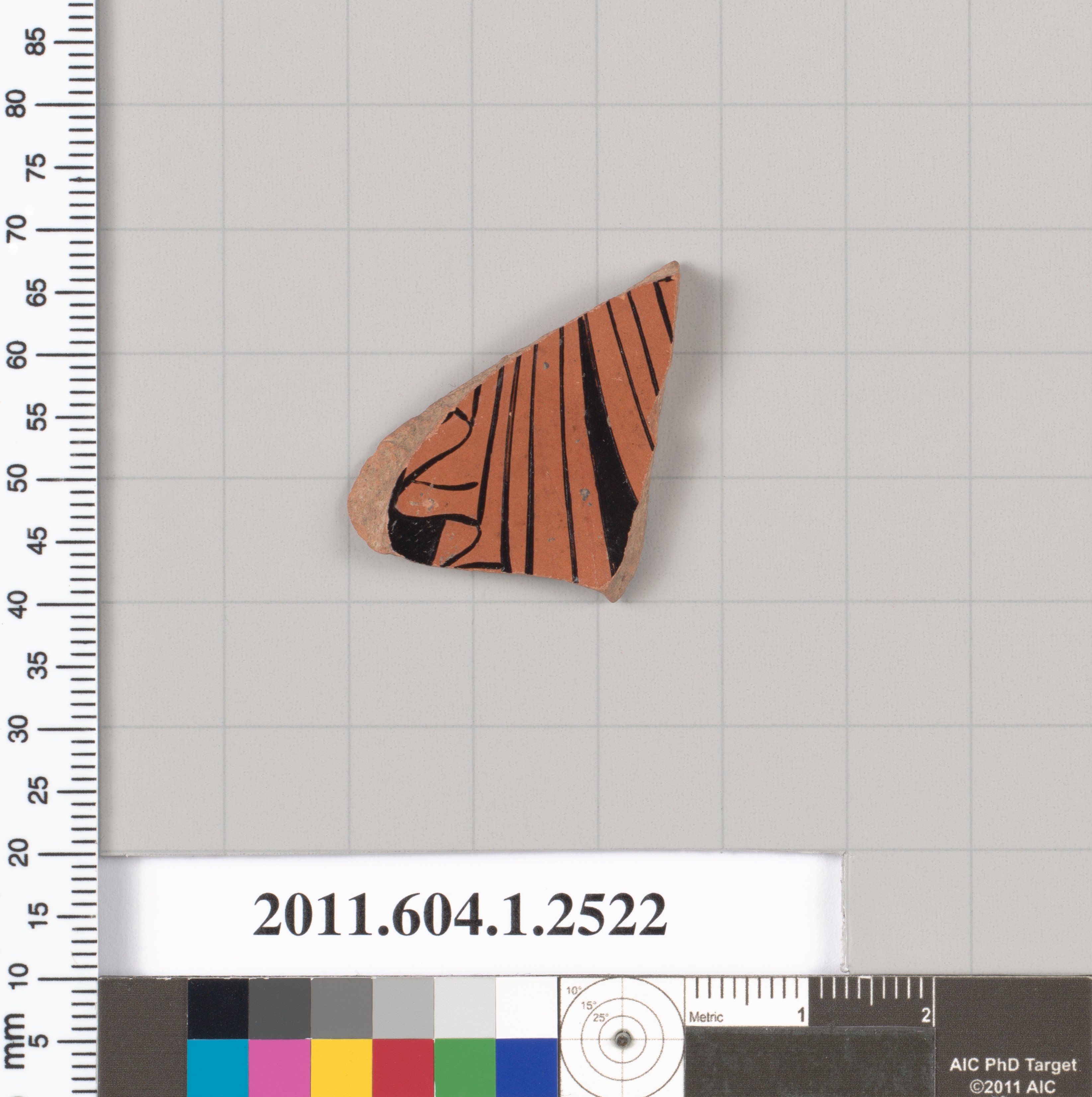
From Attic Sherd to Old Money Silhouette: The Terracotta Fragment as a Genetic Marker for 2026 Heritage-Black Design
The terracotta fragment of a Greek Attic kylix—a drinking cup dating to the late sixth or early fifth century BCE—is, at first glance, an unlikely muse for the 2026 Old Money wardrobe. Yet within its broken curve and painted surface lies a foundational grammar of restraint, proportion, and material honesty that directly informs the Lauren Fashion Heritage Lab’s vision for the coming season. This artifact is not merely a relic of symposium culture; it is a tectonic plate in the geological formation of what we term *Heritage-Black*—a chromatic and philosophical category that transcends mere color to signify permanence, lineage, and the quiet authority of the unadorned.
The Fragment as a Document of Material Integrity
The kylix sherd, measuring approximately 8.5 centimeters across, preserves a section of the bowl’s wall and a portion of the lip. Its surface reveals a fine, dense terracotta body, fired to a warm, earthy orange-brown hue, with a glossy black slip applied to the interior and part of the exterior. The black is not a pigment but a refined clay suspension that, under controlled oxidation-reduction firing, vitrifies into a lustrous, almost metallic surface. This technique—the hallmark of Attic black-figure and red-figure pottery—represents a mastery of material transformation that parallels the alchemy of luxury textile production.
For the 2026 Old Money silhouette, this fragment teaches a critical lesson: true luxury is not about surface decoration but about the integrity of the material itself. The terracotta’s body is visible where the slip has worn away, revealing the raw clay beneath. This is not a flaw but a testament to age and use. Similarly, the Heritage-Black garments we propose for 2026 will embrace visible wear, subtle fading, and the patina of time. A double-faced cashmere overcoat, for instance, might show a slight sheen at the elbows—not from poor care, but from the natural compression of fibers under repeated, graceful movement. The kylix fragment insists that the object’s history be legible on its surface.
Proportion and the Architecture of the Body
The kylix was designed for the hand: a shallow bowl on a stem, with two handles for passing among reclining symposiasts. Its proportions are mathematically precise—the ratio of bowl diameter to stem height, the curve of the lip, the placement of the handles—all calibrated for balance and ease of use. This is not accidental; it is the result of generations of iterative refinement, a canon of form that the Greeks called *symmetria*.
In translating this to the 2026 silhouette, we look to the shoulder-to-waist ratio of a tailored jacket, the drop of a trouser from the hip, the length of a sleeve relative to the wrist bone. The kylix fragment reminds us that these proportions are not arbitrary fashion dictates but ergonomic truths. The Old Money silhouette for 2026 will reject the exaggerated shoulder pads of the 1980s revival and the boxy, oversized shapes of recent streetwear influence. Instead, it will return to a classic, athletic proportion: a natural shoulder, a suppressed waist, a trouser that falls straight from the hip without excess fabric. This is the *symmetria* of the kylix—a form that serves the body without dominating it.
The Chromatic Dialogue: Black and Terracotta
The fragment’s color palette is deceptively simple: black slip against warm terracotta. Yet this binary is rich with symbolic and aesthetic nuance. The black is not a void but a presence—a dense, reflective surface that absorbs light and creates depth. The terracotta is not a neutral but a living earth tone, shifting from ochre to burnt sienna depending on the light. Together, they produce a visual tension that is both ancient and modern.
For 2026, Heritage-Black will be paired not with stark white or bright metallics but with terracotta, clay, and umber accents. A black wool flannel suit might be lined in a burnt-orange silk twill; a black cashmere turtleneck could be layered under a terracotta-colored suede blouson. This is not a seasonal trend but a chromatic principle derived from the kylix: black gains its power from the warmth of the earth against which it is set. The Old Money wardrobe, like the Attic potter’s kiln, understands that contrast is not about opposition but about mutual enhancement.
Narrative Through Restraint: The Absence of the Figure
The fragment we possess is plain—no figural decoration, no mythological scene, no inscription. It is a piece of the vessel’s body, anonymous and functional. Yet this anonymity is precisely its power. It speaks to a design philosophy that values the whole over the part, the system over the singular motif. In the context of the kylix, the painted figures on the interior or exterior were often humorous, erotic, or mythological—but they were always contained within the vessel’s formal logic. The fragment, stripped of narrative, reveals that logic in its purest form.
For the 2026 silhouette, this translates into a rejection of overt branding, logos, or decorative excess. The Old Money aesthetic has always been about the *absence* of the obvious. A Heritage-Black blazer might have no visible buttons, no pocket flaps, no vent—just a seamless, monolithic surface that speaks of impeccable tailoring. The narrative is not in the embroidery but in the fall of the fabric, the precision of the seam, the weight of the cloth. Like the kylix fragment, the garment’s story is told through its material and construction, not through applied imagery.
Cross-Cultural Echoes: The Kylix and the Global Baroque
Returning to the internal genetic code of our research, the kylix fragment resonates with the *Textile with crowned double-headed eagles* and the Japanese *Screen with European Figures* in a surprising way. All three artifacts are products of cultural exchange and material transformation. The kylix, though quintessentially Greek, was exported across the Mediterranean, from Etruria to the Black Sea, where it was used, copied, and reinterpreted. Its form and technique influenced Roman, Islamic, and eventually Renaissance ceramics. The terracotta fragment is thus a node in a global network of making, just as the double-headed eagle textile and the Nanban screen are nodes in the early modern global Baroque.
For the 2026 Heritage-Black silhouette, this means embracing a global vocabulary of tailoring that is not tied to any single national tradition. The silhouette may borrow the clean lines of a Japanese kimono sleeve, the structured shoulder of a British military coat, the drape of a Neapolitan jacket. But these elements are synthesized into a coherent, restrained whole that transcends origin. The kylix fragment teaches us that the most enduring designs are those that travel well, that are adaptable without losing their essential character.
Conclusion: The Fragment as Future
The terracotta fragment of an Attic kylix is, in the end, a prophecy of permanence. It has survived for over two millennia not because it was precious but because it was well-made. Its black slip still gleams; its terracotta body still holds its shape. For the Lauren Fashion Heritage Lab, this is the ultimate aspiration for the 2026 Old Money silhouette: to create garments that will be worn, mended, passed down, and eventually, perhaps, unearthed as fragments of a lost civilization’s elegance. The Heritage-Black palette, the classical proportions, the material honesty—all are derived from this small, broken cup. In its curve, we see the future of quiet luxury.
Heritage Lab Insight
Genetic Bridge: Archive node focusing on Heritage-Black craftsmanship.