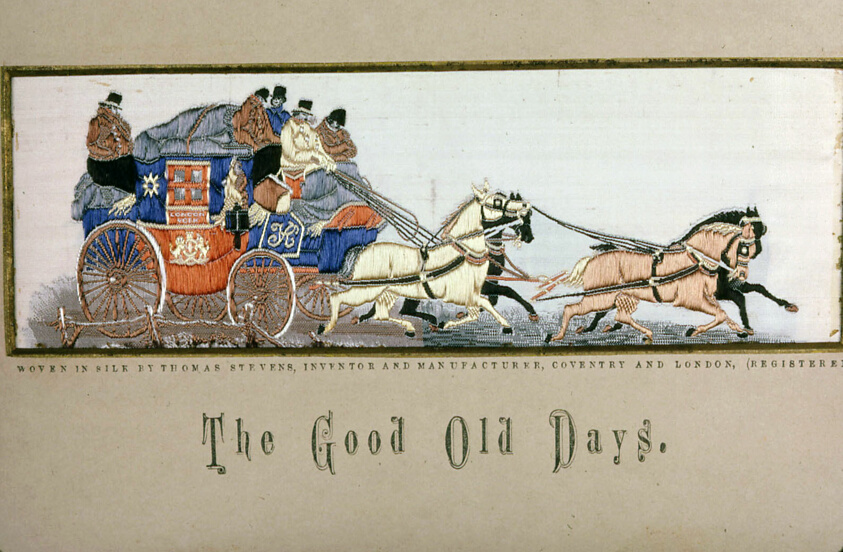
The Conveyance of Status: An Analysis of the Royal Mail Coach Motif in High Artisanal Silk
The notion of "The Good Old Days" is, in the sartorial lexicon, a perilous one. It implies a nostalgic retreat, a softening of rigour. At Lauren Fashion Heritage Lab, we reject such sentimentality in favour of forensic appreciation. The era invoked by the Royal Mail Coach—the late Georgian and Regency period—was not one of mere pastoral charm; it was an age of unprecedented velocity, systemic innovation, and sharply coded public display. The translation of this motif onto a ground of plain weave silk, elevated with supplementary brocading wefts, is not a whimsical recollection. It is a profound statement on the materiality of communication, the theatre of public life, and the immutable principles of fluid elegance.
The Ground: Plain Weave as the Turnpike
One must first consider the foundation: a plain weave silk. This is the quintessential tabby, the most fundamental and robust of weaves. In the context of our theme, it is the meticulously laid turnpike road itself—smooth, reliable, and enabling of all that travels upon it. Its surface possesses a quiet luminosity, a subdued sheen that speaks of inherent quality rather than overt spectacle. This is the backbone of classic craftsmanship, the silent partner that provides structural integrity. It does not shout; it conducts. It is upon this engineered surface that the narrative of speed and order is to be inscribed, much as the mail coach itself was the most vivid spectacle upon the physical highways of England.
The Narrative in Relief: Brocading as Heraldic Dispatch
The supplementary brocading wefts introduce the pictorial drama. This technique, wherein additional threads are woven in to create a raised pattern, is the sartorial equivalent of the coach's vivid livery, its gleaming fittings, and the authoritative blare of the guard's horn. The motif likely depicts the coach in dynamic profile, a team of horses at full extension, a vision of controlled power. The brocading wefts, often of a contrasting hue—perhaps a rich scarlet or a deep Brunswick green against an ivory or slate ground—bestow a tangible, low-relief topography to the cloth.
This material choice is profoundly significant. The raised thread catches the light differently, animating the scene with every subtle movement of the wearer. It transforms the silk from a mere canvas into a chronicle. The specificity of the detail—the spokes of the wheels, the folds of the driver's coat, the precise rendering of the Royal Arms upon the coach door—is paramount. This is not a generic impression of haste; it is a documented, heraldic dispatch. It communicates a respect for precision, for the official machinery of society, and for the narrative potential of cloth.
Fluid Elegance: The Drape of Velocity
Herein lies the central genius of the artifact. The subject is one of formidable speed and noise, yet its execution is in a material destined for garments of supreme poise and quiet authority. The silk, by its very nature, possesses a fluid drape—a graceful, falling quality that is the antithesis of rigid, static display. This creates a compelling dialectic: the imagery of thundering wheels and teaming horses is softened, civilised, and integrated into the language of elegant movement.
A gown or a gentleman’s dressing gown fashioned from this cloth would not resemble a carnival banner. In repose, the pattern is a subtle, textural richness. In motion, as the wearer turns or advances, the brocaded coach would appear to glide, the fluidity of the silk imparting a sense of smooth, effortless travel. This is the essence of true elegance: the sublimation of powerful forces into a form of graceful, controlled expression. The wearer does not run; they proceed with the assured, unimpeachable pace of the Royal Mail itself—always on time, always observed, always denoting a connection to the greater system.
Context and Connoisseurship: Beyond Nostalgia
To dismiss this as mere nostalgia is to misread its purpose entirely. For the contemporary connoisseur, this artifact is a meditation on the foundations of modern experience. The Royal Mail Coach was the internet of its day—a networked system for the rapid transmission of information, finance, and authority. To wear its image is to align oneself with values of reliability, innovation, and public service. The use of classic silk craftsmanship situates these modern virtues within a continuum of excellence.
The Savile Row tone demands this analytical rigour. We do not deal in "good old days"; we deal in enduring principles. The principle here is that elegance is never static. It is, like the mail coach, dynamic and purposeful. The materiality of the piece—the robust plain weave, the declarative brocading, the fluid drape—serves that principle. It is a wearable thesis on how society’s most progressive engines can be distilled into an object of timeless beauty and discernment. The artifact stands as a testament to the fact that true heritage is not a memory to be longed for, but a language to be spoken with precision in the present, its patterns and textures continuing to convey the most urgent of dispatches: those of taste, identity, and quiet power.