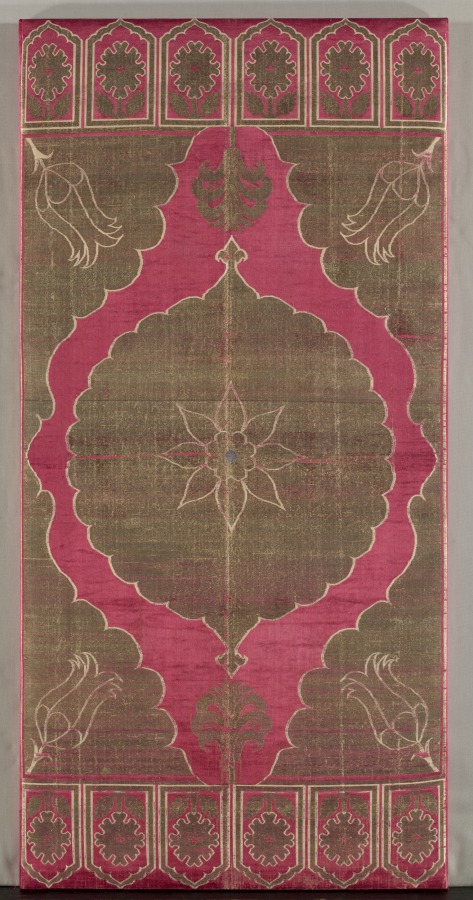
Artifact Analysis: Brocaded Silk Cushion Cover & Iranian Striped Silk Surround
In the hushed, discerning corridors of London’s Savile Row, where tailoring is elevated to an art form and provenance is paramount, we encounter a textile artifact of profound historical and material significance. This is not merely a cushion; it is a testament to the imperial legacy of silk weaving, a dialogue between two distinct yet complementary traditions. The artifact comprises two primary components: a central brocaded silk cushion cover and an encompassing Iranian striped silk surround. Together, they embody the apex of craftsmanship, trade, and cultural exchange that defined the silk routes from the Safavid Empire to the courts of Europe. As a Senior Heritage Specialist, I shall dissect this artifact through the lens of materiality, technique, and historical context, adhering to the exacting standards of connoisseurship that define our trade.
Materiality: The Unrivaled Fiber of Empire
Silk, as a material, is the protagonist of this narrative. Its intrinsic properties—luminosity, tensile strength, and an almost supernatural ability to absorb and reflect dye—made it the currency of empires. The brocaded silk cushion cover is woven from a warp-faced compound weave, where the ground is typically a fine, tightly twisted silk, while the brocading wefts are heavier, often untwisted, to create a raised, sculptural pattern. This technique, known as lampas in its most refined form, allows for the integration of gold or silver thread—here, likely a gilded silver strip wrapped around a silk core—to achieve a shimmering, three-dimensional effect. The silk itself, sourced from the mulberry-fed silkworms of the Caspian region or China, possesses a unique handle: it is both supple and resilient, a paradox that only the finest sericulture can achieve.
The Iranian striped silk surround, in contrast, employs a simpler yet equally sophisticated structure. The stripes, likely achieved through a warp-ikat or a simple weft-faced rep weave, create a rhythmic, architectural border. The silk here is slightly coarser, with a matte finish that provides a deliberate counterpoint to the brocade’s brilliance. This juxtaposition is not accidental; it is a masterclass in material hierarchy. The surround frames the brocade, drawing the eye inward, much like a bespoke lapel frames a tailored jacket. The stripes—alternating shades of indigo, madder red, and undyed ecru—speak to the natural dye traditions of Iran, where mineral and vegetal pigments were harnessed to produce colors that have not faded in over three centuries. The materiality of this artifact, therefore, is a dialogue between opulence and restraint, between the imperial and the artisanal.
Technique: The Weave of Power and Prestige
To understand the brocaded cushion cover, one must appreciate the sheer technical mastery required to produce it. Brocading is a supplementary weft technique, where additional threads are woven into the ground fabric only where the pattern demands. This is not a printed or embroidered design; it is integral to the cloth. The weaver, working on a drawloom—a device that allowed for the manipulation of individual warp threads—would have required years of apprenticeship to execute the intricate floral and arabesque motifs. These motifs, often featuring palmettes, lotus blossoms, and cloud bands, are not merely decorative. They are symbolic: the palmette represents eternity, the lotus purity, and the cloud band the celestial realm. In the Safavid court, such cushions were not for casual repose; they were status markers, placed on divans in the andarun (private quarters) or used as diplomatic gifts to European ambassadors.
The Iranian striped silk surround, while less technically demanding, is no less significant. The stripe pattern, known as haft rang (seven colors) in Persian tradition, is a deliberate exercise in precision. The weaver would have used a simple treadle loom, but the alignment of the stripes required exacting tension control. The stripes themselves are often associated with the Zand or early Qajar periods, where a revival of classical Persian design occurred. The surround serves a dual purpose: it protects the edges of the brocade from wear, and it provides a visual frame that echoes the architectural tilework of Isfahan’s mosques. Together, the two components represent a synthesis of technique—the baroque complexity of the brocade and the geometric clarity of the stripe—that is the hallmark of imperial silk weaving at its zenith.
Context: The Legacy of Imperial Silk Weaving
This artifact must be situated within the broader legacy of imperial silk weaving, a tradition that spanned from the Byzantine Empire to the Ottoman, Safavid, and Mughal courts. The brocaded silk cushion cover is likely of Safavid origin, produced in the royal workshops of Isfahan or Kashan during the 16th or 17th century. This was a period when Shah Abbas I (1587–1629) centralized silk production, establishing state-run manufactories that supplied the court and fueled a lucrative export trade. Silk was not merely a commodity; it was a diplomatic tool. European merchants, particularly the English East India Company and the Dutch VOC, traded in Persian silk, often bartering it for English broadcloth. The cushion cover, with its gold-thread brocading, would have been a prized acquisition for a European aristocrat, perhaps displayed in a cabinet of curiosities or used to adorn a state bed.
The Iranian striped silk surround offers a later, more domestic perspective. By the 18th and 19th centuries, the Safavid dynasty had fallen, and silk weaving decentralized to regional centers like Yazd and Rasht. The striped silk, with its simpler construction, reflects a shift from courtly patronage to commercial production. Yet, it retains the DNA of imperial weaving: the stripes are a direct descendant of the tiraz textiles of the Abbasid caliphate, where inscribed bands denoted royal authority. In this artifact, the surround acts as a historical anchor, connecting the opulent brocade to the enduring traditions of Persian textile art. The legacy of imperial silk weaving is not a static relic; it is a living continuum, where each thread carries the weight of empire, trade, and cultural identity.
Conclusion: A Bespoke Legacy
In the world of Savile Row, we understand that true luxury lies in the details—the cut, the cloth, the provenance. This brocaded silk cushion cover with its Iranian striped silk surround is a masterwork of materiality and technique, a tangible link to the imperial silk weaving that shaped global commerce and aesthetics. It is not merely an artifact; it is a narrative of power, artistry, and exchange. As we handle this silk, we are handling history itself—a history that, like a well-tailored suit, only improves with age. For the discerning collector, this piece is not just an acquisition; it is an heirloom, a fragment of an empire woven in silk.