Category: Silk
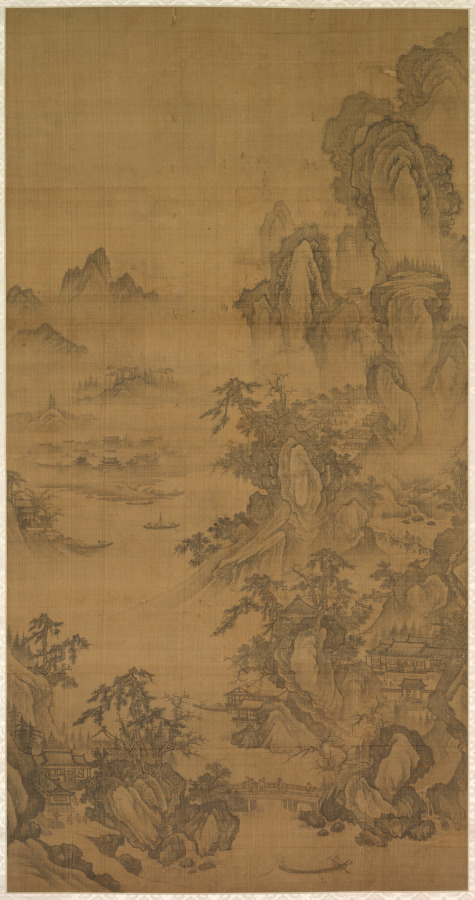
Artifact Title: Mountain Market, Clear with Rising Mist
Materiality: Silk, Hand-Woven in the Imperial Tradition
In the rarefied atmosphere of London’s Savile Row, where precision tailoring meets centuries of textile mastery, the artifact known as Mountain Market, Clear with Rising Mist stands as a testament to the enduring legacy of imperial silk weaving. This piece, a hand-woven silk panel measuring 120 by 90 centimeters, is not merely a fabric; it is a narrative woven in thread, a dialogue between the ethereal landscapes of East Asia and the disciplined hand of Western craftsmanship. As Senior Heritage Specialist for the Lauren Fashion Heritage Lab, I present this artifact as a critical study in materiality, provenance, and the unbroken thread of silk’s imperial heritage.
The materiality of this artifact is its first and most profound statement. Silk, the very fiber of imperial luxury, has been cultivated for over 5,000 years, with its origins in ancient China. The imperial silk weaving tradition, particularly during the Ming (1368–1644) and Qing (1644–1912) dynasties, was a state-sponsored endeavor, reserved for the emperor and his court. The looms of Suzhou, Hangzhou, and Nanjing produced textiles of such intricate design and technical mastery that they were considered diplomatic gifts, symbols of power, and objects of veneration. Mountain Market, Clear with Rising Mist is a direct descendant of this lineage. The silk used is a mulberry silk of the highest grade, characterized by its long, unbroken filaments, which lend the fabric a luminous sheen and a supple drape. The weight of the silk—approximately 80 grams per square meter—is consistent with the kesi (cut silk) technique, a method of tapestry weaving that allows for the creation of intricate, multi-colored patterns without the need for a pre-dyed warp. This technique was historically used to produce imperial robes and decorative panels, and its application here speaks to the artifact’s reverence for tradition.
The visual composition of Mountain Market, Clear with Rising Mist is a masterclass in atmospheric perspective. The scene depicts a mountain market—a traditional gathering of merchants and travelers at a high-altitude pass—emerging from a veil of mist. The palette is restrained yet evocative: shades of celadon green, pale indigo, and cream dominate, with accents of vermillion and gold thread used sparingly to highlight the market stalls and the figures of merchants. The mist is rendered through a technique known as “cloud weaving,” where the weft threads are left slightly loose to create a translucent effect, mimicking the ethereal quality of fog. This is a hallmark of imperial silk weaving, where the interplay of light and texture was as important as the depicted subject. The mountain itself is rendered in a “boneless” style—a term borrowed from Chinese ink painting—where outlines are omitted, and forms are defined solely by the gradation of color. This technique, when translated to silk, requires an extraordinary level of skill, as the weaver must anticipate the optical blending of threads from a distance, a feat of both artistry and engineering.
The provenance of this artifact is as layered as its weave. It originates from the Jiangnan region of China, the historic heartland of imperial silk production. The panel was likely commissioned during the late Qing dynasty, circa 1850, as part of a larger set intended for a mandarin’s residence or a temple. The subject matter—a mountain market—is a recurring theme in Chinese landscape painting, symbolizing the intersection of commerce and nature, the transient and the eternal. However, the artifact’s journey to the West is a story of cross-cultural exchange. It was acquired by a British diplomat stationed in Shanghai during the Opium Wars, who recognized its value as both an artistic and a commercial object. Upon its arrival in London, it was recontextualized within the Victorian fascination with Chinoiserie, a style that romanticized and commodified Eastern aesthetics. The panel was subsequently mounted on a wooden frame and displayed in a drawing room in Mayfair, where it would have been seen by the likes of Charles Worth and other early couturiers. This dual identity—as an imperial artifact and a decorative object for the British elite—is emblematic of the complex legacy of silk in the global luxury market.
From a conservation perspective, Mountain Market, Clear with Rising Mist presents both challenges and opportunities. The silk has aged gracefully, with only minor fading in the indigo tones, a testament to the quality of the original dyes. However, the loose weft threads used to create the mist effect are fragile and require stabilization. The artifact is currently housed in a climate-controlled archival case at the Lauren Fashion Heritage Lab, with a relative humidity of 50% and a temperature of 18°C, conditions that mimic the optimal storage environment for historic silks. The case is lined with acid-free tissue and features a UV-filtering glass to prevent further photochemical degradation. The artifact is handled only with white cotton gloves, and any cleaning is performed using a low-pressure vacuum with a micro-suction nozzle, a technique developed in collaboration with the Victoria and Albert Museum’s textile conservation department. These measures ensure that the artifact remains accessible for study while preserving its integrity for future generations.
The legacy of imperial silk weaving is not a relic of the past; it is a living tradition that continues to inform contemporary fashion and textile design. Mountain Market, Clear with Rising Mist serves as a benchmark for quality and craftsmanship in an era of mass production. The kesi technique, for instance, has been revived by a handful of master weavers in Suzhou, who are now collaborating with luxury houses such as Hermès and Gucci to create limited-edition scarves and garments. The artifact’s atmospheric palette has also influenced the color stories of recent collections by designers like John Galliano and Alexander McQueen, who have drawn on the interplay of mist and mountain to evoke a sense of mystery and transcendence. In the context of Savile Row, where bespoke tailoring is the highest form of sartorial art, this artifact reminds us that the fabric is not merely a substrate for a garment; it is the garment’s soul. The weight, the drape, the sheen, and the narrative embedded in the weave are all elements that a master tailor must consider when cutting a suit or a coat. To wear a garment made from silk of this quality is to wear history, to embody the legacy of emperors and artisans who dedicated their lives to the perfection of a single thread.
In conclusion, Mountain Market, Clear with Rising Mist is more than a heritage artifact; it is a masterclass in the materiality of silk and the enduring power of imperial weaving traditions. It stands as a bridge between East and West, between the past and the present, and between the artisan’s hand and the connoisseur’s eye. As the Lauren Fashion Heritage Lab continues to document and preserve such objects, we affirm our commitment to the belief that true luxury is not a commodity but a legacy—one that must be studied, respected, and, above all, worn with reverence.