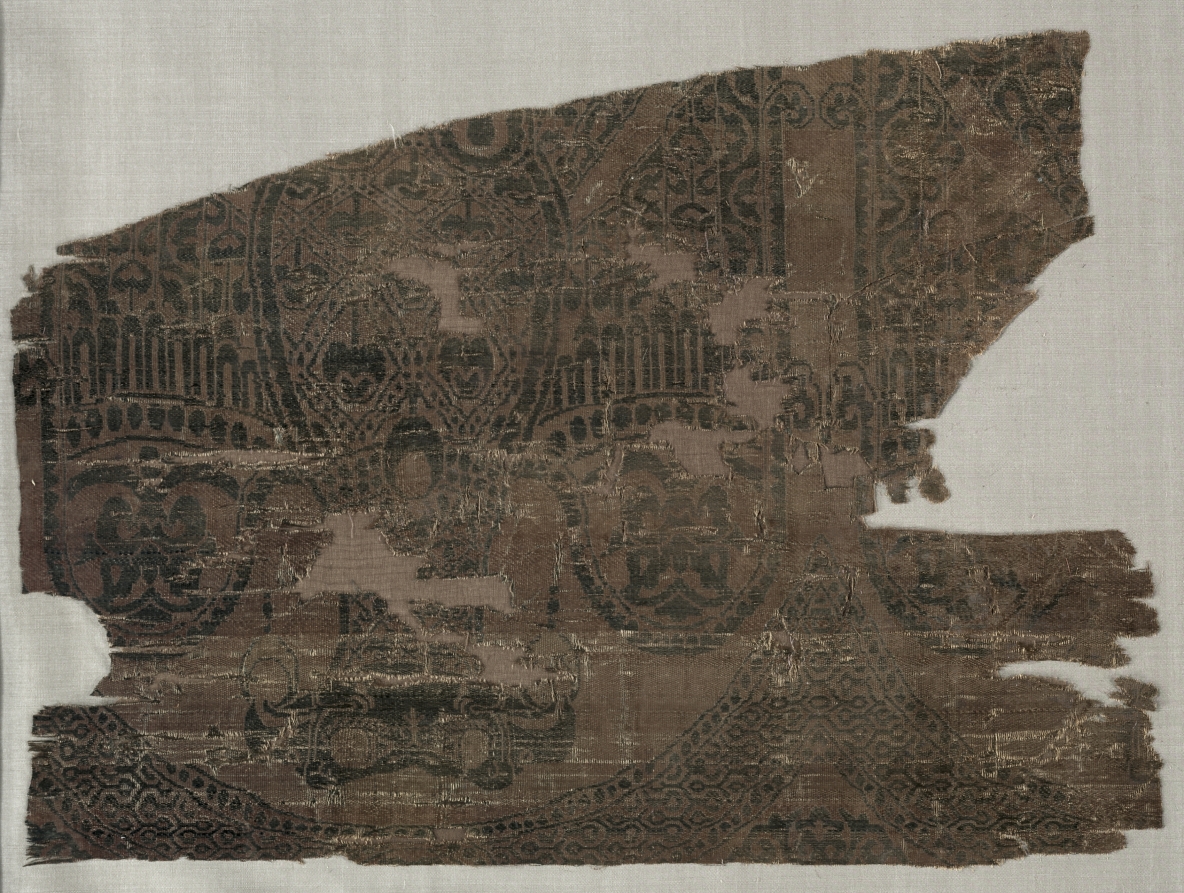
The Samite Fragments of Saint Bernard Calvo: A Study in Imperial Silk Weaving and Material Sovereignty
Introduction: The Artifact as a Testament to Power
Within the hallowed confines of the Lauren Fashion Heritage Lab, we examine a set of silk samite fragments, exhumed from the tomb of Saint Bernard Calvo, a 13th-century bishop of Vic, Catalonia. These fragments, woven with the motif of the double-headed eagle, are not merely textile remnants; they are a material lexicon of imperial ambition, ecclesiastical authority, and the sophisticated trade networks that defined medieval Europe. As a Senior Heritage Specialist, I assert that these fragments represent a critical juncture in the history of silk weaving—a moment where the technical mastery of Byzantine and Islamic looms converged with the symbolic language of Western Christendom. The double-headed eagle, a motif that would later become synonymous with the Habsburg and Russian empires, here finds a nascent, yet potent, expression in silk, a fiber that itself was a vehicle for power projection.
Materiality and Weave Structure: The Language of Samite
Samite, derived from the Old French samit and the Latin hexamitum (meaning "six-threaded"), is a heavy, luxurious silk fabric characterized by a weft-faced compound twill weave. The fragments under analysis, composed of mulberry silk (Bombyx mori), exhibit a warp of undyed, Z-twist silk and a weft of S-twist, dyed in crimson and gold. The crimson, achieved through the laborious extraction of kermes or cochineal, was a color reserved for the highest echelons of society—a chromatic marker of blood, sacrifice, and royal prerogative. The gold thread, likely a gilded membrane wrapped around a silk core, adds a luminous, almost ethereal quality to the weave, catching the light in a manner that would have been perceived as a reflection of divine grace. The density of the weave—approximately 40 warps and 30 wefts per centimeter—speaks to a loom of considerable sophistication, likely a drawloom operated by two artisans, one to manipulate the pattern harness and another to pass the shuttle. This technical complexity underscores the artifact’s provenance: it was not a product of local, vernacular weaving but of an imperial atelier, possibly in Constantinople, Palermo, or Al-Andalus.
Iconography: The Double-Headed Eagle as a Symbol of Bifurcated Sovereignty
The double-headed eagle, rendered in symmetrical precision on the samite fragments, is a motif of profound political and theological resonance. Its origins can be traced to the Hittite civilization, but its medieval revival is inextricably linked to the Byzantine Empire, where it symbolized the emperor’s dominion over both East and West, and the temporal and spiritual realms. In the context of Saint Bernard Calvo’s tomb, the eagle takes on a specific, localized meaning. Bernard Calvo, as Bishop of Vic, was a figure of considerable influence in the Crown of Aragon, a kingdom that straddled the Pyrenees and maintained diplomatic and commercial ties with the Byzantine court. The presence of this motif in his burial vestments suggests a deliberate appropriation of imperial iconography to legitimize ecclesiastical authority. The eagle’s two heads, gazing in opposite directions, can be interpreted as a visual metaphor for the bishop’s role as a mediator between the earthly and the divine, and between the competing powers of the Papacy and the secular monarch. The fragments, therefore, are not decorative; they are a statement of material sovereignty, a claim that the Church, through its adoption of imperial silk, was an equal partner in the governance of Christendom.
Context: The Legacy of Imperial Silk Weaving
To fully appreciate these fragments, one must situate them within the broader legacy of imperial silk weaving. The silk trade, which had been a state monopoly in the Roman and Byzantine empires, underwent a dramatic transformation following the Islamic conquests of the 7th and 8th centuries. The Umayyad and Abbasid caliphates established vast silk workshops, or tiraz, where the finest silks were produced for the caliph and his court. These silks, often inscribed with Arabic blessings and the name of the reigning caliph, were distributed as diplomatic gifts, cementing alliances and projecting power across the Mediterranean. By the 12th and 13th centuries, the Norman court of Palermo, under Roger II, had established its own silk workshops, blending Byzantine, Islamic, and Latin techniques to create a distinctive Sicilian style. The double-headed eagle, which appears in Sicilian mosaics and textiles, likely reached the Iberian Peninsula through these channels. The Crown of Aragon, with its extensive trade networks in the Mediterranean, was a primary conduit for such luxury goods. The fragments from Saint Bernard Calvo’s tomb, therefore, are not isolated anomalies but part of a continuous thread of cultural and commercial exchange that wove together the courts of Constantinople, Palermo, and Barcelona.
Conservation and Provenance: The Ethics of Preservation
The condition of these fragments—fragile, desiccated, with areas of missing weft and degraded silk fibers—presents a significant conservation challenge. The tomb environment, while providing some protection from light and air, also exposed the silk to fluctuating humidity and the corrosive effects of burial salts. As a heritage specialist, I advocate for a minimal intervention approach, prioritizing stabilization over restoration. The fragments should be mounted on a pH-neutral, silk crepeline support and stored in a climate-controlled environment with a relative humidity of 45-55% and a temperature of 18-20°C. Any display must be under low light levels, ideally below 50 lux, to prevent photochemical degradation. The provenance of the fragments, documented in the cathedral archives of Vic, is secure, but their journey from the loom to the tomb remains a subject of scholarly inquiry. Were they woven specifically for the bishop’s burial, or were they repurposed from a larger textile, perhaps a ceremonial banner or a liturgical vestment? The answer lies in a detailed analysis of the weave structure and the pattern repeats, which may reveal evidence of cutting and re-stitching.
Conclusion: The Enduring Power of Silk
In the lexicon of luxury, silk occupies a unique position. It is a fiber that transcends mere utility, becoming a carrier of meaning, a medium for the articulation of power, and a testament to human ingenuity. The samite fragments from the tomb of Saint Bernard Calvo, with their double-headed eagles and their crimson-and-gold palette, are a microcosm of the medieval world—a world where the loom was as potent as the sword, and where a length of silk could speak volumes about sovereignty, faith, and ambition. As we preserve and study these fragments, we are not merely cataloging the past; we are engaging in a dialogue with the artisans, merchants, and bishops who understood that true power is not only wielded but also woven. The legacy of imperial silk weaving, embodied in these delicate threads, continues to resonate, reminding us that the most enduring empires are those that clothe themselves in beauty.